Contrast Therapy Meets Red Light and Breathwork: The Science

SNIPPET: Contrast therapy — alternating cold and heat exposure — is converging with red light (photobiomodulation) and structured breathwork because each modality targets overlapping but distinct autonomic and mitochondrial pathways. A 404-person trial found breathwork plus cold exposure produced cumulative, dose-dependent gains in energy, mental clarity, and stress resilience over 29 days, while photobiomodulation enhances mitochondrial function via cytochrome c oxidase activation. Combined, these interventions may amplify recovery beyond what any single method achieves alone.
THE PROTOHUMAN PERSPECTIVE#
The biohacking community has been stacking modalities for years — cold plunge followed by sauna, breathwork before training, red light panels in every garage gym. But until recently, the evidence base for combining these stressors was thin. What's shifting now is that researchers are finally studying these interventions together, not in isolation, and the data suggests the stack is more than marketing.
This matters because we're moving from single-variable wellness interventions toward integrated stress protocols that mirror how the human autonomic nervous system actually operates — not in neat categories, but through overlapping cascades of sympathetic activation, parasympathetic recovery, and mitochondrial energy regulation. The convergence of contrast therapy, photobiomodulation, and breathwork isn't a trend. It's the logical endpoint of treating the body as an adaptive system rather than a collection of isolated problems.
For anyone optimizing performance, recovery, or long-term resilience, understanding why these modalities synergize — at the cellular level — is no longer optional.
THE SCIENCE#
Breathwork and Cold Exposure: The Dose-Dependent Stress Adaptation#
The most significant recent data on combining breathwork with cold immersion comes from a semi-randomised controlled trial published in Scientific Reports (2025), with a sample size that actually means something: N = 404 healthy adults, mean age 37[1]. This isn't a 12-person pilot. This is a properly powered study comparing the Wim Hof Method (WHM) — cyclic hyperventilation plus cold exposure — against an active control of mindfulness meditation over 29 days.
The results showed something I find more interesting than simple group differences. WHM conditions produced greater momentary improvements in self-reported energy, mental clarity, and ability to handle stress compared to meditation. But here's the nuance that matters: the WHM protocols initially resulted in smaller reductions in state stress than meditation. The benefit accumulated over time, with a clear time-condition interaction showing dose-dependent gains.
Let me say that more plainly. Meditation gave you faster stress relief on day one. But by week four, the cold-and-breathwork group had overtaken it — and the meditation group's benefits were declining.
That interaction pattern — where intentional acute stress produces cumulative resilience — aligns with hormesis theory, but seeing it demonstrated at this scale in a controlled trial is genuinely new data. The authors note that while minimal significant between-condition trait changes emerged over the 29-day period, the state interaction patterns suggest potential for longer-term state-trait shifts[1]. Translation: keep going past 29 days and these temporary state improvements may become permanent trait changes.
The catch, though. Executive function, physiological, and sleep biometric results showed "nuanced between-condition differences" — which is science-speak for messy, unclear findings. The self-reported improvements are strong. The objective biomarker data is less convincing. I'd want to see this replicated with more rigorous physiological tracking before claiming cold-plus-breathwork rewires your autonomic nervous system.
Light-Guided Breathing and HRV Optimization#
A separate controlled crossover study (N = 80) examined light-guided resonant breathing (RB) for stress recovery and found that 5 minutes of resonant breathing significantly increased RMSSD — a key heart rate variability metric reflecting parasympathetic tone — with large effect sizes[2]. This was tested after both physical stress (cold pressor test) and cognitive stress (paced serial addition test).
What makes this relevant to contrast therapy stacking is the mechanism. Resonant breathing at approximately 6 breaths per minute optimizes the baroreflex loop, driving vagal tone upward and shifting the autonomic nervous system toward recovery. When you layer this on top of cold exposure — which triggers an acute sympathetic surge — you create a controlled oscillation between sympathetic activation and parasympathetic recovery. That oscillation is, essentially, what HRV training is.
The study also found that light-guided RB was rated as more enjoyable and more effective than passive rest following cognitive stress[2]. This has practical implications: compliance matters. If a recovery protocol feels better, people actually do it.
Photobiomodulation: The Mitochondrial Layer#
Photobiomodulation therapy (PBMT) — applying red or near-infrared light to tissue — operates on a fundamentally different pathway than cold or breathwork, which is precisely why it stacks well with both.
The primary mechanism involves cytochrome c oxidase (Complex IV) in the mitochondrial electron transport chain. When near-infrared photons (typically 630-1000 nm) are absorbed by this enzyme, they dissociate inhibitory nitric oxide, allowing oxygen to bind more efficiently and increasing ATP production[4]. This isn't speculative biochemistry — it's well-established photophysics, though the clinical translation remains inconsistent.
A 2025 review in the Journal of Translational Medicine synthesized the current state of PBMT research across medical disciplines, confirming that the therapy modulates reactive oxygen species, nitric oxide signaling, and cytokine regulation[4]. The review also flagged a critical limitation: non-standardized dosimetry and inconsistent energy delivery remain major barriers to clinical reproducibility. Negative outcomes in trials involving trained or low-stress cohorts highlight that PBMT's efficacy appears context-dependent — it works better when the system is under stress or recovering from damage.
This is actually the key insight for stacking. Cold exposure creates the controlled tissue stress. Breathwork modulates the autonomic recovery window. And red light provides the mitochondrial substrate — the raw ATP production capacity — to fuel the adaptation.
A systematic review of 14 randomized clinical trials on PBM for chronic pain (published in Frontiers in Integrative Neuroscience, 2026) found that most trials demonstrated significant pain reduction, particularly in fibromyalgia and neuropathy, with low incidence of adverse events[3]. But the authors are appropriately cautious: heterogeneity of technical parameters compromises result standardization.
Synergistic Effects: What the Preclinical Data Shows#
The strongest direct evidence for combining physical activity with photobiomodulation comes from a rat model of neuropathic pain. Male Wistar rats receiving both PBMT (6 J/cm², 904 nm) and swimming exercise showed superior analgesic and functional outcomes compared to either treatment alone (p < 0.01)[6]. Combination therapy also produced the most pronounced histological improvements in muscle morphology.
I'm less convinced by this than the human trials, for obvious reasons — rats aren't humans, and swimming in a tank isn't the same as cold immersion. But the principle of multimodal synergy holds: stacking a physical stressor with photobiomodulation produced additive or synergistic effects on pain, motor function, and tissue preservation[6]. That's consistent with what the mechanisms predict.
WHM vs Meditation: Cumulative Benefit Trajectory Over 29 Days
COMPARISON TABLE#
| Method | Mechanism | Evidence Level | Cost | Accessibility |
|---|---|---|---|---|
| Cold Exposure + Breathwork (WHM) | Sympathetic activation → hormetic adaptation; cyclic hyperventilation alters blood pH, CO₂ levels | Semi-RCT, N=404; dose-dependent gains over 29 days | Low ($0–$150/month for cold plunge access) | High — can be done at home with cold shower |
| Photobiomodulation (Red/NIR Light) | Cytochrome c oxidase activation → increased ATP; NO dissociation; ROS modulation | Systematic reviews of 14+ RCTs; preclinical synergy data | Moderate ($200–$2,000 for panel devices) | Moderate — requires device purchase |
| Resonant Breathing (Light-Guided) | Baroreflex optimization → vagal tone increase; RMSSD improvement | Crossover RCT, N=80; large effect sizes on HRV | Low ($0–$30 for app) | Very high — no equipment needed |
| Combined Stack (All Three) | Multi-pathway: sympathetic stress + parasympathetic recovery + mitochondrial efficiency | Indirect; preclinical synergy data + mechanistic rationale | Moderate ($200–$2,000 total setup) | Moderate — requires some equipment and training |
| Mindfulness Meditation (Comparator) | Cognitive reappraisal; parasympathetic activation | Extensive RCT base; benefits may plateau or decline over time | Very low ($0–$15/month for app) | Very high |
THE PROTOCOL#
Based on the current evidence, here's a practical combined protocol. I want to be clear: no single trial has tested this exact stack in humans. This is built from the mechanistic rationale and the individual study findings. Treat it as a framework to trial, not a prescription.
1. Start with breathwork (5-8 minutes). Use cyclic hyperventilation (30 deep breaths, breath hold, recovery breath — 3 rounds) as per the WHM protocol tested in the 404-person trial[1]. This primes the sympathetic nervous system and raises your stress tolerance threshold for the cold exposure that follows.
2. Enter cold immersion immediately after breathwork (2-5 minutes at 10-15°C). Don't ease in. The study population practiced daily cold exposure as part of the 29-day protocol. Start at 5 minutes, not 2. The adaptation window doesn't open at 2. If you're new to cold exposure, 15°C is sufficient — you don't need ice.
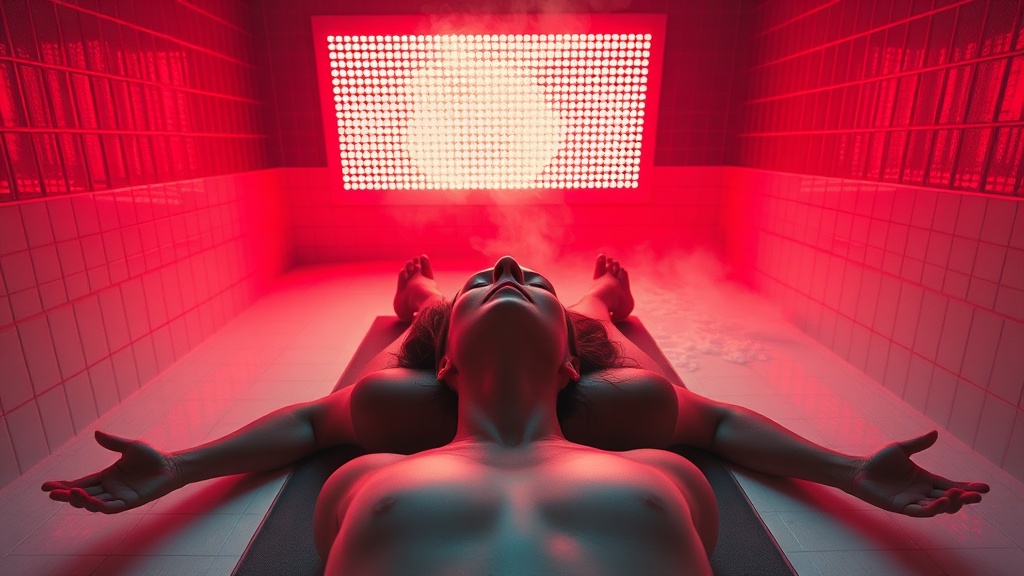
3. Transition to photobiomodulation within 15 minutes of exiting cold (10-15 minutes). Use a red/NIR panel (630-850 nm wavelength range) positioned 15-30 cm from target tissue. Based on the preclinical synergy data, a dose of approximately 6 J/cm² appears effective[6]. Cover major muscle groups or areas of soreness. The post-cold vasodilation window may enhance light penetration to deeper tissue.
4. Close with resonant breathing (5 minutes at 6 breaths per minute). This is the recovery phase. Use a light-guided breathing app or simple timer. The crossover study demonstrated large effect sizes on RMSSD with just 5 minutes[2]. This shifts your autonomic state from sympathetic dominance back to parasympathetic recovery — completing the oscillation cycle.
5. Track HRV daily. Use a wrist-worn or chest-strap HRV monitor to capture morning RMSSD readings. The resonant breathing study used RMSSD as the primary outcome[2], and it's the most practical biomarker for tracking autonomic adaptation over weeks.
6. Commit to a minimum 29-day protocol. The WHM trial showed that benefits accumulated across the full 29-day period, with the time-condition interaction growing stronger over time[1]. Shorter trials may miss the adaptation curve entirely.
Related Video
What is contrast therapy and how does it relate to red light?#
Contrast therapy traditionally refers to alternating hot and cold exposure to drive autonomic oscillation and vascular adaptation. Red light (photobiomodulation) extends this concept by adding a mitochondrial energy component — it doesn't create temperature stress but enhances cellular ATP production via cytochrome c oxidase activation[4]. The combination targets both autonomic regulation and cellular bioenergetics simultaneously.
How long does it take to see benefits from combining breathwork with cold exposure?#
According to the largest controlled trial to date (N = 404), meaningful improvements in energy, mental clarity, and stress handling accumulated over a 29-day protocol, with dose-dependent gains that increased across days[1]. Early sessions may feel less effective than simple meditation — the crossover point appears to occur after approximately 2-3 weeks of consistent daily practice.
Why does photobiomodulation work better when the body is under stress?#
A review in the Journal of Translational Medicine noted that PBMT showed negative or equivocal outcomes in trained or low-stress cohorts[4]. The likely explanation is that cytochrome c oxidase activation matters most when mitochondrial demand is elevated — such as during recovery from cold stress or exercise. When the system isn't under load, there's less room for improvement.
Who should avoid this combined protocol?#
Anyone with cardiovascular conditions, Raynaud's disease, cold urticaria, or uncontrolled hypertension should consult a physician before attempting cold immersion or cyclic hyperventilation. The WHM trial excluded participants with significant health conditions[1]. Pregnant individuals and those on medications affecting autonomic function should also seek medical guidance.
What equipment do I need to get started?#
At minimum: a way to get cold (cold shower works), a timer for breathwork, and an HRV tracking device. Red light panels range from $200 to $2,000 — look for devices specifying wavelengths in the 630-850 nm range with published irradiance data. Honestly, you can start the breathwork and cold protocol with zero equipment and add the light later.
VERDICT#
7.5/10. The individual components — breathwork, cold exposure, and photobiomodulation — each carry respectable evidence. The 404-person WHM trial is the strongest piece here, and the dose-dependent accumulation pattern is genuinely compelling data. The PBM evidence for pain and recovery is growing but still hampered by protocol heterogeneity. Where I'm less convinced is the stack itself — no human trial has tested all three combined, and the synergy evidence comes from a rat model. The mechanistic logic is sound, the individual data is solid, and the risk profile is low. But I'd be dishonest if I scored this higher without a dedicated human trial on the combined protocol. Try it. Track your data. And give it the full 29 days before deciding anything.
References
- 1.Author(s) not listed. A semi-randomised control trial assessing psychophysiological effects of breathwork and cold immersion. Scientific Reports (2025). ↩
- 2.Author(s) not listed. Light-guided resonant breathing enhances psychophysiological stress recovery in a simulated office environment. Scientific Reports (2025). ↩
- 3.Cabral Oliveira AB, Nogueira Santos G, Maia Alves Ferreira L, Baltazar Mendes JJ, Vitoria Costa G, Reis Silva I, Santos Pereira G, Lourenço Silva M. Photobiomodulation in chronic pain: a systematic review of randomized clinical trials. Frontiers in Integrative Neuroscience (2026). ↩
- 4.Author(s) not listed. From light to healing: photobiomodulation therapy in medical disciplines. Journal of Translational Medicine (2025). ↩
- 5.Martins DO, Rocha IRC, Watkins LR, Chacur M. Photobiomodulation therapy in neuropathic pain: mechanisms, evidence, and future directions. Frontiers in Photonics (2025). ↩
- 6.Author(s) not listed. Therapeutic synergy between swimming and photobiomodulation in a rat model of neuropathic pain. Lasers in Medical Science (2025). ↩
Cira Renn
Cira writes with physical conviction — she's done this, she knows what it feels like, and she doesn't pretend otherwise. Her writing has visceral energy: 'Cold water at 10°C isn't a wellness trend. It's a physical confrontation.' She distinguishes between what the research shows and what she's experienced, and she'll tell you when they diverge.
View all articles →