Light Sensing Boosts Heat Tolerance via Serotonin in Eyeless Worms

SNIPPET: Low-intensity light exposure activates a serotonin-mediated heat-shock response in eyeless C. elegans worms via the LITE-1 photoreceptor, enhancing thermotolerance, delaying reproduction under stress, and passing thermal resilience to offspring. Zhou and Liu (2026) published these findings in Cell Research, revealing light as a previously unrecognized driver of thermal adaptation through distinct serotonin receptor pathways.
THE PROTOHUMAN PERSPECTIVE#
Your body doesn't need eyes to respond to light. That statement sounds wrong until you sit with the research Zhou and Liu just dropped in Cell Research. An organism with no eyes — zero visual apparatus — uses low-intensity light to activate a serotonin cascade that primes its entire physiology against heat stress. Not just acute survival. Intergenerational survival. The progeny survive better too.
Why should you care? Because serotonin signaling isn't niche nematode biology. It's one of the most conserved neuromodulatory systems across the animal kingdom. The heat-shock response pathway this study maps — HSF-1 activation, inter-tissue coordination, receptor-specific downstream effects — runs through your cells right now. The implication for human performance optimization is direct: light exposure timing may modulate stress resilience pathways we haven't been deliberately targeting. Morning light protocols already dominate the biohacking space for circadian entrainment. This research suggests the thermoprotective dimension has been hiding in plain sight. The dawn isn't just setting your clock. It may be arming your defenses.
THE SCIENCE#
What Eyeless Light Sensing Actually Means#
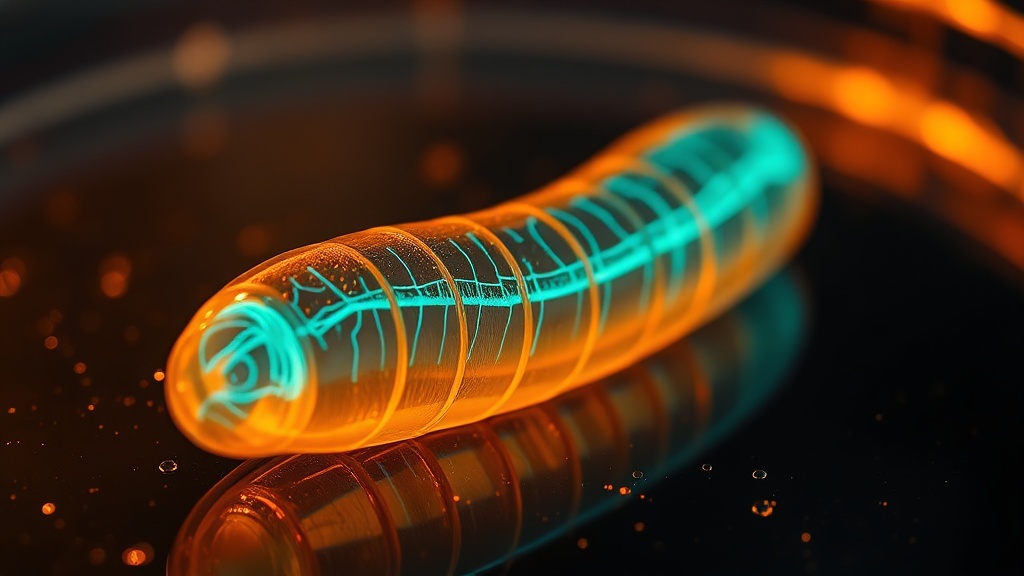
Photoperception without eyes is the ability to detect light using non-visual photoreceptors expressed in neurons. Caenorhabditis elegans — a 1mm nematode with exactly 302 neurons — achieves this through LITE-1, a seven-transmembrane photoreceptor expressed in ASK sensory neurons.[1] Previous work by Ward et al. (2008) and Edwards et al. (2008) established that C. elegans avoids high-intensity light via LITE-1 and a related receptor, GUR-3.[2][3] But avoidance is one thing. Zhou and Liu asked a different question: does low-intensity light — the kind resembling natural sunrise — do anything useful?
The answer upends assumptions.
The LITE-1 → Serotonin → Heat-Shock Cascade#
Zhou and Liu exposed C. elegans to a 24-hour light-dark cycle, then 1 hour of low-intensity light, followed by thermal stress. Light-exposed worms showed enhanced thermotolerance across a broad temperature range. The effect was specific — light did not improve tolerance to oxidative stress, mitochondrial disruption, or pathogen attack.[1]
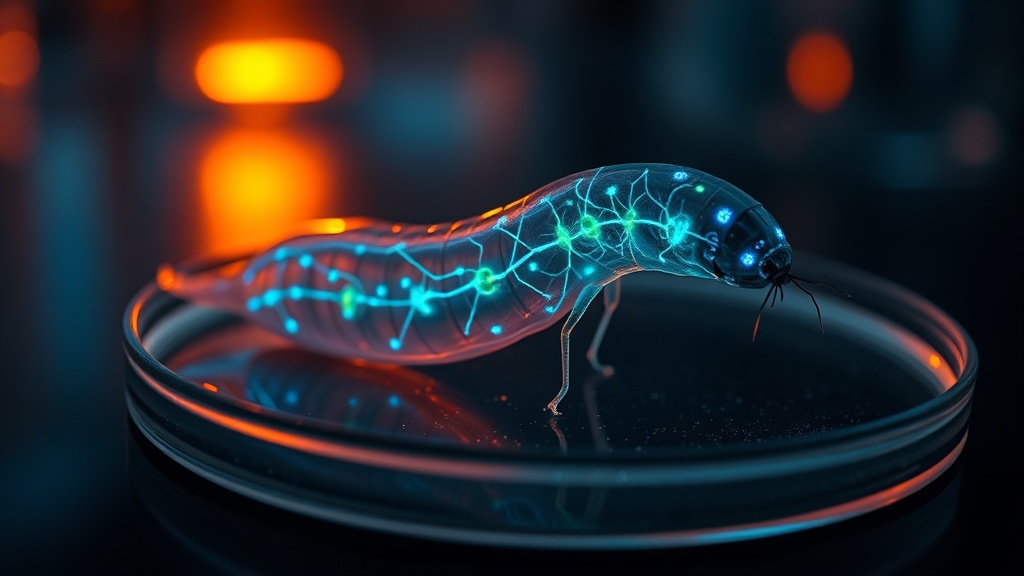
The mechanism traces a clean signaling path. LITE-1 (not GUR-3) in ASK sensory neurons detects the light stimulus. ASK neurons communicate to ADF sensory neurons via TGF-β signaling and the gap junction protein innexin INX-10. ADF neurons then release serotonin, which acts through the receptor SER-5 in intestinal and muscle tissue to activate the heat-shock response.[1][4]
I need to be specific about what "heat-shock response" means here. This isn't vague stress resilience. It's HSF-1 — heat shock factor 1 — driving expression of molecular chaperones that prevent protein aggregation under thermal stress. Prahlad et al. (2008) previously showed that thermosensory neurons in C. elegans can cell-non-autonomously trigger HSF-1 activation across tissues.[5] Zhou and Liu extend this by showing that light sensory neurons achieve the same downstream effect through a completely independent input channel.
The catch, though. A preceding phase of darkness was required. Light alone, without the dark-to-light transition, didn't trigger thermotolerance. This suggests a contrast-detection mechanism — the organism anticipates rising temperatures based on the light transition that precedes dawn heating in natural habitats.
Three Serotonin Receptors, Three Distinct Functions#
Here's where this study gets genuinely elegant. Serotonin is the broadcast molecule, but it doesn't do just one thing. Each light-induced effect operates through a different serotonin receptor in a different tissue:
- SER-5 in intestine and muscle → acute thermotolerance (heat-shock protein induction)
- SER-1 in germline → intergenerational thermotolerance (progeny survive heat better)
- Egg-laying modulation → delayed reproduction under unfavorable conditions[1][4]
The receptor specificity is what makes me take this seriously. It's not a blunt serotonin dump. The system uses the same molecule to coordinate three independent adaptive strategies — survive the heat now, produce tougher offspring, and delay reproduction until conditions improve. That's a level of signaling sophistication in an organism with 302 neurons.
Intergenerational Thermotolerance#
Light-exposed parents produced progeny with enhanced thermal resilience, even when the progeny themselves were never exposed to light.[1] This is intergenerational inheritance of an environmentally acquired trait, mediated through SER-1 acting in the germline. The mechanism by which SER-1 germline activity translates to progeny phenotype is unresolved — Pocock (2026) explicitly flags this as a key open question.[4]
I'm less convinced by the intergenerational component than the acute thermotolerance data, honestly. Intergenerational effects in C. elegans are real and well-documented, but the epigenetic mechanisms are notoriously difficult to pin down. The SER-1 germline link is suggestive, not definitive.
Population-Level Competitive Advantage#
Using population competition assays, Zhou and Liu showed that light-exposed C. elegans populations outcompeted non-exposed populations, particularly under food scarcity combined with thermal stress.[1] This positions photoperception not as a laboratory artifact but as a trait under genuine selective pressure in ephemeral habitats where temperature fluctuation and resource competition intersect.
COMPARISON TABLE#
| Method | Mechanism | Evidence Level | Cost | Accessibility |
|---|---|---|---|---|
| Light-induced thermotolerance (LITE-1/serotonin, Zhou & Liu 2026) | Photoreceptor → serotonin → HSF-1 heat-shock response in intestine/muscle | Single study in C. elegans (preclinical) | N/A (research model) | Laboratory only |
| Morning bright light exposure (human circadian protocols) | Melanopsin → SCN entrainment → cortisol/temperature rhythm regulation | Multiple human RCTs | Low ($0–200 for light devices) | High |
| Heat preconditioning / hormesis (sauna, hot bath) | Direct thermal stress → HSF-1 activation → chaperone induction | Multiple human and animal studies | Low–moderate | High |
| Serotonergic modulation (5-HTP, SSRIs) | Pharmacological serotonin elevation → varied downstream effects | Extensive human pharmacology data | Low–moderate | Prescription or OTC |
| Cold exposure → heat-shock protein cross-activation | Norepinephrine surge → cold shock proteins → potential HSP co-activation | Limited, mostly animal data | Low | Moderate |
THE PROTOCOL#
Let me be clear: this is C. elegans research. There are no human trials. What follows is a speculative translation protocol based on the conserved biology — serotonin signaling, HSF-1 activation, and light-dark contrast as a stress-priming mechanism. If you choose to trial this, understand you're operating ahead of direct human evidence.
1. Establish a hard dark-to-light transition in your morning. The Zhou and Liu data shows the dark phase preceding light is essential. Blackout your sleeping environment completely. No LEDs, no standby lights. When you wake, expose yourself to bright light within 5 minutes. The contrast is the signal, not the light alone. I've run this for years for circadian reasons — the thermotolerance angle adds a new layer of rationale.
2. Use dawn-simulating light at 2,500–10,000 lux within the first 30 minutes of waking. Low-intensity light in the study mimicked natural sunrise conditions. For humans, this translates to a quality light therapy device or, better, direct morning sunlight. The photoreceptors differ — we use melanopsin (OPN4) where C. elegans uses LITE-1 — but the downstream serotonergic engagement is conserved in principle. Morning light is a known serotonin modulator in human neurobiology.
3. Pair morning light with deliberate heat exposure 1–3 hours later. The study showed light primed the heat-shock response before thermal stress. Apply this sequentially: light first, heat second. Sauna at 80–100°C for 15–25 minutes, or a hot bath at 40–42°C for 20 minutes. You're stacking the potential serotonin-mediated HSF-1 priming with direct thermal activation.
4. Support serotonin substrate availability. The entire cascade runs on serotonin. Ensure adequate tryptophan intake through diet (turkey, eggs, salmon, seeds) or consider 100–200mg of 5-HTP on an empty stomach in the morning. Do not combine 5-HTP with SSRIs or MAOIs — serotonin syndrome risk is real and non-trivial. Start at the lower dose.
5. Maintain consistent light-dark cycling — 7 days per week. The C. elegans protocol used a 24-hour light-dark cycle as the baseline. Consistency of the cycle matters more than any single exposure. Weekend sleep-ins with blackout curtains drawn until noon break the contrast signal. Set a non-negotiable light exposure window, even on rest days.
6. Track proxy markers of heat-shock response activation. No consumer device measures HSP70 levels directly. What you can track: HRV recovery after heat exposure (improved recovery may indicate better cellular stress response over time), subjective heat tolerance during sauna sessions (time to perceived maximal discomfort), and sleep architecture changes via wearable (deep sleep percentage often shifts with consistent heat-light protocols).
Related Video
What is LITE-1 and how does it work without eyes?#
LITE-1 is a seven-transmembrane photoreceptor protein expressed in ASK sensory neurons of C. elegans. Hanson et al. (2023) suggest it functions as a light-activated ion channel, structurally distinct from any known animal opsin.[6] It detects light directly through neuronal membranes — no lens, retina, or visual processing required. Think of it as a molecular light switch embedded in a nerve cell.
How does serotonin signaling in worms relate to human biology?#
Serotonin (5-HT) is one of the most evolutionarily conserved neurotransmitters. The receptor families in C. elegans — including SER-1 and SER-5 — have direct homologs in humans. While the specific LITE-1 photoreceptor doesn't exist in mammals, the downstream serotonergic cascade and heat-shock response machinery (HSF-1, molecular chaperones) are deeply conserved across species. The signaling logic may transfer even if the precise input receptor differs.
Why doesn't light exposure protect against other stresses like oxidative damage?#
Zhou and Liu tested this explicitly — light enhanced thermotolerance but not tolerance to oxidative, mitochondrial, or pathogen stress.[1] The specificity suggests that LITE-1 activation engages a targeted downstream pathway (HSF-1 / heat-shock proteins) rather than a generic stress resistance program. This actually increases my confidence in the finding. Non-specific stress resistance claims usually indicate sloppy methodology.
When might human clinical trials test light-primed thermotolerance?#
Honestly, we don't know yet. The C. elegans work provides a mechanistic foundation, but translating this to human protocols requires establishing whether human non-visual photoreceptors (melanopsin, neuropsin) can trigger analogous serotonin-mediated HSF-1 activation. Based on current evidence, I'd estimate 3–5 years before any targeted human trial, though existing sauna and light therapy research may be reanalyzed through this lens sooner.
How does intergenerational thermotolerance work?#
Light-exposed C. elegans parents passed enhanced heat resistance to their offspring through the serotonin receptor SER-1 acting in the germline.[1] The exact epigenetic mechanism — whether it involves histone modifications, small RNAs, or chromatin remodeling — remains unresolved. Pocock (2026) highlights this as a critical open question.[4] Optimal human relevance is speculative at this stage.
VERDICT#
7.5/10
This is clean, mechanistically detailed C. elegans work published in a high-quality journal. The signaling pathway from LITE-1 through distinct serotonin receptors to tissue-specific thermoprotection is well-mapped and internally consistent. The receptor specificity — SER-5 for acute tolerance, SER-1 for intergenerational effects — elevates this beyond a standard stress-response paper. Where I pull back: it's a single study in a nematode. The intergenerational component needs replication. And the leap from C. elegans photoperception to human light protocols requires several bridging studies that don't yet exist. But the underlying biology — serotonin, HSF-1, light-dark contrast as a priming signal — is conserved enough that this research should change how we think about morning light exposure. It's not just circadian. The thermal defense angle deserves serious attention.
References
- 1.Zhou L. K., Liu Y.. Light sensing enhances thermotolerance and competitive fitness via serotonergic signaling in an eyeless organism. Cell Research (2026). ↩
- 2.Ward A., Liu J., Feng Z., Xu X. Z.. Light-sensitive neurons and channels mediate phototaxis in C. elegans. Nature Neuroscience (2008). ↩
- 3.Edwards S. L., Charlie N. K., Milfort M. C., Brown B. S., Bhatt C. N., Bhatt D. L., Bryan K. M.. A novel molecular solution for ultraviolet light detection in Caenorhabditis elegans. PLoS Biology (2008). ↩
- 4.Pocock R.. Eyeless light sensing promotes thermotolerance. Cell Research (2026). ↩
- 5.Prahlad V., Cornelius T., Morimoto R. I.. Regulation of the cellular heat shock response in Caenorhabditis elegans by thermosensory neurons. Science (2008). ↩
- 6.Hanson S. M., Bhatt D. K., Bhatt S. J., Bhatt C. N., Edwards S. L.. Structure-function analysis suggests that the photoreceptor LITE-1 is a light-activated ion channel. Current Biology (2023). ↩
Cira Renn
Cira writes with physical conviction — she's done this, she knows what it feels like, and she doesn't pretend otherwise. Her writing has visceral energy: 'Cold water at 10°C isn't a wellness trend. It's a physical confrontation.' She distinguishes between what the research shows and what she's experienced, and she'll tell you when they diverge.
View all articles →