Macimorelin Test for Adult Growth Hormone Deficiency: Cut-Offs & BMI

SNIPPET: The macimorelin stimulation test diagnoses adult growth hormone deficiency (AGHD) more frequently when using the proposed 5.1 ng/mL GH cut-off versus the FDA-approved 2.8 ng/mL threshold, with a 13.5% absolute increase in diagnostic yield. However, discordant cases concentrate in obese patients (BMI >35), suggesting adiposity confounds results. The 90-minute blood draw may be safely omitted without altering diagnostic classification.
THE PROTOHUMAN PERSPECTIVE#
Growth hormone isn't just a pediatric concern anymore. For the optimization-focused adult — whether tracking body composition, cognitive sharpness, or recovery capacity — accurate diagnosis of GH deficiency is the gateway to legitimate treatment. Get the diagnostic threshold wrong, and you either leave genuinely deficient patients untreated or hand a prescription to someone whose blunted GH response is driven by adiposity, not pituitary pathology.
Macimorelin changed the diagnostic landscape as the only oral GH stimulation test. No IV lines, no insulin-induced hypoglycemia, no glucagon injections. But the question of where to draw the line on the GH response has never been cleanly resolved. The FDA set it at 2.8 ng/mL. Post-hoc analyses pushed it to 5.1 ng/mL. This new real-world data from a retrospective cohort finally puts both thresholds under clinical pressure — and what emerges is a story less about the drug and more about how body fat distorts the entire somatotropic axis. For anyone in the biohacking space considering GH optimization, this matters more than the next peptide stack.
THE SCIENCE#
Macimorelin: Mechanism and the Cut-Off Debate#
Macimorelin (trade name: Macrilen) is a synthetic ghrelin receptor agonist — specifically, it binds the growth hormone secretagogue receptor type 1a (GHS-R1a) in the anterior pituitary, triggering GH release into circulation[1]. Unlike the insulin tolerance test (ITT), which provokes GH secretion via hypoglycemic stress and carries genuine risk in patients with cardiovascular disease or seizure disorders, macimorelin is administered orally and measured via serial blood draws over 45 to 90 minutes.
The FDA approved macimorelin for AGHD diagnosis in 2017 using a peak GH cut-off of 2.8 ng/mL — meaning if your stimulated GH doesn't exceed 2.8, you're classified as deficient. But post-hoc analyses of the original registration trial suggested a higher cut-off of 5.1 ng/mL improved sensitivity without catastrophic loss of specificity[1]. The clinical consequence is obvious: raise the threshold, diagnose more patients. The question is whether those additional diagnoses are real or artifacts.
What the New Data Shows#
This retrospective single-center study examined 37 adults who underwent macimorelin stimulation testing[1]. Patients were stratified by pre-test probability: high (e.g., known pituitary pathology, multiple hormone deficiencies), intermediate, and low.
At the 2.8 ng/mL cut-off, 15 patients (40.5%) met AGHD criteria. At 5.1 ng/mL, that number rose to 20 (54.0%) — an absolute diagnostic yield difference of 13.5% (95% CI: 2.5–24.5%). The exact McNemar test yielded p = 0.0625, which narrowly misses conventional significance. Five patients were reclassified.
Here's where it gets interesting. Of those five discordant patients — people who would be called "deficient" at 5.1 but "normal" at 2.8 — three were in the low pre-test probability group, and all three had BMI above 35 kg/m²[1].
The Obesity Confound#
This is the part I find most clinically relevant — and most underappreciated in the optimization community.
In the low pre-test probability group, BMI showed a strong monotonic inverse association with peak GH (Spearman ρ = −0.67, p = 0.006)[1]. Discordant patients had a mean BMI of 37.7 ± 2.7 kg/m² versus 28.2 ± 4.6 kg/m² in concordant patients — a difference of 9.5 kg/m² (95% CI: 5–14 kg/m²).
Obesity suppresses the GH axis. This is not new — the somatotropic axis is exquisitely sensitive to metabolic status. Visceral adiposity increases free fatty acid flux, which directly suppresses pituitary GH secretion. Elevated insulin and IGF-1 bioavailability in obesity create negative feedback loops that blunt stimulated GH output. The downstream signaling through GHRH neurons in the arcuate nucleus is attenuated[6].
The implication: at the 5.1 ng/mL cut-off, you're almost certainly capturing some patients whose blunted GH response reflects their adiposity, not genuine pituitary insufficiency. I'd want to see this replicated in a larger cohort, but the signal is consistent with everything we know about the somatotropic-adipose crosstalk.
Can We Drop the 90-Minute Blood Draw?#
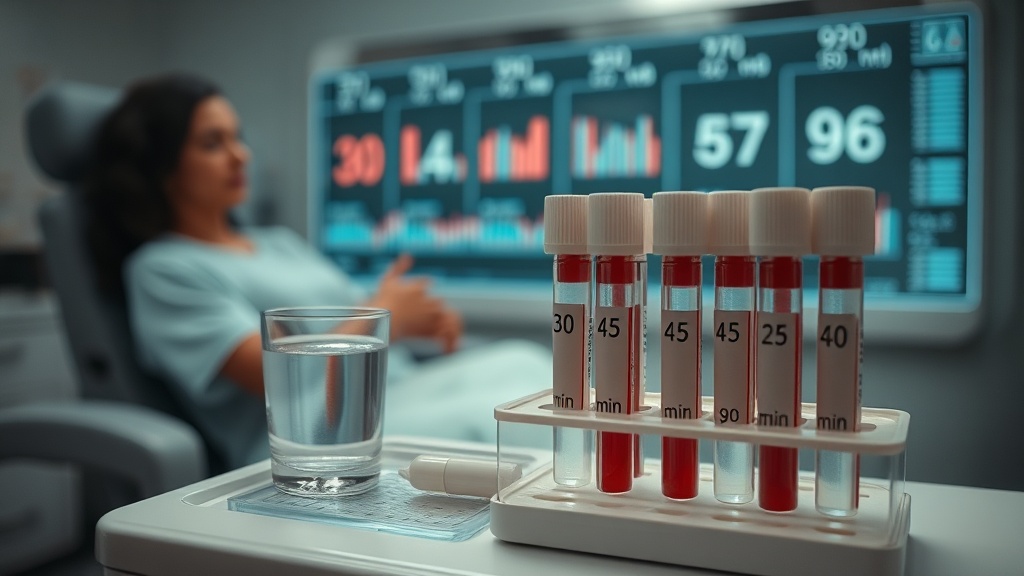
The standard macimorelin protocol requires blood sampling at 30, 45, 60, and 90 minutes. This study found GH values at 60 and 90 minutes were highly correlated (r = 0.775, p < 0.0001), and omitting the 90-minute sample did not change a single diagnostic classification[1].
From a practical standpoint, this could shorten clinic time and reduce burden. But the sample size is 37 patients. That correlation coefficient, while statistically significant, isn't so high that I'd comfortably call this definitive. It's a reasonable preliminary signal.
Context: The Broader Diagnostic Landscape#
This study arrives against a backdrop of ongoing diagnostic uncertainty. A 2025 Delphi consensus study promoted by the Growth Hormone Research Society found that adult endocrinologists reached 88% consensus on diagnostic approaches, while pediatric endocrinologists managed only 59%[6]. The disagreement centers precisely on stimulation test selection, cut-off values, and how to handle confounders like obesity.
Meanwhile, alternative oral stimulation approaches are being explored. Riehle, Lustenberger et al. (2025) tested oral urea as a potential GH secretagogue in a randomized placebo-controlled crossover trial of 22 healthy adults[2]. The result was unequivocal: oral urea did not significantly stimulate GH secretion (p = 0.08 at 120 minutes). Macimorelin remains the only viable oral option — which means getting its cut-offs right matters even more.
AGHD Diagnostic Yield by GH Cut-Off Threshold
COMPARISON TABLE#
| Method | Mechanism | Evidence Level | Approximate Cost | Accessibility |
|---|---|---|---|---|
| Macimorelin (2.8 ng/mL cut-off) | Oral ghrelin receptor agonist; serial GH blood draws over 60–90 min | FDA-approved; phase III + real-world data | ~$8,000–$17,000 USD per test | Available in US; limited in EU and other regions |
| Macimorelin (5.1 ng/mL cut-off) | Same mechanism; higher diagnostic threshold | Post-hoc analysis; one real-world validation (n=37) | Same as above | Same as above |
| Insulin Tolerance Test (ITT) | IV insulin → hypoglycemia → stress-mediated GH release | Gold standard; decades of data | ~$200–$500 | Widely available but contraindicated in CVD/seizures |
| Glucagon Stimulation Test | IM/SC glucagon → GH release via unclear central mechanisms | Well-established; Endocrine Society–recommended | ~$150–$400 | Widely available; nausea common |
| GHRH-Arginine | IV GHRH + IV arginine → direct pituitary stimulation | Strong evidence; BMI-adjusted cut-offs exist | ~$300–$600 | GHRH unavailable in several countries |
| Oral Urea | Proposed urea-cycle-mediated GH stimulation | Failed in RCT (n=22); not viable | Minimal | N/A — does not work |
THE PROTOCOL#
For clinicians or informed patients navigating macimorelin-based AGHD diagnosis, here is a structured approach based on current evidence:
Step 1. Establish pre-test probability before ordering the test. Document pituitary pathology history, prior radiation, traumatic brain injury, number of other pituitary hormone deficiencies, and symptoms consistent with AGHD (fatigue, altered body composition, reduced exercise capacity). This stratification directly influences how you interpret the result.
Step 2. Record accurate BMI at the time of testing. If BMI exceeds 30 kg/m² — and especially above 35 — note that GH response may be blunted by adiposity rather than true deficiency. The data from this cohort shows a Spearman ρ of −0.67 between BMI and peak GH in the low pre-test probability group[1]. Do not skip this step.
Step 3. Administer macimorelin per FDA-approved protocol: 0.5 mg/kg orally after an overnight fast. Draw blood samples at baseline, 30, 45, and 60 minutes. Based on this cohort's data, the 90-minute draw may be omitted without changing diagnostic outcomes, though I'd recommend retaining it until larger confirmatory studies are published.
Step 4. Interpret peak GH carefully based on clinical context. For high pre-test probability patients, the 2.8 ng/mL cut-off is likely sufficient and specific. For low pre-test probability patients with BMI >35, a peak GH between 2.8 and 5.1 ng/mL should trigger further investigation — consider confirmatory testing with a second stimulation test (ITT or glucagon) rather than automatically diagnosing AGHD.
Step 5. If AGHD is confirmed, baseline IGF-1 should be documented before initiating GH replacement. Titrate recombinant GH (somatropin) starting at 0.1–0.2 mg/day for adults, adjusting based on IGF-1 levels, clinical response, and side effects. Weekly somatrogon formulations are now available for pediatric populations and may eventually extend to adult protocols[3].
Step 6. Reassess annually. GH replacement requires monitoring of IGF-1, fasting glucose, HbA1c, lipid panels, and body composition. In patients initially diagnosed at the 5.1 ng/mL threshold with high BMI, consider retesting after significant weight loss — the deficiency diagnosis may not hold.
Related Video
VERDICT#
Score: 6.5/10
This is a useful real-world signal, but let's be honest about what it is: a single-center retrospective study with 37 patients. The finding that BMI confounds macimorelin results in low pre-test probability patients is the most actionable takeaway — and it's consistent with established physiology. The 90-minute sampling finding is practical but needs replication. The p = 0.0625 on the primary comparison is suggestive but not definitive. I give it credit for addressing a genuinely under-studied clinical question with appropriate statistical methodology, but the sample size limits how far we can push these conclusions. Clinicians should note the BMI interaction; the optimization community should stop assuming every blunted GH response means deficiency.
Frequently Asked Questions5
References
- 1.Author(s) not listed. Real-world diagnostic performance of the macimorelin stimulation test in the diagnosis of adult growth hormone deficiency. Pituitary (2026). ↩
- 2.Riehle F, Lustenberger S. Oral urea does not stimulate growth hormone secretion: a secondary analysis of a randomized placebo-controlled crossover trial. Pituitary (2025). ↩
- 3.Fachin A, Fabretto A, Tamaro G, Rodaro C, Tornese G. Two-year real-world experience with somatrogon in children and adolescents with growth hormone deficiency. Frontiers in Endocrinology (2026). ↩
- 4.Zhou H, Ma J, Chen X, Yang H, Zheng H, Wang A, Wang H, Wang Y. Serum osteocalcin as a novel biomarker for differentiating growth hormone deficiency from idiopathic short stature. Frontiers in Endocrinology (2026). ↩
- 6.Author(s) not listed. Diagnosis of growth hormone deficiency: searching for consensus along life. Pituitary (2025). ↩
Petra Luun
Petra writes with clinical depth and a slight edge of frustration at how poorly understood this space is by both advocates and critics. She will dismantle bro-science and mainstream medical conservatism with equal energy in the same article. Her writing has surgical precision: she explains receptor pharmacology, feedback loops, and half-life considerations in one coherent thread without dumbing any of it down.
View all articles →