rTMS and Mindfulness for Treatment-Resistant Depression: New Synergy

SNIPPET: Combining repetitive transcranial magnetic stimulation (rTMS) with mindfulness-based interventions (MBI) may enhance treatment outcomes for treatment-resistant depression by converging on shared brain networks — the default mode, central executive, and salience networks. A 2026 narrative review by Yun and Figee proposes that mindfulness primes neural circuit states, potentially reducing the response variability that limits rTMS efficacy alone.
THE PROTOHUMAN PERSPECTIVE#
Treatment-resistant depression is not a failure of willpower. It's a network-level malfunction — circuits locked in ruminative loops, default mode hyperactivity drowning out executive control. And for roughly 40–50% of people who try rTMS, the stimulation alone isn't enough to break the pattern.
What makes this new theoretical framework from Mount Sinai worth paying attention to is the specificity of the proposal: that the brain state at the moment of stimulation may determine whether rTMS actually rewires anything. Mindfulness isn't being tacked on as a wellness add-on. It's being positioned as a neural primer — a way to shift network configuration before the magnetic pulse lands. For those of us tracking the convergence of neuromodulation and contemplative neuroscience, this is the kind of mechanistic overlap that's been hiding in plain sight. The question is whether the clinical data will catch up with the theory.
THE SCIENCE#
Shared Network Architecture: DMN, CEN, and Salience#
The core argument from Yun and Figee (2026) hinges on a deceptively simple observation: rTMS and mindfulness meditation both target the same three large-scale brain networks [1]. The default mode network (DMN), overactive in depression and responsible for self-referential rumination. The central executive network (CEN), underactive in depressed states, responsible for goal-directed cognition. And the salience network (SN), which gates the dynamic switching between the two.
In treatment-resistant depression, the DMN essentially hijacks attentional resources. The SN fails to properly toggle control to the CEN when external demands require it. rTMS — particularly high-frequency stimulation to the left dorsolateral prefrontal cortex (DLPFC) — aims to boost CEN activity and dampen DMN hyperconnectivity. Mindfulness meditation, through a different route entirely, appears to do something similar: reducing DMN rumination, strengthening attentional control via the CEN, and enhancing interoceptive awareness through the SN [1].
This reminds me of something from the attentional blink literature — different context, but the pattern holds. When two systems are trying to modulate the same bottleneck, timing matters enormously.
The State-Dependency Problem#
Here's where it gets complicated. rTMS doesn't land on a blank canvas. It lands on whatever neural state exists at the moment of stimulation. Yun and Figee propose a "state-dependent synergy model" — the idea that if you can shift someone's brain into a more receptive configuration before stimulation, the effects of rTMS amplify [1].
This isn't purely theoretical. Humble et al. (2025) used TMS-EEG to probe the DLPFC of experienced mindfulness meditators versus matched controls. They found that meditators had statistically larger P60/N100 ratios in response to DLPFC stimulation — both left and right hemisphere — with Bayesian evidence factors exceeding 39 [4]. That's not a marginal difference. That's a shifted excitation/inhibition balance in exactly the region rTMS targets for depression.
What does this actually feel like? I think that's worth asking. Meditators often describe a quality of "open readiness" — less default-mode chatter, more perceptual clarity. The P60/N100 data suggests this isn't just phenomenological hand-waving. There's a measurable cortical signature.
The rTMS-Mindfulness Evidence So Far#
Let me push back on the enthusiasm slightly. The direct clinical evidence for combining rTMS with mindfulness in depression specifically is thin. Yun and Figee acknowledge this — their paper is a narrative review synthesizing analogous combinations, not reporting trial results [1].
But the adjacent evidence is accumulating. Rayani et al. (2025) conducted a sham-controlled rTMS trial in PTSD patients (n=31) and found that active rTMS significantly improved dispositional mindfulness scores — measured by the Five Facet Mindfulness Questionnaire — at three-month follow-up, with particular gains in nonreactivity [2]. The honest answer is the sample was too small for strong conclusions, and the initial post-treatment differences didn't survive false discovery rate correction. But the delayed-onset pattern — benefits appearing at three months rather than immediately — is interesting. It suggests rTMS may be initiating a plasticity window that unfolds over time, and mindfulness-related capacities may be among the functions that consolidate within that window.
Divarco et al. (2023) conducted a systematic review of studies combining transcranial electrical stimulation (tES, a related but distinct modality) with meditation practice [3]. While the review covered low-intensity electrical stimulation rather than magnetic stimulation, the convergent finding was that combining brain stimulation with contemplative practice appeared to produce effects exceeding either intervention alone — particularly on measures of attention and emotional regulation.
Precision Targeting: The AI Variable#
One factor that could dramatically shift the equation is precision targeting. Liu et al. (2025) reviewed the integration of neuroimaging and machine learning for personalizing TMS stimulation sites [6]. Conventional rTMS uses anatomical landmarks — the "5cm rule" for locating the DLPFC — which ignores massive individual variability in functional brain architecture. fMRI-guided targeting, combined with AI algorithms that predict optimal stimulation coordinates based on individual connectivity profiles, has already shown improved response rates in depression trials.
If you combine precision-targeted rTMS with pre-stimulation mindfulness priming — essentially selecting the right where via neuroimaging and the right when via state manipulation — the theoretical case for synergy becomes considerably stronger.
TMS-Evoked P60/N100 Ratio: Meditators vs. Controls
COMPARISON TABLE#
| Method | Mechanism | Evidence Level | Cost | Accessibility |
|---|---|---|---|---|
| rTMS alone (standard DLPFC) | Electromagnetic modulation of CEN/DMN connectivity | Multiple RCTs, FDA-cleared | $6,000–$15,000 per course | Clinic-based; requires trained operator |
| Mindfulness-Based Interventions alone | Attention training, DMN deactivation, interoceptive awareness | Meta-analyses support efficacy for depression | $0–$500 (courses/apps) | High; self-directed or group-based |
| rTMS + Mindfulness (proposed) | State-dependent neural priming + electromagnetic modulation | Narrative review; no direct RCTs yet | Combined: ~$6,500–$16,000 | Clinic-based with brief pre-session practice |
| Precision TMS (fMRI-guided + AI) | Individualized targeting via connectivity mapping | Emerging RCTs; promising response data | $8,000–$20,000+ (includes imaging) | Limited to research/academic centers |
| tDCS + Meditation | Low-current electrical stimulation combined with contemplative practice | Systematic review; mixed but positive signals | $200–$1,000 (device + training) | Home-use devices available; lower barrier |
THE PROTOCOL#
Based on the current evidence and the state-dependent synergy model proposed by Yun and Figee, here's a practical framework. I want to be clear: this is extrapolated from the mechanistic literature. No direct RCT has validated this combined protocol for TRD specifically. If you choose to trial this, work with a qualified clinician.
Step 1: Clinical Assessment and Baseline Neuroimaging Before initiating any protocol, obtain a clinical evaluation confirming treatment-resistant depression (failure of ≥2 adequate antidepressant trials). Where available, pursue fMRI-guided targeting to identify your individual DLPFC-to-subgenual ACC connectivity profile. This is the emerging standard for precision rTMS [6].
Step 2: Establish a Brief Mindfulness Practice (2–4 Weeks Pre-Treatment) Begin a short daily mindfulness practice — 10–15 minutes of focused attention meditation (breath-based). The goal isn't expertise. It's establishing a minimal capacity for attentional stability. Use a structured program (MBSR-adapted or app-guided) to build consistency.
Step 3: Pre-Session Mindfulness Priming (5–10 Minutes) Immediately before each rTMS session, engage in 5–10 minutes of seated mindfulness practice. Focus on breath awareness with open monitoring. The aim is to shift your network state — dampening DMN rumination and activating the attentional components of the CEN — creating a more receptive neural configuration for stimulation [1][4].
Step 4: rTMS Administration Receive standard high-frequency (10 Hz) rTMS to the left DLPFC, or intermittent theta burst stimulation (iTBS), per your clinician's protocol. Standard courses involve 20–30 sessions over 4–6 weeks. The Stanford Neuromodulation Therapy (SNT) accelerated protocol — 10 sessions per day over 5 days — is an alternative for those with access.
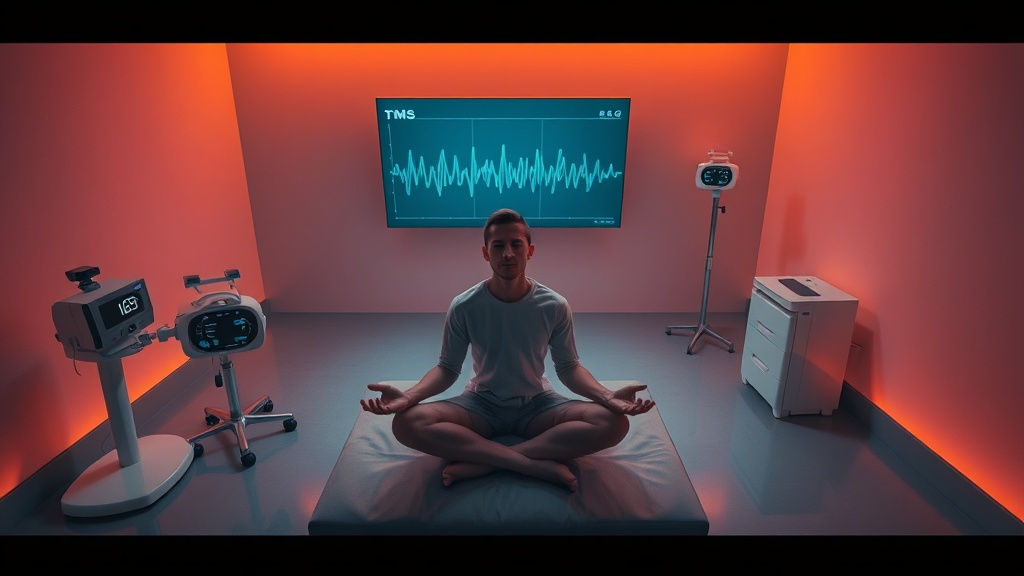
Step 5: Post-Session Integration Practice (5 Minutes) After each rTMS session, sit quietly for 5 minutes with open monitoring meditation. Early data from the PTSD literature suggests mindfulness-related benefits from rTMS may consolidate over weeks [2]. This brief post-session practice may support that consolidation.
Step 6: Track and Adjust Monitor depressive symptoms (PHQ-9 or MADRS), HRV metrics (as a proxy for autonomic regulation), and subjective mindfulness capacity (FFMQ) weekly throughout the course. Adjust mindfulness practice duration based on tolerance — some TRD patients find even brief meditation aversive early in treatment. That's not failure. It's data.
Related Video
What is the state-dependent synergy model for rTMS and mindfulness?#
It's the proposal that the brain's network configuration at the moment of TMS stimulation determines how effectively the magnetic pulse reshapes neural circuitry. Mindfulness meditation may shift that configuration into a more receptive state — less DMN rumination, more CEN engagement — potentially amplifying rTMS effects. Yun and Figee (2026) formalized this model in their narrative review, though direct clinical validation is still needed [1].
How does mindfulness change the brain's response to TMS?#
Humble et al. (2025) found that experienced meditators show significantly altered excitation/inhibition balance in the DLPFC when probed with TMS-EEG, with P60/N100 ratios over 39 times more likely to differ from controls than to be the same [4]. This suggests meditation physically reshapes how the prefrontal cortex responds to electromagnetic stimulation.
Who is a candidate for combined rTMS and mindfulness treatment?#
The primary candidates, based on the current theoretical framework, are individuals with treatment-resistant depression — those who haven't responded adequately to two or more antidepressant medications. However, adjacent evidence from PTSD populations suggests the combination may have broader applications [2]. Anyone considering this should consult a psychiatrist experienced in neuromodulation.
Why hasn't this combination been tested in a randomized controlled trial yet?#
The honest answer is that the field has been siloed. Neurostimulation researchers and contemplative neuroscience researchers haven't historically collaborated closely. The mechanistic overlap is now clear enough to justify trials, and Yun and Figee's review explicitly calls for future RCT designs. I'd expect the first dedicated trials within 1–2 years.
When during the rTMS course is mindfulness most important?#
Based on the state-dependency model, the pre-stimulation window matters most — the 5–10 minutes immediately before each session. But the delayed mindfulness improvements seen in Rayani et al.'s PTSD trial [2] suggest that post-course practice may also be critical for maintaining and consolidating gains over months.
VERDICT#
Score: 7/10
The mechanistic logic here is sound and specific — this isn't vague wellness talk layered onto neurostimulation. The shared network targets are well-documented, and the TMS-EEG data from Humble et al. provides a genuinely compelling biomarker showing that meditative states alter exactly how the prefrontal cortex responds to stimulation. I'm less convinced by the PTSD mindfulness data from Rayani et al., which was small and didn't fully survive statistical correction.
The gap — and it's a meaningful one — is the absence of any direct RCT combining rTMS and mindfulness for depression. Yun and Figee have built a strong theoretical scaffold, but until someone runs the trial, this remains an elegant hypothesis. I'd want to see a well-powered, sham-controlled study with pre-registered outcomes before upgrading this score. The theory deserves an 8. The evidence, today, keeps it at 7.
References
- 1.Yun S, Figee M. The neurobiological synergy of transcranial magnetic stimulation and mindfulness-based interventions in treatment-resistant depression: a narrative review. Frontiers in Psychiatry (2026). ↩
- 2.Rayani K, Grabovac A, Chan P, Montgomery S, Ghovanloo M, Sacchet MD. Brain stimulation enhances dispositional mindfulness in PTSD: an exploratory sham-controlled rTMS trial. Frontiers in Psychiatry (2025). ↩
- 3.Divarco R, Ramasawmy P, Petzke F, Antal A. Stimulated brains and meditative minds: A systematic review on combining low intensity transcranial electrical stimulation and meditation in humans. International Journal of Clinical and Health Psychology (2023). ↩
- 4.Humble G, Geddes H, Baell O, Payne JE, Hill AT, Chung SW, Emonson M, Osborn M, Caldwell B, Fitzgerald PB, Cash R, Bailey NW. TMS-EEG Shows Mindfulness Meditation Is Associated With a Different Excitation/Inhibition Balance in the Dorsolateral Prefrontal Cortex. Mindfulness (2025). ↩
- 5.Wang W, Yan Q, Zhu C, Chai SC, Singh DKA, Yao L, Subramaniam P, Fu Y. Effectiveness of transcranial electrical stimulation combined with dual-task training in stroke, mild cognitive impairment and Parkinson's disease: a systematic review and meta-analysis of randomized controlled trials. Frontiers in Human Neuroscience (2026). ↩
- 6.Liu B, Hu C, Bao P. Precision TMS through the integration of neuroimaging and machine learning: optimizing stimulation targets for personalized treatment. Frontiers in Human Neuroscience (2025). ↩
Fen Adler
Fen writes with psychological nuance and a slightly meandering quality that feels human. He'll start pursuing one idea, realize it connects to something else, and follow it briefly before returning: 'This reminds me of something from the attentional blink literature — different context, but the pattern holds.' He's interested in the experience, not just the mechanism, which means he'll occasionally ask: 'What does this actually feel like?' when discussing neurological effects.
View all articles →