BioDynamic Lighting vs Bright Light Therapy for Dementia Sleep

SNIPPET: BioDynamic Lighting (BDL) — light that shifts color temperature and intensity across the day — showed no significant improvement in sleep or rest-activity rhythms over standard bright light therapy in nursing home residents with dementia, according to a 12-month crossover trial published in BMC Geriatrics (2026). Neither BDL nor bright light therapy outperformed baseline on any measured sleep parameter.
THE PROTOHUMAN PERSPECTIVE#
This matters because the lighting industry has been selling a seductive story: install circadian-tuned LEDs, and biology fixes itself. BioDynamic Lighting — panels that mimic sunrise-to-sunset spectral shifts — has become a premium wellness feature in care facilities, corporate offices, and biohacker setups alike. The promise is elegant. Your suprachiasmatic nucleus receives the right melanopic signal at the right time, melatonin onset sharpens, sleep consolidates.
The problem is that the largest controlled trial to date in dementia care found none of that happened. Not with BioDynamic Lighting. Not with conventional bright light therapy either. For those of us optimizing circadian architecture as a performance lever, this is a necessary reality check. Light matters — but the delivery context, timing, and competing behavioral signals may matter more. If sleep hygiene is broken at the institutional level (scheduled napping, excessive time in bed, minimal daytime activity), even the most sophisticated photonic intervention gets drowned out.
THE SCIENCE#
What BioDynamic Lighting Actually Is#
BioDynamic Lighting (BDL) refers to automated LED systems that modulate both illuminance (lux) and correlated color temperature (CCT) across a 24-hour cycle — typically delivering high-intensity, blue-enriched light (~6500 K) during morning hours and transitioning to warmer, dimmer light (~2700 K) in the evening. The mechanism targets intrinsically photosensitive retinal ganglion cells (ipRGCs), which relay melanopic signals to the suprachiasmatic nucleus (SCN) to entrain circadian oscillators. In theory, this should improve the amplitude and stability of rest-activity rhythms, downstream melatonin synthesis, and — ultimately — sleep consolidation.
Bright Light Therapy (BLT), by contrast, delivers a fixed high-intensity white light (typically ≥1000 lux) at scheduled times, usually morning. It's a blunt instrument compared to BDL's dynamic approach, but it has decades of evidence behind it.
The BMC Geriatrics Trial: What They Actually Found#
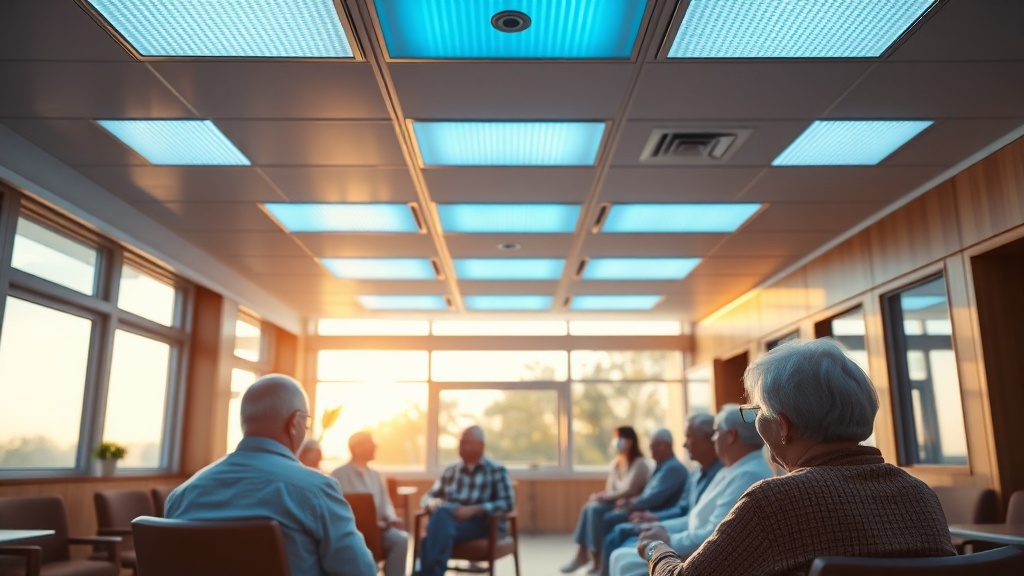
The study by researchers published in BMC Geriatrics (March 2026) enrolled 42 nursing home residents with dementia in a nonrandomized 12-month crossover design[1]. Each participant cycled through four 3-month blocks: two periods of standard lighting, one of BDL, and one of BLT. Sleep was tracked via wrist actigraphy and bed sensors — a solid dual-measurement approach.
Here's the headline: neither BDL nor BLT produced statistically significant changes in any primary sleep or rest-activity variable compared to baseline. Not sleep efficiency. Not sleep onset latency. Not total sleep time. Not interdaily stability or intradaily variability. Not the number of awakenings or their duration. Nothing moved.
That's striking. Especially given that BDL systems in institutional settings cost substantially more than standard BLT setups.
One curious finding did emerge after BDL was discontinued: a significant increase in nocturnal awakenings (Cohen's d = 0.35, p = .01) and a paradoxical decrease in sleep onset latency (d = -0.47, p = .003). I want to be careful here — this is a discontinuation effect, not a treatment effect, and interpreting it is messy. It could suggest some subthreshold circadian stabilization that only becomes visible when removed, or it could be a statistical artifact in a small, nonrandomized sample.
I'm less convinced by the discontinuation finding than some readers will be. With n = 42 and no randomization, these p-values don't inspire confidence.
The Confounding Problem Nobody Wants to Talk About#
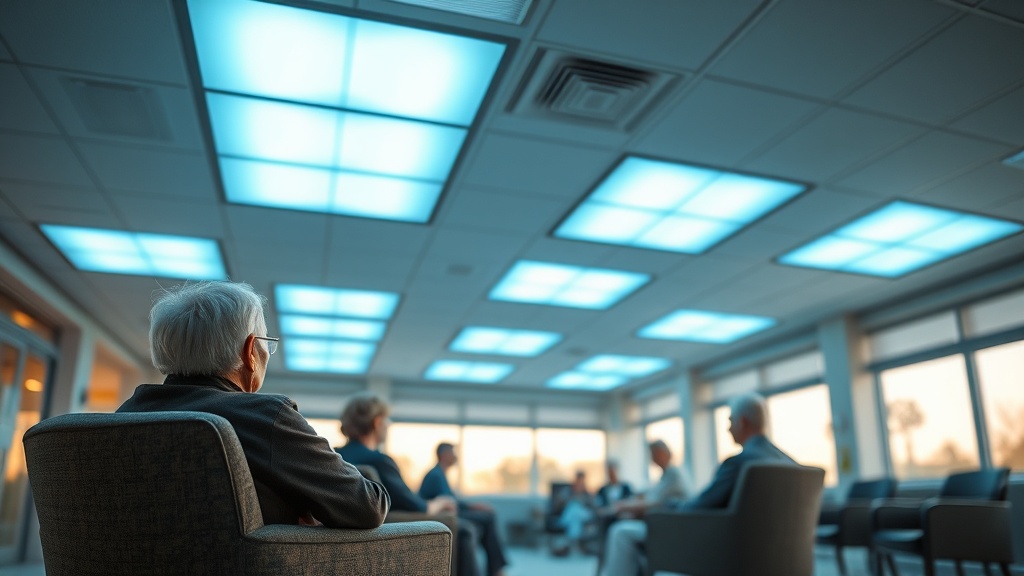
The authors themselves flag this, and I think it's the most important part of the paper: suboptimal sleep hygiene likely overwhelmed any photonic signal. Residents had long bed episodes, scheduled afternoon rest periods, and daytime napping. In circadian biology terms, these behaviors flatten the amplitude of the rest-activity rhythm at a behavioral level. You can deliver perfect melanopic input to the SCN, but if the downstream behavioral output is being overridden by institutional scheduling — forced rest periods, minimal daytime physical activity, extended time in bed — the entrainment signal gets buried.
— Actually, I want to rephrase that. It's not just that it gets buried. It's that the behavioral zeitgebers (activity, feeding, social interaction) are actively contradicting the photic zeitgeber. The SCN is getting a "be alert" signal from the light while the body is lying in bed for 12+ hours. That's a circadian conflict, not a circadian intervention.
What the Broader Evidence Says#
Contrast this with Constantino, Lederle et al. (2025) in GeroScience, who studied blue-enriched light (17,000 K) versus control white light (4,000 K) in 36 healthy older adults living at home[2]. Their results were meaningfully different: morning blue-enriched light improved rest-activity rhythm stability and decreased sleep fragmentation. Critically, evening exposure worsened sleep — increasing latency and lowering efficiency. The key difference? These participants were living independently, self-administering light in 2-hour blocks, and their behavioral context wasn't being overridden by institutional scheduling.
A small Jordanian pilot study (n = 8) published in Scientific Reports (2025) found even more dramatic effects with dynamic lighting: sleep quality up 43.4 percentage points, total sleep time increased by over 3 hours, sleep efficiency up 16.4 points[3]. But here's where I get suspicious. Eight participants. No control group — just a pre-post design. Those effect sizes are enormous, which in a sample this small usually means noise, not signal. I'd file this under "interesting but unreliable."
Sleep Efficiency Change Across Dynamic Lighting Studies
COMPARISON TABLE#
| Method | Mechanism | Evidence Level | Cost | Accessibility |
|---|---|---|---|---|
| BioDynamic Lighting (BDL) | Automated CCT + lux shifts mimicking solar cycle; targets ipRGCs/SCN | One nonrandomized crossover (n=42): no significant effects | High ($2,000–$15,000+ per room) | Low — requires professional installation |
| Bright Light Therapy (BLT) | Fixed high-intensity white light (≥1,000 lux), timed exposure | Multiple RCTs with mixed-to-moderate positive results in dementia | Moderate ($50–$300 for lightbox) | High — consumer devices widely available |
| Blue-Enriched Morning Light | High melanopic content (~17,000 K) delivered in AM hours | One crossover RCT (n=36): improved rhythm stability, reduced fragmentation | Low–Moderate ($100–$500) | Moderate — requires timed self-administration |
| Dynamic Lighting (Institutional) | Automated intensity + CCT resembling day-night cycle | Pilot data only (n=8): large effects but unreliable sample | High ($5,000–$20,000+) | Low — institutional setup |
| Natural Outdoor Light Exposure | Full-spectrum sunlight with natural intensity/spectral variation | Strong observational evidence; limited RCTs | Free | Variable — depends on mobility, geography, weather |
THE PROTOCOL#
Based on the current evidence — and its gaps — here's how I'd approach circadian light optimization, particularly for older adults or those managing someone in care.
Step 1. Prioritize morning light exposure above all else. Aim for at least 30 minutes of bright light (≥2,500 lux, or ideally outdoor daylight at 10,000+ lux) within 1 hour of waking. The Constantino et al. data suggests blue-enriched light at 17,000 K in the morning improves circadian stability, but standard bright light above 2,500 lux also appears effective[2].
Step 2. Eliminate or reduce evening blue light aggressively. The same GeroScience study showed evening light exposure increased sleep onset latency and lowered sleep efficiency. After 6 PM, shift to warm-spectrum lighting below 2,700 K and under 50 lux where possible.
Step 3. Fix behavioral sleep hygiene before investing in lighting hardware. This is the lesson the BMC Geriatrics trial inadvertently taught us. If daytime napping is uncontrolled, time in bed exceeds actual sleep time by hours, and physical activity is minimal — no light intervention will overcome those signals. Restrict bed episodes to actual sleep periods, limit daytime naps to ≤30 minutes before 2 PM, and increase daytime physical activity.
Step 4. If you are managing a care facility, audit the full circadian environment before purchasing BDL systems. Check: Are residents getting outdoor light? Is there a scheduled rest period that's flattening their rhythm? What is the ambient lux level during daytime common areas? I've seen facilities spend $50,000 on BDL panels while keeping residents indoors with the blinds closed. That's a lighting problem money won't fix.
Step 5. Track your circadian markers if possible. Wrist actigraphy (devices like ActiGraph or even consumer wearables with HRV and movement tracking) can reveal interdaily stability and rest-activity amplitude. If you're serious about optimizing, measure before and after any lighting intervention for at least 2 weeks to see whether the signal is real.
Step 6. Consider blue-enriched light devices for home-dwelling older adults as a first-line, low-cost intervention. Consumer-grade 10,000 lux therapy lights with adjustable CCT are available for under $200. Use exclusively in morning hours for 20–45 minutes.
Related Video
VERDICT#
Score: 4/10
This is an important negative result, and I mean that sincerely. The biodynamic lighting industry has outrun its evidence base. A 12-month crossover trial with dual sleep measurement (actigraphy + bed sensors) found zero significant effects for either BDL or BLT on any primary outcome in dementia care residents. The broader literature shows morning blue-enriched light has real promise — but only when behavioral sleep hygiene isn't actively sabotaging the signal. If you're optimizing your own circadian environment, spend $150 on a morning light therapy lamp and fix your sleep schedule before spending $10,000 on dynamic ceiling panels. The photons matter less than what you do between them.
Frequently Asked Questions5
References
- 1.Biodynamic lighting versus bright light effects on rest-activity rhythm and night-time sleep in nursing homes residents with dementia. BMC Geriatrics (2026). ↩
- 2.Constantino DB, Lederle KA, Middleton B, Revell VL, Sletten TL, Williams P, Skene DJ, van der Veen DR. The bright and dark side of blue-enriched light on sleep and activity in older adults. GeroScience (2025). ↩
- 3.Pilot study of dynamic lighting and sleep consolidation among older adults in a Jordanian senior care facility. Scientific Reports (2025). ↩
Yuki Shan
Yuki writes with measured precision but genuine intellectual frustration when the data is messy. She uses long, careful sentences for complex mechanisms, then cuts to very short ones for emphasis: 'That's the problem.' She's comfortable saying 'I'm not sure this matters clinically' even when the statistics look impressive. She'll sometimes restart a line of reasoning mid-paragraph: '— actually, I want to rephrase that.' She's suspicious of studies with small sleep cohorts and says so.
View all articles →