Deep Sleep Slow Wave–Spindle Coupling Predicts Amyloid-β Levels

SNIPPET: Deep sleep slow wave–spindle coupling — the precise timing between slow oscillations and sleep spindles during NREM sleep — is a stronger predictor of plasma amyloid-β levels than total slow wave activity, age, or cognitive status in older adults. Acoustic stimulation that enhances this coupling may selectively benefit amyloid clearance in cognitively impaired individuals, pointing toward a new sleep-based biomarker for early Alzheimer's risk.
THE PROTOHUMAN PERSPECTIVE#
This is not another "sleep is important" story. We already know that. What this research isolates is something far more specific: the microarchitecture of deep sleep — the millisecond-level synchronization between two distinct brain oscillations — appears to track amyloid-β accumulation better than any other sleep metric tested. That's a meaningful shift.
For the optimization-minded reader, the implication is direct. Total sleep time, sleep efficiency, even gross slow wave power — these are blunt instruments. The precision of your brain's internal timing during deep sleep may matter more than how much deep sleep you get. And crucially, this timing can be externally modulated. Acoustic stimulation protocols already exist that enhance slow wave–spindle coupling. The question is no longer whether sleep clears amyloid — a randomized crossover trial in Nature Communications confirmed glymphatic clearance of Aβ and tau during sleep earlier this year [4]. The question is which specific sleep processes drive that clearance most efficiently. This study narrows the answer considerably. For anyone building a longevity protocol, sleep architecture just became a higher-resolution target.
THE SCIENCE#
What Is Slow Wave–Spindle Coupling?#
Slow wave–spindle coupling refers to the temporal coordination between cortical slow oscillations (0.5–1 Hz) and thalamocortical sleep spindles (12–15 Hz) during non-rapid eye movement (NREM) sleep. When a sleep spindle nests precisely within the up-state of a slow oscillation, a cascade of cellular events follows: calcium influx into cortical neurons, activation of synaptic plasticity pathways, and — this is the part that matters here — enhanced clearance of metabolic waste via glymphatic flow [4][6].
The coupling isn't binary. It exists on a spectrum. Tighter, more phase-locked coupling resembles what you see in younger brains. Looser, desynchronized coupling is characteristic of aging and neurodegeneration. The researchers in this study specifically measured coupling precision and asked: does this predict amyloid-β levels independently of everything else?
Study Design and Population#
The primary study, published April 2026 in Scientific Reports, pooled data from three clinical trials [1]. Forty-seven older adults (mean age 70.5, SD 0.68) with a range of cognitive functioning — from healthy to impaired — completed an adaptation night and a baseline polysomnography night. A subsample of 39 participants then underwent a three-night acoustic stimulation intervention designed to boost slow wave activity. Blood samples were drawn post-baseline and post-intervention and analyzed for the Aβ 1–42/1–40 ratio, a validated plasma biomarker where lower ratios indicate greater amyloid burden.
I want to flag the sample size here. Forty-seven participants for baseline, 39 for intervention. That's not large. It's not disqualifying — this is mechanistic research, not an efficacy trial — but I'd want to see this replicated in a cohort three or four times bigger before treating these associations as settled.
The Key Finding: Coupling Beats Everything Else#
Slow wave–spindle coupling was the single best predictor of baseline Aβ 1–42/1–40 ratio, outperforming total slow wave activity, chronological age, and cognitive functioning scores [1]. Participants whose coupling physiology resembled younger brains had more favorable amyloid levels. That's a clean result, and it held regardless of whether participants were cognitively normal or impaired.
— Actually, let me rephrase that. It's clean statistically, but the cross-sectional baseline design means we cannot say coupling causes better amyloid clearance. It could be that both are downstream of some third factor — vascular health, perhaps, or thalamic integrity. The directionality matters, and we don't have it yet.
The Intervention Response Split#
Here's where it gets complicated. When acoustic stimulation boosted slow wave activity, the resulting improvement in Aβ-response was seen across all cognitive levels. Good — that's consistent with the broader literature on slow wave sleep and glymphatic clearance.
But when the intervention specifically enhanced slow wave–spindle coupling, the Aβ benefit was exclusive to cognitively impaired individuals [1][2]. Cognitively healthy older adults who showed coupling improvements did not see a corresponding amyloid shift.
This is the finding that I find most interesting and most uncertain simultaneously. The selective benefit in impaired individuals suggests that coupling may relate to a compensatory mechanism — or that coupling dysfunction is only rate-limiting for clearance when amyloid burden is already elevated. Either interpretation has different therapeutic implications. The authors suggest this hints at a specific role for coupling in early Alzheimer's pathophysiology, and I think that's a reasonable interpretation, but "hints" is doing heavy lifting in that sentence.
The Glymphatic Connection#
A separate randomized crossover trial (n = 39) published in Nature Communications in January 2026 provides the mechanistic context [4]. That study demonstrated that glymphatic clearance during normal sleep increased morning plasma levels of Aβ and tau compared to sleep deprivation. The mechanism involved reduced brain parenchymal resistance during sleep, which facilitates cerebrospinal fluid–interstitial fluid exchange along perivascular channels.
Connecting the dots: slow wave–spindle coupling may optimize the hydrodynamic conditions — via coordinated neuronal firing and silence — that allow glymphatic flow to reach its maximum efficiency. The slow oscillation's down-state creates a window of neuronal silence during which interstitial space expands; the subsequent spindle-locked up-state may drive a rhythmic pumping effect. This is still partly theoretical, but the convergence of the two datasets is suggestive.
Modulating Coupling: What Works?#
Dikici et al. (2025/2026) tested slow oscillatory transcranial direct current stimulation (so-tDCS) in 22 healthy older adults [5]. Anodal stimulation improved SO-spindle synchrony and increased spindle power, but only in participants with intermediate or evening chronotypes. Cathodal stimulation, which was hypothesized to enhance coupling through hyperpolarization-triggered spindle bursts, did not outperform sham.
That chronotype finding is worth pausing on. Individual circadian phenotype may moderate the effectiveness of any brain stimulation protocol targeting sleep architecture. Morning types showed no benefit from anodal so-tDCS. If this holds, personalized stimulation protocols based on chronotype assessment will become necessary.
Separately, the ALPS trial protocol — a larger RCT targeting 116 older adults aged 65–85 — is testing a behavioral approach: time-in-bed restriction to 85% of habitual sleep time, designed to increase slow wave activity through homeostatic sleep pressure [3]. Results aren't in yet, but the study design recognizes something important: longer sleep isn't always better. Compressed, higher-pressure sleep may produce superior slow wave architecture.
Predictive Strength for Baseline Plasma Aβ 1–42/1–40 Ratio
COMPARISON TABLE#
| Method | Mechanism | Evidence Level | Cost | Accessibility |
|---|---|---|---|---|
| Acoustic Slow Wave Stimulation | Phase-locked auditory tones enhance SW amplitude and SW–spindle coupling | 3 pooled clinical trials, n = 47 [1] | $200–$500 (consumer devices) | Moderate — consumer headbands available, clinical-grade systems limited |
| Anodal so-tDCS | Depolarizes cortex during SO up-states, enhances SO-spindle synchrony | Single study, n = 22 [5] | $300–$800 (research-grade devices) | Low — requires professional supervision, chronotype-dependent |
| Time-in-Bed Restriction (ALPS protocol) | Increases homeostatic sleep drive, compresses SWA into shorter sleep window | RCT protocol, n = 116 target, results pending [3] | Free (behavioral) | High — requires adherence coaching only |
| Standard Sleep Hygiene | General sleep quality improvement | Extensive, but limited effects on SWA specifically [3] | Free | High |
| Pharmacological (e.g., suvorexant) | Dual orexin receptor antagonism, may enhance glymphatic clearance | Referenced in glymphatic literature [4] | $15–$30/month (Rx) | Moderate — prescription required |
THE PROTOCOL#
Optimizing slow wave–spindle coupling based on current evidence. Note: optimal protocols for coupling enhancement in humans are not yet established. What follows reflects the best available data, not definitive prescription.
Step 1: Assess your chronotype. Use a validated questionnaire (Munich Chronotype Questionnaire or Morningness-Eveningness Questionnaire). Dikici et al. found that stimulation benefits were chronotype-dependent — evening and intermediate types responded; morning types did not [5]. Knowing your chronotype informs whether brain stimulation approaches are worth pursuing.
Step 2: Consider time-in-bed compression. Based on the ALPS trial design, restricting time in bed to approximately 85% of your habitual duration may increase homeostatic sleep pressure and enhance slow wave activity [3]. If you habitually spend 8.5 hours in bed, try restricting to ~7.2 hours for 2–4 weeks. Monitor daytime sleepiness carefully — this is a trade-off, not a free gain.
Step 3: Trial acoustic slow wave stimulation. Consumer-grade devices (e.g., Dreem, Philips SmartSleep) deliver phase-locked auditory tones during NREM sleep. The clinical trials in this study used precisely timed acoustic stimulation over three nights to boost slow wave activity and coupling [1]. Start with manufacturer default settings and track subjective sleep quality and morning cognitive clarity.
Step 4: Prioritize consistent sleep–wake timing. Circadian alignment supports the thalamocortical oscillatory machinery that generates coupling. Irregular schedules degrade spindle density and slow oscillation amplitude. A fixed wake time (±30 minutes, including weekends) is the single most impactful behavioral lever.
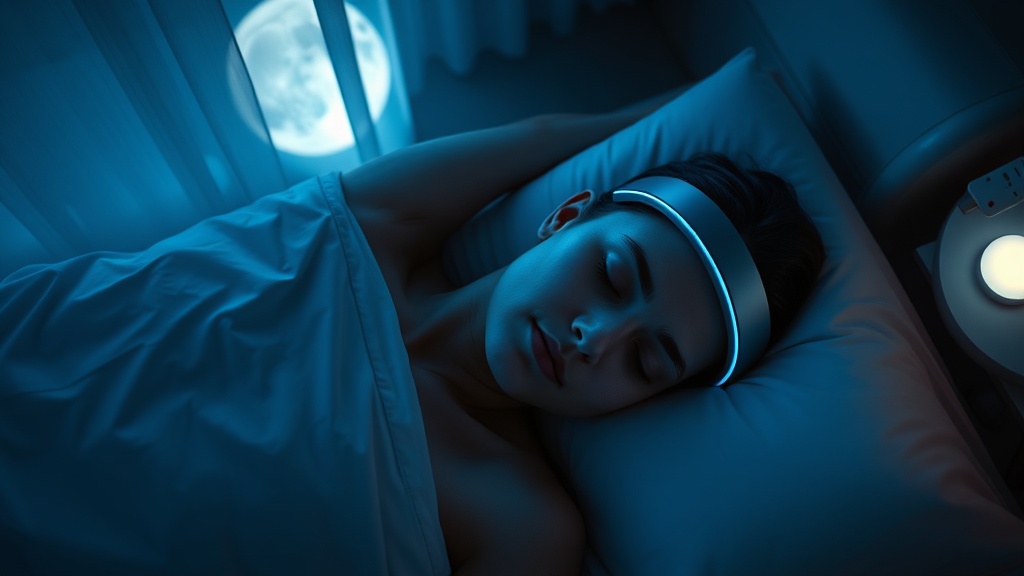
Step 5: Support glymphatic clearance mechanically. Sleep position matters — lateral (side) sleeping has been associated with more efficient glymphatic transport in preclinical models. Avoid alcohol within 4 hours of sleep; ethanol suppresses slow wave activity and disrupts spindle generation. Maintain adequate hydration but avoid excessive fluid intake that fragments sleep with nocturia.
Step 6: Track and iterate. If you use a sleep-tracking device that reports sleep staging, monitor your deep sleep percentage and, if available, spindle metrics over 2–4 week cycles. Changes in coupling are not visible on consumer devices yet, but proxy markers (deep sleep stability, morning Aβ-related blood biomarkers if available through clinical panels) can guide adjustments.
Related Video
VERDICT#
7.5/10. The core finding — that coupling predicts amyloid levels better than gross slow wave metrics — is genuinely novel and published post-2024 AI training cutoffs, making this primary-source material. The mechanistic logic connecting coupling to glymphatic clearance is strengthened by the concurrent Nature Communications trial. But the sample sizes are small (n = 47, n = 39), the design is cross-sectional for the key baseline finding, and the selective benefit in cognitively impaired individuals needs replication before anyone should build clinical protocols around it. The science is ahead of the application here. I'm watching this space closely, but I'm not rewriting my sleep protocol based on one pooled analysis — yet.
Frequently Asked Questions5
References
- 1.Author(s) not listed. Deep sleep slow wave–spindle coupling is selectively linked to plasma amyloid-β levels in older adults in clinical trials. Scientific Reports (2026). ↩
- 2.Author(s) not listed. Slow wave–spindle coupling during deep sleep is selectively linked to Plasma Amyloid-β levels in Older Adults. Research Square (Preprint) (2025). ↩
- 3.Author(s) not listed. The Alzheimer's Pathways Sleep Study (ALPS): an experimental randomized controlled trial to improve cognition and Alzheimer's pathophysiology through slow-wave sleep. Trials (2026). ↩
- 4.Author(s) not listed. The glymphatic system clears amyloid beta and tau from brain to plasma in humans. Nature Communications (2026). ↩
- 5.Dikici B, Malinowski R, Kordaß J-B, Ladenbauer J, Flöel A, Obermayer K. Polarity-dependent modulation of sleep oscillations and cortical excitability in aging. Frontiers in Aging Neuroscience (2025). ↩
- 6.Author(s) not listed. Temporal sleep spindle clustering and slow-oscillation coupling in motor memory consolidation and generalization. Communications Biology (2026). ↩
Yuki Shan
Yuki writes with measured precision but genuine intellectual frustration when the data is messy. She uses long, careful sentences for complex mechanisms, then cuts to very short ones for emphasis: 'That's the problem.' She's comfortable saying 'I'm not sure this matters clinically' even when the statistics look impressive. She'll sometimes restart a line of reasoning mid-paragraph: '— actually, I want to rephrase that.' She's suspicious of studies with small sleep cohorts and says so.
View all articles →