
Dried Blood Spot P-Tau217 Test for Alzheimer's Detection

SNIPPET: A finger-prick dried blood spot test measuring p-tau217 can now detect Alzheimer's disease pathology with an AUC of 0.864, correlating strongly (rS = 0.74) with standard venous plasma draws. Combined with new "p-tau217 clock" models that predict symptom onset within 3–3.7 years, blood-based Alzheimer's diagnostics are shifting from clinical labs to potentially self-collected home samples.
Dried Blood Spot Tests and P-Tau217 Clocks Are Rewriting Alzheimer's Diagnostics
THE PROTOHUMAN PERSPECTIVE#
Alzheimer's disease kills neurons for a decade or more before anyone notices. That's not a treatment problem — it's a detection problem. And detection, until very recently, meant either a $5,000+ PET scan or a lumbar puncture. Neither scales. Neither happens at home.
What's emerging now is something fundamentally different: a convergence of capillary blood biomarkers and predictive clock models that could transform Alzheimer's screening from a specialist-gatekept procedure into something closer to a glucose test. For those of us tracking cognitive longevity as part of healthspan optimization, this isn't incremental. The ability to estimate when symptoms will appear — not just whether pathology exists — changes the calculus on every neuroprotective intervention. If you know your timeline, you can act on it. The data here is early but directionally clear, and I think the implications for preventive neurology are hard to overstate.
THE SCIENCE#
What is a dried blood spot Alzheimer's test?#
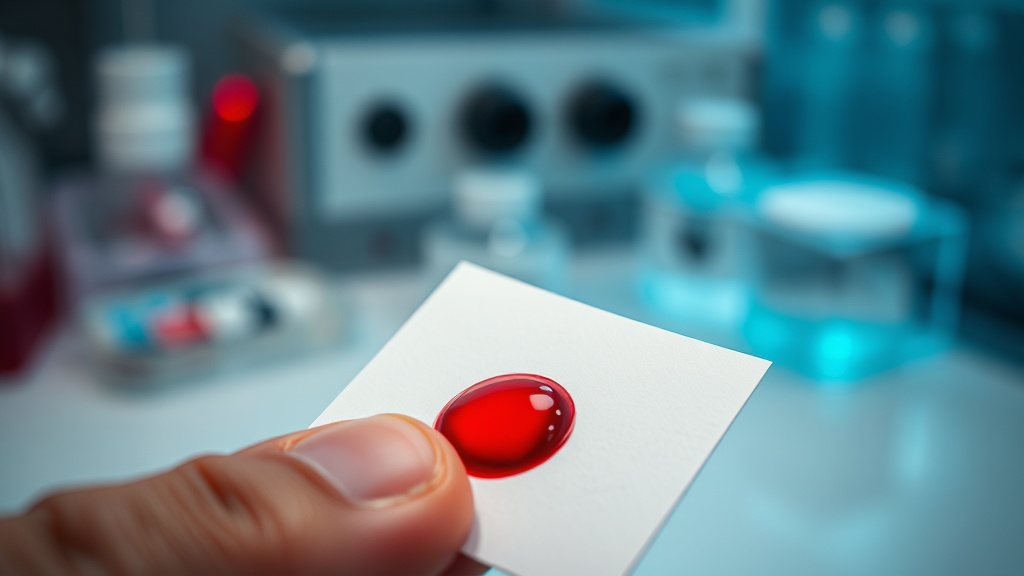
A dried blood spot (DBS) test collects capillary blood — typically from a finger prick — onto absorbent cards, which are then dried and shipped to a lab for biomarker analysis. The DROP-AD project, published in Nature Medicine in January 2026 by Huber et al., tested this approach across 337 participants at 7 centers, measuring three key biomarkers: phosphorylated tau at amino acid 217 (p-tau217), glial fibrillary acidic protein (GFAP), and neurofilament light (NfL)[1].
These aren't obscure analytes. P-tau217 is the current front-runner among blood-based Alzheimer's biomarkers — it reflects both amyloid plaque burden and tau tangle formation, which is annoyingly rare for a single marker. GFAP signals astrocytic activation (neuroinflammation, essentially), and NfL indicates neuroaxonal damage broadly.
The correlation data#
Here's where I'd normally get skeptical about a new collection method, but the numbers are reasonable. Dried plasma spot (DPS) p-tau217 correlated with venous plasma p-tau217 at rS = 0.74 (P < 0.001)[1]. That's not perfect — and anyone claiming it's equivalent to venous draws is overstating — but it's strong enough to be clinically useful for triage purposes.
More importantly, DPS p-tau217 progressively increased with disease severity and predicted CSF biomarker positivity with an AUC of 0.864[1]. For context, the field consensus from Schindler et al. sets the minimum acceptable AUC for a triage blood test at around 0.85–0.90[2]. So this lands right at the threshold — not dominant, but viable.
The study also included individuals with Down syndrome, a population with near-universal amyloid pathology by age 40 but in whom venipuncture can be genuinely difficult. The DBS method successfully detected elevated biomarkers in those with dementia versus asymptomatic individuals[1]. That's a real clinical gap being filled.
And then there's unsupervised collection. Participants self-collected blood spots at home, and concordance with supervised samples was high[1]. Which is annoying, actually, because it removes the last good excuse for not doing population-level screening.
P-tau217 clocks: predicting when, not just if#
This is the part that genuinely changes things. A separate study, also in Nature Medicine (February 2026), developed "clock models" using longitudinal plasma %p-tau217 — the ratio of phosphorylated to non-phosphorylated tau at position 217 — to estimate when cognitively normal individuals will develop Alzheimer's symptoms[3].
Using two independent cohorts (n = 258 and n = 345), the models estimated the age at p-tau217 positivity, which correlated with symptom onset age at an adjusted R² of 0.337–0.612, with a median absolute error of 3.0–3.7 years[3].
Let me be direct about what that means: from a single blood test, these models could estimate symptom onset within roughly a 3-year window. That's not perfect for individual clinical decisions — I'd want tighter precision before telling someone to restructure their life — but for clinical trial enrollment and population-level risk stratification, it's transformative.
One finding that deserves more attention: the time from p-tau217 positivity to symptom onset was markedly shorter in older individuals[3]. This implies that the preclinical window narrows with age, which has direct implications for when screening yields the most actionable information. Screen at 50, you might have a 15-year runway. Screen at 70, maybe 5. The intervention window is not fixed.
The broader biomarker landscape#
Two additional studies round out this picture. A team publishing in Nature Communications developed a biomarker-integrated prognostic staging system (Stage 0–IVB) using the K-ROAD cohort (N = 1,263), finding that the dominant prognostic biomarker shifted by clinical stage — GFAP dominated in cognitively unimpaired individuals, hippocampal volume in MCI, and age in dementia — while p-tau217 provided consistent secondary prognostic value throughout[4].
Meanwhile, a structural proteomics approach in Nature Aging profiled plasma protein conformational changes in 520 participants, developing a three-marker panel (C1QA, CLUS, ApoB) that achieved 83.44% accuracy in three-way classification (healthy vs. MCI vs. AD) and AUROCs above 0.93 for binary classification[5]. This is a genuinely different approach — looking at protein shape rather than quantity — and I'm less convinced it'll scale to point-of-care testing, but the biology is interesting.
Diagnostic Accuracy of Emerging Blood-Based AD Tests
COMPARISON TABLE#
| Method | Mechanism | Evidence Level | Estimated Cost | Accessibility |
|---|---|---|---|---|
| DBS/DPS p-tau217 (finger prick) | Capillary blood on dried spot card; immunoassay for p-tau217 | Multi-center validation (n=337); AUC 0.864 [1] | Low (est. $50–150) | Home self-collection feasible |
| Venous plasma p-tau217 | Standard venipuncture; Lumipulse/Elecsys immunoassay | Large-scale validation; AUC ~0.92–0.96 [2] | Moderate ($150–400) | Requires phlebotomy, clinical lab |
| Amyloid PET scan | Radiotracer imaging of brain amyloid plaques | Gold standard; highest accuracy | High ($3,000–6,000+) | Specialized imaging centers only |
| CSF Aβ42/p-tau | Lumbar puncture; immunoassay panel | Well-established; high accuracy | Moderate-high ($500–1,500) | Invasive; requires trained clinician |
| Structural proteomics panel | Mass spectrometry of protein conformational changes | Single-cohort (n=520); AUROC 0.93 [5] | Unknown (research stage) | Research labs only |
| RNA biomarker panel | Whole blood RNA sequencing; 4-mRNA panel | Small cohort (n=100); PPV >90% | Unknown (research stage) | Requires RNA sequencing infrastructure |
THE PROTOCOL#
How to approach Alzheimer's biomarker screening based on current evidence:
Step 1: Establish your baseline risk profile. Know your APOE status. APOE ε4 carriers have 3–12x increased risk depending on zygosity. If you haven't done genetic testing, a consumer genomics panel or clinical APOE test is the starting point. This determines urgency, not destiny.
Step 2: Request a plasma p-tau217 test from your physician. The commercially available Lumipulse p-tau217 assay (Ashton & Brum, JAMA Neurology, 2024) is the current clinical standard[2]. Discuss with your clinician whether this is appropriate given your age and risk factors. Most guidelines suggest considering screening from age 50+ for high-risk individuals.
Step 3: Track, don't snapshot. A single p-tau217 value tells you about current amyloid status. But the clock model data from 2026 suggests that longitudinal %p-tau217 measurements — the trajectory — may predict symptom timing[3]. If your first test is positive, plan for repeat testing at 12–18 month intervals to establish your rate of change.
Step 4: Layer additional biomarkers for staging. Based on the K-ROAD prognostic framework, GFAP may be particularly informative for cognitively unimpaired individuals[4]. If your p-tau217 is borderline or positive, adding GFAP and NfL to your panel provides a more complete picture of neuroinflammation and neurodegeneration status.

Step 5: Act on the data with neuroprotective strategies. If biomarkers indicate preclinical AD pathology, current evidence supports aggressive modifiable risk factor management: cardiovascular exercise (150+ min/week), sleep optimization targeting 7–8 hours with consolidated architecture, Mediterranean-MIND dietary patterns, and cognitive engagement. Pharmacological options (lecanemab, donanemab) are currently approved for early symptomatic AD — not preclinical — but trials in preclinical populations are underway.
Step 6: Watch for DBS home collection availability. The DROP-AD data validates unsupervised self-collection[1]. Once commercial assays integrate dried blood spot formats — which I'd estimate is 2–4 years out — home-based longitudinal monitoring becomes realistic. This is where the field is heading.
Related Video
What is p-tau217 and why does it matter for Alzheimer's detection?#
P-tau217 is a form of tau protein phosphorylated at amino acid position 217. It's currently the most accurate single blood biomarker for Alzheimer's disease because it reflects both amyloid plaque accumulation and early tau pathology simultaneously. Multiple large-scale studies have validated its diagnostic performance with AUROCs exceeding 0.90 for detecting amyloid positivity via standard venous blood draws[2].
How accurate is a finger-prick test compared to a standard blood draw?#
The DROP-AD study found a correlation of rS = 0.74 between dried plasma spot p-tau217 and venous plasma p-tau217, with an AUC of 0.864 for predicting CSF biomarker positivity[1]. This is good enough for screening and triage purposes but not yet a direct replacement for venous testing in clinical diagnosis. Think of it as a first-pass filter, not a definitive answer.
When should someone consider getting an Alzheimer's blood biomarker test?#
There's no universal consensus yet, but based on the emerging data, individuals with APOE ε4 carrier status, family history of early-onset AD, or subjective cognitive concerns should discuss testing with their physician starting around age 50. The p-tau217 clock data suggests that earlier testing provides a longer actionable window — the gap between biomarker positivity and symptom onset narrows significantly with age[3].
Why can't the p-tau217 clock model give an exact year of symptom onset?#
The median absolute error of 3.0–3.7 years reflects real biological variability — cognitive reserve, comorbidities, lifestyle factors, and genetic modifiers all influence when pathology translates to symptoms[3]. The model captures the central tendency well (R² up to 0.612) but individual trajectories diverge. Honestly, a 3-year margin is impressive for a blood test predicting a process that unfolds over decades.
How does the dried blood spot approach help underserved populations?#
Standard Alzheimer's diagnostics require specialized clinics — PET scanners, lumbar puncture facilities, phlebotomy services. Dried blood spots can be self-collected at home, mailed to a lab, and analyzed without cold-chain logistics[1]. This potentially opens screening to rural communities, low-resource settings, and populations like individuals with Down syndrome for whom venipuncture is particularly challenging.
VERDICT#
Score: 8/10
The convergence of validated dried blood spot collection, high-performing p-tau217 assays, and predictive clock models represents a genuine shift in Alzheimer's diagnostics — not hype. The DBS data lands right at the minimum acceptable performance threshold, which is honest rather than spectacular. The clock models are the more exciting development, but they need replication in more diverse populations before I'd trust them for individual clinical decisions. What I find most compelling is the practical trajectory: self-collection at home, mailed to a lab, results that tell you not just if but roughly when. That's a fundamentally different proposition than anything available even two years ago. The main limitation is that we're still in research-grade territory — commercial DBS assays aren't here yet, and the clock models used specific immunoassay platforms. But the direction is unambiguous, and for the biohacking-adjacent crowd already tracking blood biomarkers, p-tau217 should be on the panel.
References
- 1.Huber H et al.. A minimally invasive dried blood spot biomarker test for the detection of Alzheimer's disease pathology. Nature Medicine (2026). ↩
- 2.Ashton NJ, Brum WB. Diagnostic accuracy of a plasma phosphorylated tau 217 immunoassay for Alzheimer disease pathology. JAMA Neurology (2024). ↩
- 3.Author(s) not listed. Predicting onset of symptomatic Alzheimer's disease with plasma p-tau217 clocks. Nature Medicine (2026). ↩
- 4.Author(s) not listed. Biomarker-integrated prognostic stagings for Alzheimer's Disease. Nature Communications (2026). ↩
- 5.Author(s) not listed. Structural signature of plasma proteins classifies the status of Alzheimer's disease. Nature Aging (2026). ↩
Saya Kimm
Saya is analytical, methodical, and subtly contrarian about popular biomarker interpretations. She'll specifically challenge what readers think they know: 'Testosterone doesn't tell you what most people think it tells you at a single timepoint.' She writes with a researcher's caution about causation vs. correlation — but instead of hiding behind it, she turns it into an insight.
View all articles →