Home-Based LLLT for Low Back Pain: RCT Shows No Benefit Over Sham

SNIPPET: A 2026 double-blind RCT (n=30) testing a multi-wavelength home LLLT device for chronic low back pain found both laser and sham groups improved equally on pain scores, with no statistically significant between-group differences on any outcome measure. The sham group actually outperformed on disability and quality-of-life metrics. The device appears safe but unproven.
THE PROTOHUMAN PERSPECTIVE#
Low back pain is the single largest contributor to disability worldwide, and the photobiomodulation community has been promising relief for years. The appeal is obvious: a portable, non-pharmacological device you use at home, no appointments, no NSAIDs grinding down your gut lining. But appeal is not evidence.
This trial matters because it tested exactly the scenario biohackers want — unsupervised, home-based, multi-wavelength laser therapy — and the result was a clean null. Both groups got better. The laser group did not get more better. That's the kind of finding that should make anyone reaching for a consumer PBM device pause and ask harder questions about dosimetry, tissue penetration, and whether the parameters being sold to you have ever been validated against sham in a controlled setting.
I'm not saying LLLT doesn't work for pain. I'm saying this device, at these parameters, for this condition didn't separate from placebo. Wavelength matters. Irradiance matters. And this trial just showed us what happens when the numbers don't add up.
THE SCIENCE#
What Is Home-Based Low-Level Laser Therapy?#
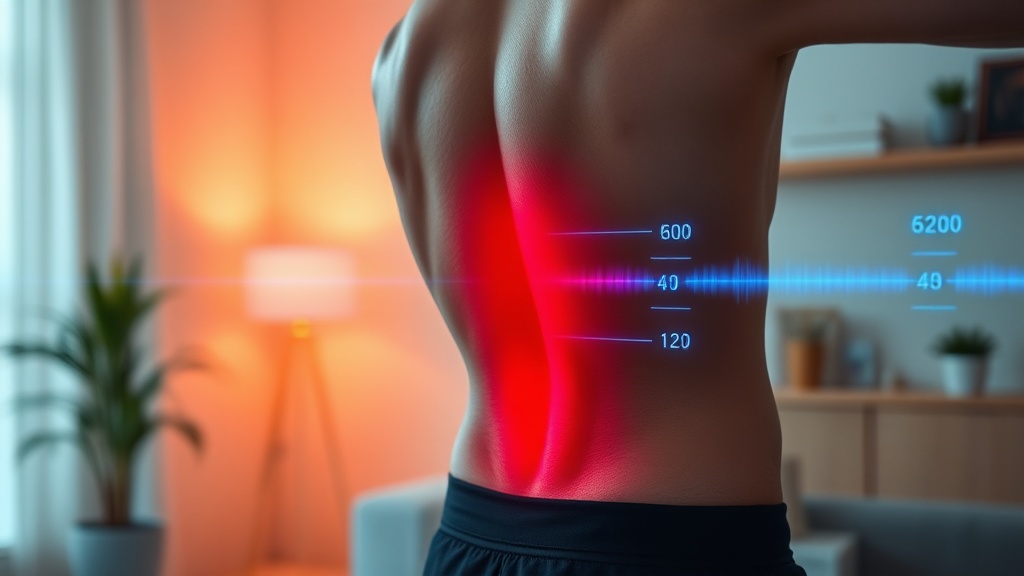
Home-based low-level laser therapy (LLLT) is the application of low-power coherent light — typically in the red to near-infrared spectrum (600–1000 nm) — to biological tissue, delivered via portable consumer or medical-grade devices without clinical supervision. It aims to modulate cellular metabolism, primarily through photon absorption by cytochrome c oxidase in the mitochondrial electron transport chain, theoretically enhancing ATP synthesis and reducing oxidative stress at the treatment site[1]. For chronic low back pain sufferers, the promise is reduced inflammation, improved local microcirculation, and analgesic effects — all without leaving your house.
The problem? Most consumer devices operate at power outputs so low that meaningful energy delivery to deep paraspinal tissues is questionable at best.
The 2026 Home LLLT Trial: Parameters and Design#
The study published in Lasers in Medical Science by researchers in Korea enrolled 30 patients with chronic low back pain into a prospective, randomized, sham-controlled trial[1]. The device — branded CareRay™ — used 110 vertical-cavity surface-emitting laser (VCSEL) diodes across four wavelengths:
- 55 units at 670 nm (1 mW each)
- 25 units at 780 nm (2 mW each)
- 10 units at 830 nm (15 mW each)
- 20 units at 910 nm (5 mW each)
Spot size: 0.16 cm². Treatment protocol: 20 minutes per session, 5 days per week, 3 weeks (15 total sessions). The sham device was identical in appearance and emitted a red light but produced no laser output[1].
Let me be direct about the power here. The total output across all 110 diodes sums to roughly 355 mW. Spread across the treatment area, and factoring in the tiny 0.16 cm² spot size per diode, the irradiance per point is modest. For deep tissue targets like the lumbar paraspinal muscles or facet joints, you need photons reaching 3–5 cm depth. At 670 nm, tissue penetration is shallow. The 830 nm and 910 nm diodes have better penetration profiles, but there are only 30 of them, delivering 250 mW combined. I'd want to see the actual energy density at target depth calculated, and it wasn't reported.
Results: The Sham Matched the Laser#
Here's where it gets uncomfortable for LLLT advocates.
Both groups improved significantly on VAS pain scores. The laser group dropped from 4.38 ± 1.19 to 3.25 ± 1.04 (Δ1.13, p = 0.026). The sham group dropped from 4.00 ± 0.53 to 2.88 ± 0.83 (Δ1.13, p = 0.024)[1]. Identical magnitude of change. Both reached statistical significance within their own groups. But the between-group comparison showed zero significant differences across all outcome measures.
Schober's test for lumbar flexibility improved in both groups (laser: p = 0.007; sham: p = 0.002). On the Oswestry Disability Index and SF-36 quality-of-life survey, both groups improved — but only the sham group reached statistical significance on those measures[1].
Read that again. The sham group showed significant disability and quality-of-life improvements. The laser group did not.
No adverse events were reported in either group, which is expected at these power levels. You're not going to hurt anyone with 355 mW spread across 110 diodes. But you might not be helping them either.
Why Didn't It Work? Dosimetry Problems#
I'm not surprised by this result, and here's why. The World Association for Photobiomodulation Therapy has emphasized repeatedly that inadequate dosing is the most common reason LLLT trials fail. A device can have the right wavelengths and still deliver insufficient energy density to the target tissue.
The 670 nm diodes — which constitute half the array — penetrate poorly through skin and subcutaneous fat. Lumbar tissue is covered by some of the thickest soft tissue on the body. The higher-wavelength diodes (830 nm, 910 nm) penetrate deeper but are fewer in number and lower in total output. Without reporting joules per cm² at target depth, we're essentially guessing whether therapeutic photon density was achieved.
Context: When Laser Therapy Does Separate From Sham#
Not all laser therapy trials produce null results. Hong et al. (2026) conducted a larger RCT (n=106) testing 650 nm invasive laser acupuncture for chronic low back pain and found the treatment group was approximately 36% more likely to respond than controls, with an odds ratio of 4.69[2]. The critical difference: invasive delivery (fiber-optic insertion to acupuncture points) bypasses the tissue penetration problem entirely.
Labanca et al. (2024) tested Multiwave Locked System (MLS) laser therapy — which uses synchronized pulsed emissions at higher peak powers — in 45 patients with chronic non-specific low back pain in a double-blind sham-controlled design[3]. While full results require journal access, the MLS approach uses peak powers orders of magnitude higher than continuous-wave LLLT, which addresses the depth-of-penetration issue through a different mechanism.
The pattern is consistent with what I've seen across the PBM literature for years: when the photon dose at target tissue is adequate, you see effects. When it isn't, you see placebo.
VAS Pain Score Changes: Laser vs. Sham (Home LLLT Trial)
COMPARISON TABLE#
| Method | Mechanism | Evidence Level | Estimated Cost | Accessibility |
|---|---|---|---|---|
| Home LLLT (CareRay™ multi-wavelength VCSEL) | Photobiomodulation via cytochrome c oxidase absorption; 670–910 nm | Single small RCT (n=30); no between-group significance vs. sham | $200–$600 (consumer device estimate) | High — fully home-based, no supervision |
| 650 nm Invasive Laser Acupuncture | Fiber-optic laser delivery to acupuncture points; bypasses tissue penetration limits | RCT (n=106); OR 4.69 favoring treatment[2] | $50–$150 per session (clinical setting) | Low — requires trained practitioner |
| MLS Laser Therapy (clinic-based) | Synchronized dual-wavelength pulsed laser; higher peak power | RCT (n=45); double-blind sham-controlled[3] | $75–$200 per session | Low — clinical equipment only |
| NSAIDs (Ibuprofen/Naproxen) | COX-1/COX-2 inhibition; prostaglandin reduction | Extensive meta-analyses; well-established efficacy | $5–$20/month | Very high — OTC |
| Structured Exercise Therapy | Mechanical loading, neuromuscular adaptation, endorphin release | Strong systematic review evidence; first-line recommendation | Free to low cost | Very high — self-directed |
THE PROTOCOL#
If you still want to experiment with home-based LLLT for low back pain — and I understand the appeal — here's how to approach it without fooling yourself.
Step 1: Select a device with documented irradiance specifications, not just wavelength claims. You need to know the power density (mW/cm²) at the treatment surface, and ideally the manufacturer should provide estimated fluence at depth. Devices using 800–860 nm as the primary wavelength will penetrate lumbar tissue better than 670 nm dominant arrays.
Step 2: Target energy density of 4–8 J/cm² at the skin surface for superficial musculature, understanding that deep lumbar structures may require significantly higher surface doses (up to 20–50 J/cm² surface irradiance) to achieve therapeutic photon density at 3–5 cm depth. Calculate your treatment time: Energy (J) = Power (W) × Time (seconds).
Step 3: Apply the device directly to clean, dry skin over the painful area. No clothing, no lotions, no sunscreen — these absorb and scatter photons before they reach tissue. Maintain firm contact to minimize the air gap.
Step 4: Treat for 15–30 minutes per session, based on your calculated energy density needs. The trial used 20 minutes at modest power, which may have been insufficient. If your device outputs higher power density, adjust time downward accordingly.
Step 5: Maintain a daily pain log using a 0–10 VAS scale before and after each session, plus a weekly Oswestry Disability Index score. Without objective tracking, you will not be able to distinguish real improvement from placebo response — and as this trial demonstrates, placebo response in low back pain is substantial.
Step 6: Run your personal trial for a minimum of 3 weeks (15 sessions), consistent with the study protocol. If you see no measurable improvement in your tracked metrics after this period, the device is likely not delivering adequate dosimetry for your anatomy.
Step 7: Do not abandon evidence-based first-line treatments (structured exercise, physical therapy) in favor of LLLT. Based on current evidence, LLLT for low back pain should be considered adjunctive at best, not a replacement for movement-based rehabilitation.
Related Video
What is low-level laser therapy for low back pain?#
Low-level laser therapy (LLLT), also called photobiomodulation, applies low-power laser light (typically 600–1000 nm wavelength) to tissue with the goal of reducing pain and inflammation. The proposed mechanism involves photon absorption by mitochondrial cytochrome c oxidase, which may enhance ATP production and modulate inflammatory signaling. For low back pain, it's been studied both in clinical and home-based settings with mixed results.
Why did the sham group improve as much as the laser group?#
Placebo response in chronic low back pain trials is notoriously strong — the ritual of daily self-treatment, the expectation of improvement, and natural symptom fluctuation all contribute. The sham device emitted visible red light, which may have reinforced the belief that treatment was occurring. Additionally, the laser device's parameters may have delivered insufficient energy to deep lumbar tissues, making it functionally equivalent to sham at the target site[1].
How does invasive laser acupuncture differ from surface LLLT?#
Invasive laser acupuncture delivers photons directly to deep tissue via fiber-optic needles inserted at specific acupuncture points, completely bypassing the skin and subcutaneous fat that attenuate surface-applied light. Hong et al. found an odds ratio of 4.69 favoring this approach over sham in 106 patients with chronic low back pain[2]. The trade-off is that it requires a trained practitioner and clinical setting.
What wavelength is best for treating deep tissue pain?#
Near-infrared wavelengths between 800 and 950 nm penetrate tissue most effectively, reaching depths of 3–5 cm depending on tissue composition. Shorter wavelengths like 670 nm are largely absorbed in the first 1–2 cm. For lumbar spine targets covered by thick muscle and adipose tissue, I'd prioritize 830–910 nm diodes with adequate power output over multi-wavelength arrays dominated by visible red.
When will we have definitive evidence on home LLLT for back pain?#
Honestly, we're not close. The existing trials are small (n=30–45), use heterogeneous parameters, and most fail to report energy density at target depth. What we need are multi-center RCTs with standardized dosimetry, adequate sample sizes (n>100), and long-term follow-up. Until then, the evidence remains preliminary and inconsistent.
VERDICT#
Score: 4/10
The trial was well-designed for what it was — double-blind, sham-controlled, reasonable outcome measures. I give it credit for that. But the result is unambiguous: this home LLLT device did not outperform sham on a single outcome measure. The sample was tiny (n=30), the dosimetry was likely inadequate for deep lumbar tissue, and the sham group actually showed stronger improvements on disability and quality-of-life metrics. This doesn't kill home-based PBM as a concept, but it kills the idea that you can throw a low-power multi-wavelength array at your back and expect meaningful analgesic effects. I'd want to see this repeated with a device delivering substantially higher irradiance at 830+ nm before writing off the modality — but I'd also want to see the LLLT field stop publishing underpowered trials that perpetuate ambiguity.
References
- 1.Author(s) not listed. Efficacy of home-based low-level laser therapy in patients with low back pain: a double-blinded randomized controlled trial. Lasers in Medical Science (2026). ↩
- 2.Hong Y, Nam D, Yang C, Kang BK, Kim AR, Shin KM, Kim J, Jeon S, Park GC, Kim JH. Efficacy and safety of 650 nm invasive laser acupuncture on non-specific chronic low back pain: a randomized clinical trial. Frontiers in Medicine (2025). ↩
- 3.Labanca L, Berti L, Tedeschi R, D'Auria L, Platano D, Benedetti MG. Effects of MLS Laser on pain, function, and disability in chronic non-specific low back pain: A double-blind placebo randomized-controlled trial. Journal of Back and Musculoskeletal Rehabilitation (2024). ↩
Sova Reld
Sova writes with focused intensity and low tolerance for vague claims. She came to photobiomodulation through personal experimentation and is irritated by both true believers and reflexive skeptics. Her writing has edge: 'The wellness market has done more damage to this field than the skeptics ever could.' She's extremely precise about parameters — wavelength, irradiance, duration — and will tell you when a study used inadequate dosing without apology.
View all articles →