NMN Supplementation for Exercise Tolerance: New Trial Data

THE PROTOHUMAN PERSPECTIVE#
The decline in NAD+ with age isn't just a biochemical footnote — it's one of the central bottlenecks in human physical performance after 50. Mitochondrial efficiency drops, ATP output falters, and suddenly the body you trained for decades starts betraying you during a flight of stairs. NMN has been the longevity community's darling for years, but most of the excitement has run ahead of the evidence. What's changed is that we now have a properly designed crossover trial (NCT07144527) recruiting older adults specifically to measure exercise tolerance — not just blood NAD+ levels, not just mouse treadmill times, but actual human time-to-fatigue on a cycle ergometer. That's the kind of endpoint that matters. Meanwhile, a February 2026 RCT in Scientific Reports adds a strange but interesting wrinkle: NMN alone didn't significantly improve interoception after exhaustive exercise, but PQQ did. The picture is getting more nuanced, which is exactly what we need before anyone starts prescribing grams of this stuff daily.
THE SCIENCE#
What NMN Actually Does at the Cellular Level#
Nicotinamide mononucleotide is a direct precursor to nicotinamide adenine dinucleotide (NAD+), a coenzyme involved in over 500 enzymatic reactions — from mitochondrial electron transport to sirtuin-mediated DNA repair and autophagy pathway regulation. NAD+ levels decline roughly 50% between age 40 and 60 in key tissues, and this decline tracks closely with reduced mitochondrial membrane potential, impaired oxidative phosphorylation, and decreased exercise capacity [4].
The logic is straightforward: supplement the precursor, boost NAD+ synthesis, restore mitochondrial efficiency. And in principle, it works. An 8-week open-label trial at Keio University confirmed that 250 mg/day of NMN increased NAD+ levels in peripheral blood mononuclear cells in healthy middle-aged Japanese men, while also modestly attenuating postprandial hyperinsulinemia in a subset of participants with insulin oversecretion [4].
But — and this is where I get impatient with the NMN marketing machine — that was an 11-person, single-arm, open-label study. No placebo. No blinding. The NAD+ increase is real, but the clinical significance of that increase for actual physical performance? Still an open question.
The NCT07144527 Trial: Finally, a Proper Exercise Endpoint#
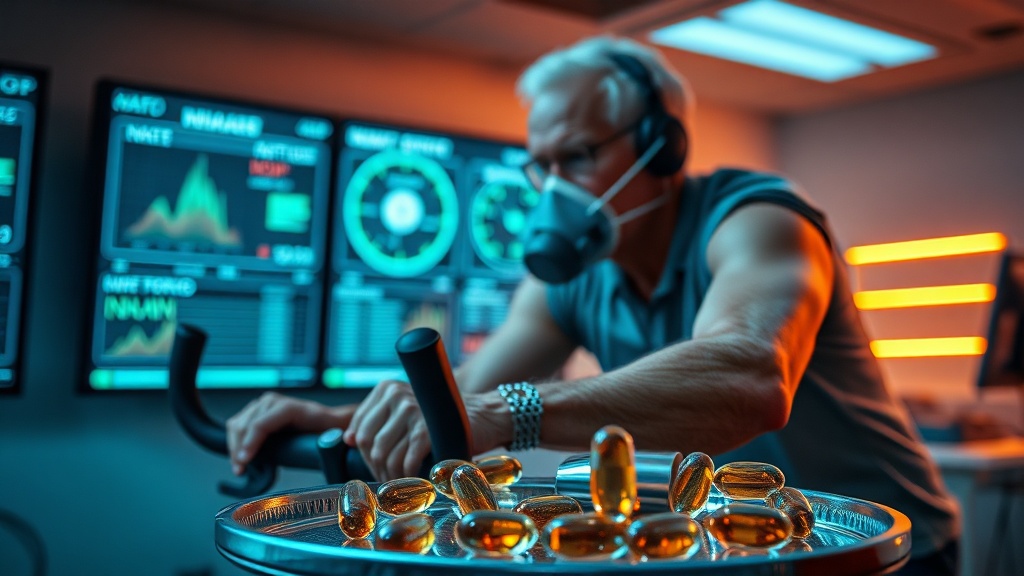
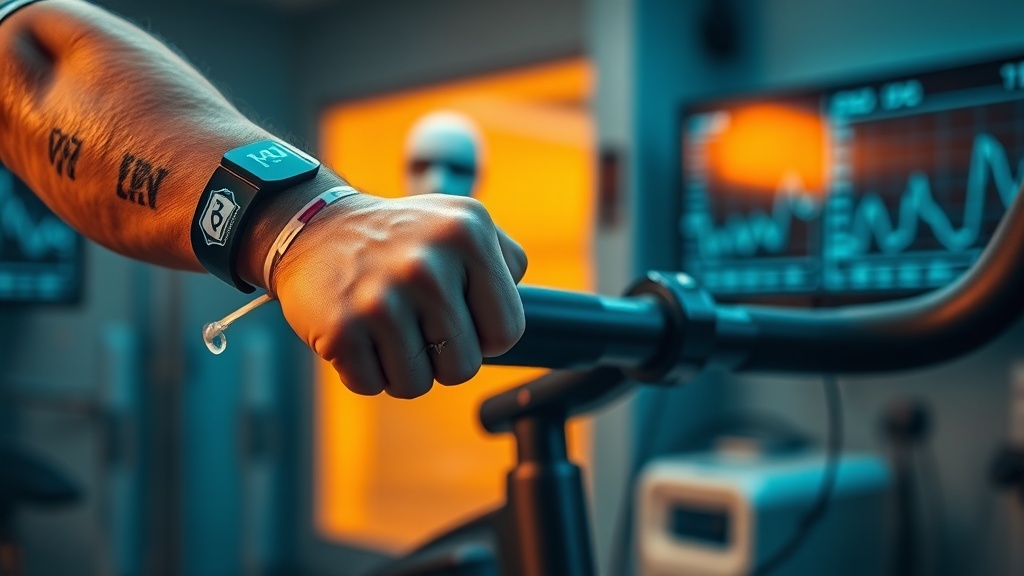
This is the trial I've been waiting for. NCT07144527 is a randomized, double-blind, placebo-controlled, two-arm crossover trial recruiting adults aged 60–80. It compares a proprietary formulation called EGA® — which contains 1,000 mg NMN plus two other undisclosed endogenous metabolomic compounds — against conventional NMN at the same dose (1,000 mg twice daily) [1].
The primary endpoint is constant work rate cycle ergometry time to fatigue (CWR-Tlim). Secondary endpoints include VO₂peak, critical power, anaerobic work capacity, lactate threshold, and circulating NAD+ metabolite levels [1].
This matters because time-to-fatigue is a functional outcome. It's not a biomarker surrogate. It's not a mouse running on a wheel. It's a 68-year-old pedaling until they physically cannot continue. That's the kind of data that moves the needle.
Look, the EGA® angle introduces a complication. This is a proprietary formulation, which means we can't fully evaluate the mechanism unless we know what those other two compounds are. The trial sponsor (Scott Silveira) isn't an academic institution. I'd want to see independent replication before getting too excited. But the trial design itself — crossover, double-blind, placebo-controlled — is solid.
The PQQ + NMN Interoception Study: Where NMN Falls Short#
Here's where it gets complicated. A February 2026 randomized, double-blind, placebo-controlled study published in Scientific Reports tested four groups: placebo, PQQ alone (20 mg), NMN alone (300 mg), and PQQ + NMN combined. Sixty participants completed the Bruce treadmill test after a single dose taken 60 minutes pre-exercise [2].
The headline finding? PQQ — not NMN — was the supplement that significantly improved interoceptive body listening after exhaustive exercise (group × time interaction p = 0.016). The NMN group? No significant group × time interaction on any interoception domain. The combined PQQ + NMN group actually maintained stable scores rather than improving — which the authors interpret cautiously but which, frankly, is a bit of a letdown [2].
Wait, let me be more precise here. This study wasn't measuring exercise performance directly. It was measuring interoception — the ability to perceive and interpret internal bodily signals post-exercise. That's relevant for athletic decision-making and recovery perception, but it's not VO₂max. Still, the fact that 300 mg NMN didn't move the needle on any interoceptive domain in a properly controlled trial should temper expectations about single acute doses.
Mouse Data: Synergy with Exercise#
Hsu et al. (2025) in Nutrients provide the strongest mechanistic case for NMN's exercise benefits — in mice. Aged C57BL/6J mice (85 weeks) receiving 300 mg/kg/day NMN combined with aerobic exercise showed improved aerobic performance, glucose regulation, and systemic energy metabolism compared to exercise alone or NMN alone [3].
The combination group showed the most pronounced effects on the NAD+ salvage pathway via NAMPT upregulation, suggesting that exercise may potentiate NMN's bioavailability or cellular uptake. The synergy finding is mechanistically compelling, but I've seen too many mouse longevity results fail to translate to humans. The dose of 300 mg/kg/day in a mouse doesn't scale linearly to humans — the human equivalent would be roughly 1,460 mg/day for a 60 kg person, which interestingly is in the ballpark of the NCT07144527 protocol (2,000 mg/day).
Interoception Body Listening Scores by Supplement Group (Post-Exercise)
COMPARISON TABLE#
| Method | Mechanism | Evidence Level | Cost (Monthly) | Accessibility |
|---|---|---|---|---|
| NMN (conventional, 250–500 mg/day) | NAD+ precursor via NAMPT salvage pathway | Small human trials, mouse data | $40–$80 | OTC supplement, widely available |
| NMN (high-dose, 1,000–2,000 mg/day) | Same pathway, higher substrate loading | Active RCT (NCT07144527), no published results yet | $100–$200+ | OTC, but cost-prohibitive for many |
| EGA® (NMN + proprietary compounds) | NAD+ modulation + undisclosed synergists | Active RCT, no published results | Unknown (not commercially available) | Clinical trial only |
| NR (Nicotinamide Riboside) | NAD+ precursor via NRK pathway | Multiple human RCTs, mixed exercise results | $40–$70 | OTC (Tru Niagen, etc.) |
| PQQ (20 mg) | Mitochondrial biogenesis, antioxidant | One RCT for interoception; limited exercise data | $15–$30 | OTC supplement |
| Aerobic Exercise Alone | NAMPT upregulation, mitochondrial biogenesis, AMPK activation | Extensive RCT evidence | Free | Universal |
THE PROTOCOL#
Based on the available evidence — and I want to stress that optimal human dosing is not yet established — here's a reasonable framework for those who want to trial NMN for exercise performance:
1. Start with a conservative dose of 250–500 mg NMN daily for 2 weeks. Take it in the morning before breakfast, consistent with the Keio University protocol that confirmed NAD+ elevation at this dose range [4]. Monitor for any GI discomfort or flushing.
2. If well-tolerated, consider escalating to 500–1,000 mg daily. The NCT07144527 trial uses 1,000 mg twice daily, but that's a clinical research dose. For self-experimenters, 500–1,000 mg total daily is more prudent until we see results from that trial.
3. Pair NMN supplementation with structured aerobic exercise (3–5 sessions per week, 30–45 minutes at moderate intensity). The Hsu et al. mouse data strongly suggests that exercise potentiates NMN's metabolic benefits via NAMPT upregulation — NMN without exercise may be leaving significant value on the table [3].
4. Consider adding PQQ at 20 mg daily if interoceptive awareness and recovery perception are priorities. The February 2026 Scientific Reports trial showed significant improvements in body listening with PQQ, not NMN, suggesting complementary mechanisms [2].

5. Track biomarkers if possible. Ideal markers include fasting insulin, HbA1c, resting HRV (as a proxy for autonomic function), and, if accessible through a longevity clinic, NAD+ metabolite panels. Time-to-fatigue on a standardized exercise test is the gold standard functional measure.
6. Reassess at 8 weeks. The Keio University trial used an 8-week protocol and saw NAD+ elevation within that window [4]. If no subjective or objective improvement is noted, continuing at the same dose is unlikely to yield different results.
7. Do not combine with high-dose niacin or nicotinamide. These share metabolic pathways and excessive nicotinamide can actually inhibit sirtuins — the very enzymes NMN is supposed to activate. Keep it clean.
Related Video
What is the optimal NMN dose for improving exercise performance?#
Optimal dosing in humans has not been established. The most rigorous ongoing trial (NCT07144527) uses 1,000 mg twice daily in adults aged 60–80, while the Keio University study showed NAD+ elevation at just 250 mg daily. For self-experimenters, 500–1,000 mg daily appears to be the most commonly used range, but we're still waiting on dose-response data from controlled trials.
How does NMN differ from NR (nicotinamide riboside) for exercise?#
Both are NAD+ precursors, but they enter the salvage pathway through different enzymatic steps — NMN via NMNAT, NR via NRK then NMNAT. In practice, NR has more published human trial data but mixed results for exercise outcomes specifically. NMN may have a pharmacokinetic advantage for tissue-level NAD+ repletion, but head-to-head human exercise trials comparing the two don't yet exist.
Why did NMN fail to improve interoception in the 2026 study while PQQ succeeded?#
The honest answer is we don't fully know. One possibility is that a single 300 mg acute dose of NMN is insufficient to meaningfully alter NAD+ levels within 60 minutes — NAD+ synthesis requires time. PQQ's mechanism is distinct: it promotes mitochondrial biogenesis and acts as a potent antioxidant, which may more directly protect neural interoceptive pathways from exercise-induced oxidative stress [2].
When should NMN be taken relative to exercise?#
Current evidence suggests taking NMN in the morning, ideally 60+ minutes before exercise. The Scientific Reports study used a 60-minute pre-exercise window. Chronic daily dosing (as in the Keio protocol) likely matters more than acute timing, but morning administration aligns with circadian NAD+ metabolism.
Who should avoid NMN supplementation?#
Individuals on medications metabolized through NAD+-dependent pathways should consult a physician. Those with active cancers should exercise caution — NAD+ fuels cellular proliferation in both healthy and malignant cells. Pregnant or breastfeeding individuals lack any safety data. And anyone expecting a miracle from a supplement alone should recalibrate: the mouse data consistently shows exercise is the primary driver, with NMN as a potentiator.
VERDICT#
Score: 6.5/10
Look, NMN is the most promising NAD+ precursor we have for exercise performance in aging adults — but the emphasis has to land on "promising," not "proven." The Keio study confirms NAD+ elevation is real. The Hsu et al. mouse data confirms exercise synergy is real. The NCT07144527 trial design is exactly what this field needs. But we don't have results yet. And the 2026 interoception trial is a useful reality check: a single 300 mg dose of NMN didn't outperform placebo on any measured domain. I'm cautiously optimistic, but I'd score this higher once we see the crossover trial data published. For now, exercise remains the undisputed king, and NMN is a plausible adjunct — not a replacement.
References
- 1.Silveira S. Nicotinamide Mononucleotide Supplementation for Exercise Tolerance Improvement in Healthy Older Adults. ClinicalTrials.gov (2025). ↩
- 2.Author(s) not listed. The effects of pyrroloquinoline quinone and nicotinamide mononucleotide supplementation on interoception following acute exhaustive exercise: a randomised, double-blind, placebo-controlled study. Scientific Reports (2026). ↩
- 3.Hsu YJ, Lee MC. Effects of Nicotinamide Mononucleotide Supplementation and Aerobic Exercise on Metabolic Health and Physical Performance in Aged Mice. Nutrients (2025). ↩
- 4.Itoh H. Safety and efficacy of long-term nicotinamide mononucleotide supplementation on metabolism, sleep, and nicotinamide adenine dinucleotide biosynthesis in healthy, middle-aged Japanese men. Endocrine Journal (2024). ↩
Nael Voss
Nael is data-obsessed and slightly impatient with over-hyped claims. He's tested most of what he covers personally, which means he occasionally contradicts the research when his n=1 doesn't match. His writing moves fast, sometimes too fast — he'll drop a complex mechanism in one sentence and move on. He has a specific verbal tic: 'Look,' when he's about to say something the reader might not want to hear. He's sardonic about supplement marketing but genuinely excited about good mechanistic data.
View all articles →