P-Tau217 Blood Test for Alzheimer's: Accuracy, Protocol, Limits

SNIPPET: Plasma phosphorylated tau 217 (p-tau217) now achieves diagnostic accuracy of 0.955 AUC for Alzheimer's disease classification — approaching cerebrospinal fluid and PET scan performance. A joint Italian position paper from SIN, SIBioC, and SINdem establishes standardized protocols for clinical adoption, though kidney dysfunction remains a significant confounder requiring creatinine-based correction.
THE PROTOHUMAN PERSPECTIVE#
A blood draw instead of a spinal tap. That's the promise — and it's closer to clinical reality than most people realize.
For anyone tracking cognitive performance, neurodegeneration risk, or family history of Alzheimer's, the shift from cerebrospinal fluid (CSF) sampling and expensive PET imaging toward a simple plasma test represents something genuinely significant. Not because blood biomarkers are new — they aren't — but because the validation infrastructure is finally catching up to the science. The Italian joint position paper published in March 2026 is one of the first national-level consensus documents that lays out exactly how to collect, process, store, and interpret these plasma markers in clinical practice.
This matters for the longevity-focused community because early detection of amyloid and tau pathology — years before symptoms emerge — is the window where interventions (pharmacological, lifestyle, or otherwise) have the highest probability of altering disease trajectory. If you're optimizing for healthspan, understanding when and how to access these biomarkers is no longer optional knowledge. It's infrastructure.
THE SCIENCE#
What Are Blood-Based AD Biomarkers, Exactly?#
Blood-based biomarkers for Alzheimer's disease are plasma proteins that reflect the core neuropathological processes occurring in the brain: amyloid-β plaque accumulation, tau phosphorylation and tangle formation, neurodegeneration, and neuroinflammation. The key analytes include phosphorylated tau at threonine 217 (p-tau217), phosphorylated tau at threonine 181 (p-tau181), the amyloid-β 42/40 ratio (Aβ42/Aβ40), and neurofilament light chain (NfL) as a marker of axonal damage [1][2].
Why do they matter for human performance and longevity? Because Alzheimer's pathology begins decades before clinical symptoms. Detecting amyloid and tau changes at the presymptomatic stage fundamentally changes the intervention calculus — from reactive management to proactive risk mitigation.
P-tau217 has emerged as the standout performer. According to the Italian position paper by SIN and SIBioC, p-tau217 alone or as a ratio with Aβ42 shows "the highest diagnostic accuracy, approaching CSF and PET performance" [1]. The kidney function study by Alzheimer's Research & Therapy quantified this precisely: an AUC of 0.955 (95% CI: 0.920–0.990) for AD classification [3].
That's a number worth sitting with. An AUC of 0.955 from a blood draw.
The P-Tau217 Performance Gap#
Here's where I find the data genuinely interesting — and where most summaries gloss over the important nuance. P-tau217 doesn't just outperform p-tau181. It outperforms it by a margin that is clinically meaningful.
The kidney function study showed p-tau181 achieving an AUC of 0.830 (95% CI: 0.752–0.907) compared to p-tau217's 0.955 [3]. That's a 15-percentage-point gap in diagnostic accuracy. In biomarker science, that's not a rounding error — that's the difference between a screening tool and a diagnostic one.
But here's where it gets complicated. The Nature review by Hansson and colleagues emphasizes that these biomarkers don't exist in isolation [2]. They reflect overlapping pathophysiological processes — amyloid cascade dynamics, tau propagation along neural networks, glial reactivity, and synaptic dysfunction. A single biomarker value is a snapshot of a multi-system process, which is annoying, actually, because it means interpretation requires clinical context that a number alone cannot provide.
The Kidney Problem Nobody Wants to Talk About#
This is the part that should concern anyone with impaired renal function — and given the aging demographics of those most at risk for AD, that's a substantial portion of the target population.
The kidney dysfunction study (n=112, including 52 AD patients) found that kidney disease was associated with higher plasma concentrations of p-tau217, p-tau181, Aβ42, Aβ40, and NfL [3]. The Aβ42/Aβ40 ratio was notably unaffected, which makes it a more robust marker in renal-impaired populations.
Creatinine-based correction improved things — but not as dramatically as you might hope. For p-tau217, correction nudged the AUC from 0.955 to 0.965, a numerical improvement that was not statistically significant. For p-tau181, correction moved the AUC from 0.830 to 0.862 — again, not significant [3]. The corrected cut-offs did align more closely with those established in cohorts without kidney disease, which is practically useful even if the overall accuracy bump is modest.
I'm less convinced by the correction strategy for NfL. While creatinine- and eGFR-based correction improved plasma-CSF NfL correlation, NfL is inherently nonspecific for AD — it rises in virtually any neurodegenerative process, traumatic brain injury, and even normal aging. Correcting for kidney function on a nonspecific marker adds precision to imprecision. Clinically actionable? Debatable.
Pre-Analytical Handling: Where Labs Will Make or Break This#
The Italian position paper specifies a detailed protocol for sample handling that most clinicians won't read carefully enough [1]. The process matters enormously:
- Collection: Whole blood, preferring EDTA plasma tubes
- Centrifugation: 1800 × g for 10 minutes
- Storage: ≤24 hours at 4°C or long-term at −80°C
- Freeze-thaw tolerance: Up to three cycles
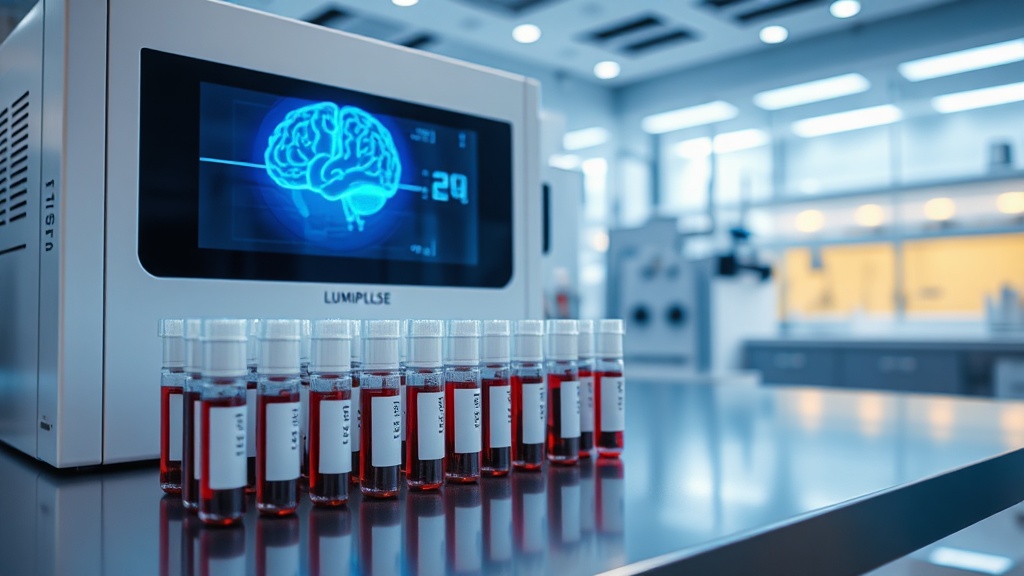
Fully automated platforms like the Lumipulse system ensure analytical reproducibility, but pre-analytical errors — wrong tube type, delayed centrifugation, improper storage temperature — can introduce variance that no algorithm will correct downstream. The position paper explicitly flags this as a key barrier to clinical adoption [1].
Diagnostic Accuracy (AUC) of Plasma Biomarkers for AD Classification
COMPARISON TABLE#
| Method | Mechanism | Evidence Level | Cost | Accessibility |
|---|---|---|---|---|
| Plasma p-tau217 | Detects phosphorylated tau in blood via automated immunoassay | High — AUC 0.955 in validated cohorts [3] | Low–Moderate (~€50–150 per test) | Expanding; requires certified lab with automated platform |
| Plasma p-tau181 | Detects earlier-phosphorylated tau isoform in blood | Moderate — AUC 0.830 [3] | Low–Moderate | Widely available on multiple platforms |
| CSF biomarkers (Aβ42/40, p-tau, t-tau) | Direct sampling of brain-adjacent fluid via lumbar puncture | Very High — established reference standard | Moderate (~€200–400) | Requires trained clinician; invasive |
| Amyloid PET | Radiotracer imaging of amyloid plaque burden | Very High — gold standard for amyloid | High (~€2,000–4,000) | Limited to specialized imaging centers |
| Plasma Aβ42/Aβ40 ratio | Ratio-based amyloid assessment resistant to renal confounders | Moderate–High | Low–Moderate | Available on automated platforms |
THE PROTOCOL#
How to navigate blood-based AD biomarker testing based on current evidence and the Italian consensus recommendations:
Step 1: Determine Clinical Indication. Blood-based biomarkers are appropriate for individuals with subjective cognitive decline, mild cognitive impairment, or early dementia where Alzheimer's pathology is suspected. They are not validated for population-level screening in asymptomatic individuals without risk factors. Discuss with a neurologist or memory clinic specialist [1].
Step 2: Select the Right Test. Request plasma p-tau217, ideally as a ratio with Aβ42, measured on a fully automated, validated platform (e.g., Lumipulse). Avoid low-accuracy or poorly validated assays — the position paper explicitly states that if only such tests are available, CSF or PET should be preferred instead [1].
Step 3: Ensure Proper Sample Collection. Blood should be drawn into EDTA plasma tubes, centrifuged at 1800 × g for 10 minutes, and either processed within 24 hours at 4°C or frozen at −80°C. Confirm with your lab that they follow these pre-analytical standards. A maximum of three freeze-thaw cycles is acceptable [1].
Step 4: Account for Confounders Before Interpreting Results. If the patient has chronic kidney disease (eGFR < 60 mL/min/1.73 m²), results may require creatinine-based correction. Advanced age and certain comorbidities can also affect biomarker concentrations. The lab report should include reference intervals adjusted for age and sex [1][3].
Step 5: Integrate Results Into a Clinical Framework. A positive p-tau217 result does not equal an Alzheimer's diagnosis. It indicates amyloid and tau pathology. The result must be interpreted alongside clinical assessment, neuroimaging, and the patient's overall medical history. For candidates being evaluated for anti-amyloid therapies (e.g., lecanemab, donanemab), amyloid PET remains the preferred confirmatory modality [1].
Step 6: Establish a Monitoring Cadence. Based on current evidence, serial plasma biomarker testing may be useful for tracking treatment response in patients receiving anti-amyloid immunotherapy. Optimal retest intervals are not yet firmly established — I'd want to see more longitudinal data before recommending a specific schedule.
Related Video
What is p-tau217 and why is it important for Alzheimer's diagnosis?#
P-tau217 is a phosphorylated form of the tau protein detectable in blood plasma. It reflects both amyloid and tau pathology in the brain, achieving a diagnostic accuracy (AUC 0.955) that approaches cerebrospinal fluid analysis and PET imaging [3]. Its importance lies in making Alzheimer's molecular diagnosis accessible through a simple blood draw rather than invasive or expensive procedures.
How does kidney disease affect blood-based Alzheimer's biomarkers?#
Kidney dysfunction (eGFR < 60 mL/min/1.73 m²) elevates plasma concentrations of p-tau217, p-tau181, and NfL, potentially leading to false-positive interpretations [3]. The Aβ42/Aβ40 ratio appears resistant to this effect. Creatinine-based correction strategies can help align cut-offs with those established in renal-healthy populations, though the improvement is modest and not statistically significant for p-tau217.
Who should get a plasma biomarker test for Alzheimer's disease?#
According to the Italian consensus recommendations, plasma biomarkers are indicated for individuals presenting with cognitive symptoms suggestive of neurodegeneration — not for general population screening [1]. They are particularly suitable for patients who cannot undergo lumbar puncture (due to anticoagulant use, obesity, spinal surgery) or who wish to avoid radiation exposure from PET imaging.
When will blood-based Alzheimer's tests be widely available?#
Automated platforms like Lumipulse are already operational in specialized laboratories across Europe and the US. The Italian position paper outlines steps toward regulatory inclusion in Italy's national healthcare system [1]. Broad clinical availability depends on regulatory approval, lab certification, and reimbursement frameworks — likely within the next one to three years for most Western healthcare systems.
Why can't a single blood test confirm an Alzheimer's diagnosis?#
Because biomarker positivity indicates pathology, not disease. Many individuals carry amyloid and tau pathology without clinical symptoms. The diagnosis requires integrating biomarker results with clinical evaluation, cognitive testing, and neuroimaging [1][2]. The honest answer is that no single test — blood, CSF, or imaging — is sufficient in isolation.
VERDICT#
Score: 8/10
The Italian joint position paper does something that most biomarker publications fail to do: it bridges the gap between analytical validation and clinical implementation. The p-tau217 data is genuinely strong, and the pre-analytical standardization guidance is the kind of practical infrastructure work that determines whether a promising biomarker actually works in real-world labs. I dock points because the kidney dysfunction correction, while sensible, is underwhelming in its statistical impact — and because the paper's scope is limited to the Italian regulatory context, which may not translate directly to other healthcare systems. The evidence base for p-tau217 is now substantial enough to consider it clinically actionable in specialist settings, but optimal dosing of testing frequency, population-level cut-off validation, and reimbursement remain open questions. This is not the finish line. It's the starting blocks, set properly for once.
References
- 1.SIN, SIBioC, SINdem. Blood-based biomarkers for Alzheimer's disease diagnosis: a joint position paper from the Italian Societies of Neurology (SIN) and of Clinical Biochemistry and Clinical Molecular Biology - Laboratory Medicine (SIBioC) and from the Autonomous Association affiliated with SIN for dementia (SINdem). Neurological Sciences (2026). ↩
- 2.Hansson O et al.. Biofluid biomarkers in Alzheimer's disease and other neurodegenerative dementias. Nature (2026). ↩
- 3.Author(s) not listed. Blood-based biomarkers for Alzheimer's disease: influence of kidney function. Alzheimer's Research & Therapy (2026). ↩
Saya Kimm
Saya is analytical, methodical, and subtly contrarian about popular biomarker interpretations. She'll specifically challenge what readers think they know: 'Testosterone doesn't tell you what most people think it tells you at a single timepoint.' She writes with a researcher's caution about causation vs. correlation — but instead of hiding behind it, she turns it into an insight.
View all articles →