PBM for Orofacial Neuropathic Pain: WALT Position Paper Review

THE PROTOHUMAN PERSPECTIVE#
Orofacial neuropathic pain is one of those conditions that quietly destroys quality of life. It resists conventional pharmacology. It frustrates clinicians. And for the people living with it — trigeminal neuralgia, post-surgical nerve damage, burning mouth syndrome — it's relentless.
This is where photobiomodulation enters the conversation. Not as a cure-all, not as the next wellness-market gimmick, but as a non-pharmacological intervention with a plausible mechanism and growing — if frustratingly inconsistent — clinical data. The 2026 WALT Position Paper matters because it represents the first serious attempt by the field's governing body to impose dosimetric order on what has been, frankly, a mess of heterogeneous protocols. For those of us tracking PBM as a performance and recovery tool, this has broader implications. If standardized parameters can be established for neuropathic pain, the framework extends to neuroinflammation, cognitive optimization, and mitochondrial efficiency protocols. The signal is there. The noise is what's been killing us.
THE SCIENCE#
What Photobiomodulation Actually Does at the Cellular Level#
Photobiomodulation therapy — formerly called low-level laser therapy (LLLT) — applies specific wavelengths of red and near-infrared light to tissue. The primary chromophore is cytochrome c oxidase in the mitochondrial electron transport chain. When photons at 600–1100 nm are absorbed, the result is enhanced mitochondrial membrane potential, increased ATP production, a transient burst of reactive oxygen species (ROS) that triggers protective signaling cascades, and downstream modulation of NF-κB and other inflammatory mediators[1].
This isn't speculative. The photochemistry is well-characterized.
What remains contested is whether consumer and clinical devices deliver adequate irradiance to the target tissue — and whether the protocols used in trials bear any resemblance to what practitioners actually do. Martins et al. (2025) laid out the mechanistic framework clearly: PBMT can reduce oxidative stress, modulate neuroinflammation via glial cell regulation, and support neural repair through upregulation of neurotrophic factors like BDNF and NGF[1]. In preclinical models, the effects on autophagy pathways and mitochondrial biogenesis are striking.
But here's where it gets complicated. Preclinical is not clinical. And the gap between a controlled rat sciatic nerve injury model and a human trigeminal neuropathy patient is enormous.
The WALT 2026 Position Paper: What It Actually Says#
The World Association for Photobiomodulation Therapy published its position paper in the Journal of Clinical Medicine in February 2026, based on recommendations from the 15th WALT Congress (PBM2024) held in London[2]. The paper is a systematic review specifically targeting orofacial neuropathic pain — a narrower scope than previous WALT guidelines.
The core problem WALT identifies: inconsistent PBM dosimetry and methodological variability that limit clinical application. This is not a new complaint. I've been saying this for years. Wavelength matters. Irradiance matters. Time matters. Tissue penetration depth matters. Most published trials get at least one of these parameters inadequately reported or outright wrong.
WALT's position is cautious: PBM therapy has shown potential in managing ONP, but the evidence base isn't yet strong enough for unconditional clinical recommendation. They call for standardized reporting of all dosimetric parameters and more rigorous RCT design[2].
I appreciate the honesty, even if it's frustrating.
The Systematic Review Data: What the Numbers Show#
Ferreira et al. (2026) published a parallel systematic review in Frontiers in Integrative Neuroscience covering PBM across chronic pain conditions broadly, not just orofacial[3]. The review synthesized evidence on analgesic effects, functional outcomes, quality of life impact, and safety profiles.
Meanwhile, the Díaz et al. (2025) systematic review in Photodiagnosis and Photodynamic Therapy provides the hardest numbers we have specifically for maxillofacial neuropathies. Across 18 RCTs involving 1,220 patients[4]:
- VAS pain reduction: mean –3.5 points (95% CI: –4.2 to –2.8, P < 0.001)
- Sensory threshold recovery: 45% faster versus controls (P < 0.001)
- Healing time reduction: 25% (P < 0.05)
- Adverse events (transient erythema) in fewer than 5% of cases
Those numbers are clinically meaningful. A 3.5-point VAS reduction isn't subtle.
The catch, though. Díaz et al. themselves note variability in laser dosimetry and small sample sizes across the included studies[4]. So we have a meta-analytic signal that's strong on effect size but weakened by protocol heterogeneity. This is the recurring theme in PBM research and it drives me up the wall.
Wavelength-Specific Effects and the Dosimetry Problem#
Martins et al. (2025) provide a useful wavelength-specificity table in their review[1]. The therapeutic window for neuropathic pain clusters around two ranges:
- Red (630–670 nm): Primarily superficial tissue effects — mucosal healing, surface nerve modulation, anti-inflammatory action at the epithelial level
- Near-infrared (808–980 nm): Deeper penetration, reaching nerve trunks, ganglia, and deeper musculoskeletal structures — more relevant for trigeminal and inferior alveolar nerve targets
The irradiance threshold matters enormously. Too low, and you get no biological effect. Too high, and you risk inhibitory biphasic dose responses — the Arndt-Schulz curve that PBM researchers love to invoke but rarely measure properly in vivo.
Most consumer devices operate well below therapeutic thresholds for deep nerve targets. I'll say it plainly: a $40 red light panel is not treating your trigeminal nerve. The photons aren't getting there.
LLLT Efficacy in Maxillofacial Neuropathies: Key Outcomes vs Controls
COMPARISON TABLE#
| Method | Mechanism | Evidence Level | Cost | Accessibility |
|---|---|---|---|---|
| PBM/LLLT (Clinical-grade) | Cytochrome c oxidase activation, mitochondrial ATP enhancement, NF-κB modulation | Moderate — 18 RCTs, systematic reviews, WALT position paper | $150–400/session | Specialist clinics only |
| Carbamazepine (Standard pharmacotherapy) | Sodium channel blockade | High — decades of RCT data, first-line for trigeminal neuralgia | $10–30/month | Widely available (Rx) |
| Botulinum Toxin Injection | Acetylcholine release inhibition, peripheral sensitization reduction | Moderate — growing RCT base | $300–600/session | Specialist clinics |
| Transcutaneous Electrical Nerve Stimulation (TENS) | Gate control theory, endorphin release | Low-Moderate — mixed results in neuropathic pain | $30–150 (device) | Home use available |
| Consumer Red Light Panels | Same putative mechanism as PBM — but inadequate irradiance for deep targets | Very Low — no RCTs for neuropathic pain | $40–500 (device) | Widely available |
THE PROTOCOL#
Based on the current evidence — and I want to be clear, optimal dosing in humans is not yet fully established — here is a protocol framework synthesized from the WALT recommendations and the Díaz et al. systematic review parameters[2][4].
1. Confirm the diagnosis first. Orofacial neuropathic pain requires differential diagnosis by a qualified clinician. PBM is not a substitute for identifying the underlying pathology. Trigeminal neuralgia, post-traumatic neuropathy, and burning mouth syndrome each may respond differently.
2. Select the appropriate wavelength for target depth. For superficial mucosal targets (burning mouth, post-surgical oral nerve): 630–670 nm red laser at 30–50 mW output. For deeper nerve trunks (inferior alveolar, infraorbital): 808–980 nm near-infrared laser at 100–300 mW.
3. Apply correct irradiance and energy density. Based on the RCTs reviewed by Díaz et al., effective protocols typically deliver 2–6 J/cm² per point, with treatment times of 30–90 seconds per point depending on output power[4]. Calculate actual irradiance at the tissue surface — not just the device label power.
4. Use point-application technique along the nerve pathway. Apply the probe in direct contact or near-contact mode at multiple points along the affected nerve distribution. For trigeminal neuropathy: map the V1, V2, or V3 dermatome and treat 4–8 points at 1–2 cm intervals.
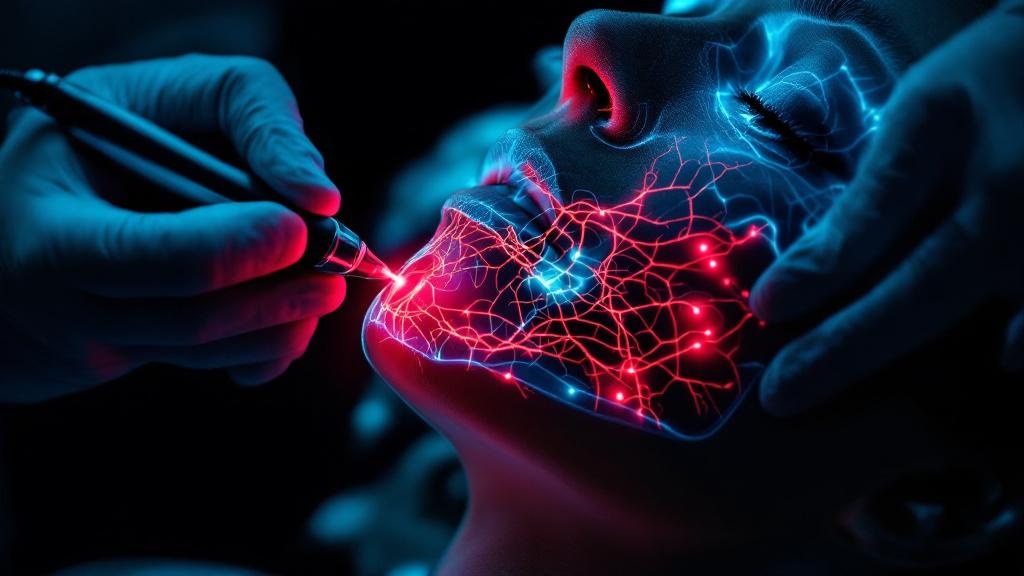
5. Follow a structured treatment schedule. The most effective protocols in the reviewed RCTs used 2–3 sessions per week for 4–8 weeks. Reassess pain scores (VAS) and sensory thresholds at week 4. Discontinue if no measurable improvement by week 6.
6. Document everything. Record wavelength, power output, spot size, energy density per point, number of points, total energy delivered, and treatment duration. This is non-negotiable. If you can't report your parameters, your results are meaningless.
7. Do not combine with photosensitizing medications without medical clearance. Certain antibiotics, NSAIDs, and chemotherapy agents increase photosensitivity. Screen for these before initiating PBM.
Related Video
What is photobiomodulation therapy and how does it differ from general red light therapy?#
PBM therapy uses specific wavelengths of red and near-infrared light, typically delivered by medical-grade lasers or LEDs, to modulate cellular function — primarily through cytochrome c oxidase in the mitochondria. The critical difference from consumer "red light therapy" is dosimetric precision: clinical PBM controls wavelength, irradiance, energy density, and application technique. Most consumer panels lack the power density to affect deep nerve tissue, which is why I'm cautious about equating the two.
Why does the WALT 2026 Position Paper stop short of full clinical endorsement?#
Because the evidence, while promising, is plagued by protocol heterogeneity. Studies use different wavelengths, power outputs, treatment durations, and application methods — making direct comparison difficult. WALT is essentially saying: the signal is real, but we need standardized dosimetry before we can issue definitive clinical guidelines[2]. Honestly, that's the responsible position.
How effective is PBM for orofacial neuropathic pain compared to medication?#
Based on Díaz et al.'s systematic review, LLLT produced a mean 3.5-point VAS pain reduction across 18 RCTs — which is clinically significant[4]. Carbamazepine remains the first-line standard with a deeper evidence base, but PBM shows a substantially better side-effect profile. For patients who can't tolerate anticonvulsants — and there are many — PBM may represent a viable adjunct or alternative, pending further standardized trials.
Who should avoid photobiomodulation therapy?#
Patients on photosensitizing medications, those with active malignancy in the treatment area, and individuals with undiagnosed facial pain should not undergo PBM without thorough medical evaluation. Pregnant patients should also exercise caution, though the safety data for localized facial application suggests minimal systemic risk. When in doubt, get cleared by your treating physician first.
What wavelengths work best for neuropathic pain specifically?#
Martins et al. (2025) suggest 808–980 nm near-infrared for deeper nerve targets and 630–670 nm for superficial mucosal conditions[1]. The choice depends entirely on the anatomical depth of the target. Using red light for a deep inferior alveolar nerve injury is like trying to heat a room with a candle — the physics don't support it.
VERDICT#
Score: 6.5/10
The evidence for PBM in orofacial neuropathic pain is real but incomplete. The Díaz et al. numbers — 3.5-point VAS reduction, 45% faster sensory recovery — are clinically meaningful and the safety profile is excellent. But I'm less convinced the field has solved its fundamental problem: dosimetric chaos. Every systematic review I read on PBM ends with the same lament about protocol variability, and WALT's 2026 position paper, while important, confirms rather than resolves this. The mechanism is sound. The preclinical data from Martins et al. is compelling. But until we see large, multi-center RCTs with standardized parameters — wavelength, irradiance, energy density, treatment schedule — all clearly reported, I can't rate this higher. If you're a clinician, it's worth adding to your toolkit with proper equipment. If you're a consumer hoping your LED panel will fix trigeminal neuralgia — it won't. I'd want to see this next generation of standardized trials before moving the needle further.
References
- 1.Martins DO, Rocha IRC, Watkins LR, Chacur M. Photobiomodulation therapy in neuropathic pain: mechanisms, evidence, and future directions. Frontiers in Photonics (2025). ↩
- 2.Haddad R et al.. Photobiomodulation Therapy in the Management of Orofacial Neuropathic Pain—WALT Position Paper 2026. Journal of Clinical Medicine (2026). ↩
- 3.Ferreira LMA, Oliveira ABC, Mendes JJB, Costa GV, Silva IR, Santos GN, Pereira GS, Silva ML. Photobiomodulation in chronic pain: a systematic review of randomized clinical trials. Frontiers in Integrative Neuroscience (2026). ↩
- 4.Díaz L, Basualdo J, Chaple-Gil A, Von Marttens A, Fernández E. Effectiveness of low-level laser therapy in patients with maxillofacial neuropathies. A systematic review of randomized controlled trials. Photodiagnosis and Photodynamic Therapy (2025). ↩
Sova Reld
Sova writes with focused intensity and low tolerance for vague claims. She came to photobiomodulation through personal experimentation and is irritated by both true believers and reflexive skeptics. Her writing has edge: 'The wellness market has done more damage to this field than the skeptics ever could.' She's extremely precise about parameters — wavelength, irradiance, duration — and will tell you when a study used inadequate dosing without apology.
View all articles →