PBM Therapy for Breast Cancer Lymphedema: Meta-Analysis Results

SNIPPET: Photobiomodulation therapy significantly reduces upper limb lymphedema volume (SMD = −0.78) and circumference (−3.61 cm) in breast cancer survivors, while improving grip strength (+1.72 kg) and reducing pain, according to a new meta-analysis of nine RCTs by Qian et al. in Frontiers in Oncology (2026). Evidence certainty is moderate.
Photobiomodulation for Breast Cancer Lymphedema: What the New Meta-Analysis Actually Shows
THE PROTOHUMAN PERSPECTIVE#
Breast cancer–related lymphedema (BCRL) affects up to 40% of women after axillary lymph node dissection, and it is one of those conditions the oncology world has largely accepted as "managed, not solved." Compression garments. Manual lymphatic drainage. Elevation. Repeat forever. The fact that a non-invasive light-based therapy can meaningfully reduce limb volume and restore grip strength matters — not because it replaces existing care, but because it may augment it at a cellular level most current approaches don't touch. If PBM works the way the mechanistic data suggests — via cytochrome c oxidase activation, downstream nitric oxide release, and modulation of inflammatory cascades — then we're looking at a tool that addresses the tissue environment itself, not just the fluid. That's a different category of intervention. For anyone tracking human performance optimization beyond the gym, understanding how photons interact with compromised lymphatic tissue is no longer optional. It's infrastructure knowledge.
THE SCIENCE#
What Photobiomodulation Actually Is (And Isn't)#
Photobiomodulation (PBM) is the application of red or near-infrared light — typically 600–1,000 nm wavelength — at low power densities (under 500 mW) to biological tissue. It is not heat therapy. It is not UV exposure. It is the targeted delivery of photon energy to mitochondrial chromophores, primarily cytochrome c oxidase (Complex IV of the electron transport chain), which triggers a cascade of downstream effects: increased ATP production, transient bursts of reactive oxygen species that activate NF-κB signaling, release of nitric oxide from metal centers, and modulation of pro-inflammatory cytokines[6].
Why does this matter for lymphedema? Because BCRL isn't just "extra fluid." It's a chronic inflammatory condition with progressive tissue fibrosis, impaired lymphatic contractility, and local immune dysregulation. Radiation-induced fibrosis alone affects over 50% of cancer survivors within a year, climbing to 65% by eight years[4]. The tissue environment is broken, and PBM targets the cellular machinery that drives that breakdown.
The Qian et al. Meta-Analysis: Numbers That Matter#
The new systematic review and meta-analysis by Qian et al. (2026), published in Frontiers in Oncology, pooled data from nine randomized controlled trials involving 312 participants with BCRL[1]. The methodology is solid: PRISMA-compliant, PROSPERO-registered (CRD420261296197), with risk of bias assessed via RoB 2, methodological quality via the PEDro scale, and certainty of evidence graded using GRADE.
Here's what they found:
- Limb volume reduction: SMD = −0.78 (95% CI −1.03 to −0.54; I² = 22%). That's a moderate-to-large effect size with low heterogeneity. I'll take that.
- Limb circumference reduction: MD = −3.61 cm (95% CI −4.85 to −2.38; I² = 44%). The heterogeneity here is higher, which tells me protocols varied — and protocol variation is the perennial problem in this field.
- Grip strength improvement: MD = 1.72 kg (95% CI 1.07 to 2.37; I² = 14%). Low heterogeneity. Consistent signal.
- Pain reduction: MD = −0.29 (95% CI −0.52 to −0.05; I² = 0%). Statistically significant but clinically modest.
The I² values are worth dwelling on. For limb volume and grip strength, heterogeneity was low (22% and 14%, respectively), meaning these studies were measuring roughly the same thing in roughly the same way. That's rare in PBM research, where one trial uses 808 nm and another uses 904 nm, one delivers 1 J/cm² and another delivers 6 J/cm², and then people wonder why results conflict.
Where I Push Back#
312 participants across nine trials. Let me be direct: that's a small evidence base. Each trial averaged roughly 35 participants. The GRADE assessment came back as "mostly moderate certainty," with some concerns about allocation concealment. That's code for: we're not entirely sure blinding was maintained in all trials, which matters because PBM involves a visible light source. Sham controls in PBM research are notoriously tricky — you need a device that looks and sounds identical but delivers no therapeutic dose.
The pain reduction, while statistically significant, had a mean difference of −0.29 on what appears to be a visual analog scale. Honestly, that's barely clinically meaningful. I wouldn't sell PBM on pain reduction alone for this population. The volume and circumference data are far more convincing.
Also absent from this meta-analysis: long-term follow-up data. Most BCRL trials measure outcomes at the end of the treatment period. What happens six months later? Does the volume reduction hold? Does fibrosis progress more slowly? We don't know yet. And that matters enormously for a chronic condition.
The Broader PBM Evidence Landscape#
This meta-analysis doesn't exist in isolation. A separate systematic review by Oliveira et al. (2026) in Frontiers in Integrative Neuroscience examined PBM across 14 RCTs for chronic pain conditions — fibromyalgia, peripheral neuropathies, orofacial and musculoskeletal pain — and found significant pain reduction in most trials, with low adverse event rates[5]. Martins et al. (2025) provided mechanistic context in Frontiers in Photonics, detailing how PBM activates mitochondrial cytochrome c oxidase, modulates cytokines and oxidative stress markers, and upregulates neurotrophic factors like BDNF[6].
And then there's the LED therapy data for radiodermatitis from a 2026 systematic review in Lasers in Medical Science, which found that LED-based PBM reduced radiodermatitis severity dramatically — 94.7% achieving Grade 0–1 in the LED group versus 14.3% in controls (p < 0.0001)[3]. Different application, same underlying mechanism. The tissue responds to photons.
PBM Therapy Outcomes in Breast Cancer Lymphedema
COMPARISON TABLE#
| Method | Mechanism | Evidence Level | Cost | Accessibility |
|---|---|---|---|---|
| PBM/LLLT | Cytochrome c oxidase activation → ATP ↑, NO release, anti-inflammatory cascade | Moderate (9 RCTs, meta-analysis) | $200–$2,000 (device) or ~$50–$150/session clinical | Moderate — requires specific devices or clinic access |
| Manual Lymphatic Drainage (MLD) | Mechanical stimulation of lymphatic contractility and fluid rerouting | Moderate-High (multiple systematic reviews) | $75–$200/session | High — widely available through trained therapists |
| Compression Garments | External pressure gradient reduces fluid accumulation | High (standard of care, extensive evidence) | $50–$300 per garment | Very High — OTC and prescribed |
| Complete Decongestive Therapy (CDT) | Combined MLD, compression, exercise, skin care | High (gold standard) | $500–$3,000+ per treatment course | Moderate — requires specialized center |
| Pneumatic Compression Pumps | Sequential mechanical compression mimics lymphatic flow | Moderate (variable trial quality) | $100–$5,000 (home devices) or clinic-based | Moderate — home and clinical use |
THE PROTOCOL#
For those considering PBM therapy for breast cancer–related lymphedema, based on current evidence and the parameters most commonly used across the included RCTs:
1. Confirm diagnosis and staging. PBM is an adjunctive therapy. Ensure BCRL has been properly staged (ISL classification) and that complete decongestive therapy is either concurrent or has been trialed. Do not use PBM as a standalone replacement for compression.
2. Select appropriate wavelength. The trials in Qian et al. predominantly used wavelengths in the 808–904 nm range (near-infrared). This is critical. Visible red (630–670 nm) penetrates shallowly and is more suited to superficial skin conditions. For lymphedema, you need near-infrared to reach the deeper lymphatic vasculature and fibrotic tissue.
3. Establish dosimetry parameters. Based on the pooled trial data, target an energy density of 1–4 J/cm² per treatment point. Power output should be under 500 mW. Treatment points should follow the lymphatic drainage pathway of the affected limb — axillary region, medial upper arm, antecubital fossa, and forearm.
4. Set treatment frequency. Most included trials used 2–3 sessions per week over 4–12 weeks. Start with 3 sessions per week for the first 4 weeks, then reassess limb circumference and adjust frequency.

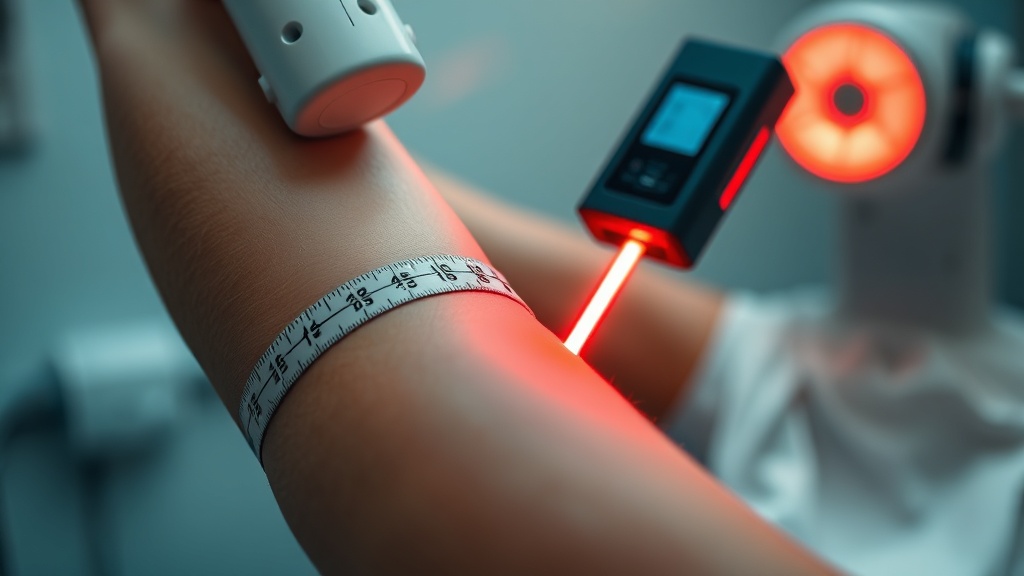
5. Track objective outcomes. Measure limb circumference at standardized anatomical landmarks (metacarpals, wrist, mid-forearm, elbow, mid-upper arm) before every fourth session. Use water displacement volumetry if available. Grip strength via dynamometer is a useful functional proxy.
6. Combine with active care. PBM appears most effective as part of a multimodal approach. Continue compression garment use, exercise, and skin care protocols throughout the PBM treatment course.
7. Reassess at 8 weeks. If no measurable reduction in limb volume or circumference by session 16–24, the protocol may not be effective for that individual. Not everyone responds to the same dosimetry, and we don't yet have reliable predictors of response.
Related Video
What is photobiomodulation therapy for lymphedema?#
PBM therapy uses low-power red or near-infrared light (typically 600–1,000 nm) to stimulate cellular repair processes in lymphedema-affected tissue. It works primarily by activating cytochrome c oxidase in mitochondria, increasing ATP production and triggering anti-inflammatory signaling. It is used as an adjunctive therapy alongside standard lymphedema care like compression and manual drainage.
How effective is PBM compared to compression therapy alone?#
The Qian et al. meta-analysis found PBM produced a moderate-to-large effect on limb volume reduction (SMD = −0.78) and a 3.61 cm reduction in circumference compared to control conditions. However, most trials used PBM alongside existing care, not as a direct replacement. Head-to-head comparisons with compression-only protocols are limited, and I'd want to see those before making strong claims about superiority.
Who is a good candidate for PBM therapy?#
Women with established BCRL (Stage I–II) who have not achieved adequate symptom control with standard decongestive therapy may benefit most. PBM is generally well-tolerated with low adverse event rates. It is not recommended over active tumor sites without oncologist clearance — the data on PBM and tumor biology is a separate, more complicated conversation.
Why do PBM study results vary so much?#
Wavelength. Irradiance. Time. Skin type. Most consumer devices and even some clinical protocols get at least one of these wrong. A study using 632 nm at 0.5 J/cm² is not testing the same intervention as one using 904 nm at 3 J/cm². Until the field standardizes treatment parameters, heterogeneity in results will persist. The low I² values in Qian et al. for volume and grip strength suggest the included trials were more consistent than average — which is encouraging.
When should patients expect to see results from PBM?#
Based on the trial durations in the meta-analysis, measurable improvements in limb volume and circumference typically appeared within 4–8 weeks of regular treatment (2–3 sessions per week). Grip strength gains may take longer to become clinically noticeable. Long-term maintenance protocols have not been well-studied, and whether benefits persist after treatment cessation remains an open question.
VERDICT#
7.5/10. The Qian et al. meta-analysis is well-constructed and the effect sizes for volume and circumference reduction are real. Low heterogeneity on the key outcomes is a good sign — these trials were measuring something consistent. But 312 total participants is still a thin evidence base, the pain reduction is barely clinically relevant, and we have no long-term follow-up data. I'm cautiously optimistic. If I were managing BCRL, I'd add PBM to my protocol, not rely on it alone. The mechanism makes sense, the numbers point in the right direction, and the safety profile is clean. But I'd want to see this replicated at larger scale — and with standardized dosimetry — before calling it anything more than a promising adjunct.
References
- 1.Qian C, He Z, Liu C, Fang Y, Zheng Y, Zhang Z, Ye Z. Effects of photobiomodulation therapy on upper limb lymphedema secondary to breast cancer: a systematic review and meta-analysis. Frontiers in Oncology (2026). ↩
- 3.Author(s) not listed. Light-emitting diode therapy for the prevention and treatment of radiodermatitis in women with breast cancer: systematic review. Lasers in Medical Science (2026). ↩
- 4.Author(s) not listed. Potential role of photobiomodulation as a prevention and treatment strategy for radiation induced fibrosis: a review of effectiveness and mechanisms. PeerJ (2025). ↩
- 5.Oliveira ABC, Santos GN, Ferreira LMA, Mendes JJB, Costa GV, Silva IR, Pereira GS, Silva ML. Photobiomodulation in chronic pain: a systematic review of randomized clinical trials. Frontiers in Integrative Neuroscience (2026). ↩
- 6.Martins DO, Rocha IRC, Watkins LR, Chacur M. Photobiomodulation therapy in neuropathic pain: mechanisms, evidence, and future directions. Frontiers in Photonics (2025). ↩
Sova Reld
Sova writes with focused intensity and low tolerance for vague claims. She came to photobiomodulation through personal experimentation and is irritated by both true believers and reflexive skeptics. Her writing has edge: 'The wellness market has done more damage to this field than the skeptics ever could.' She's extremely precise about parameters — wavelength, irradiance, duration — and will tell you when a study used inadequate dosing without apology.
View all articles →