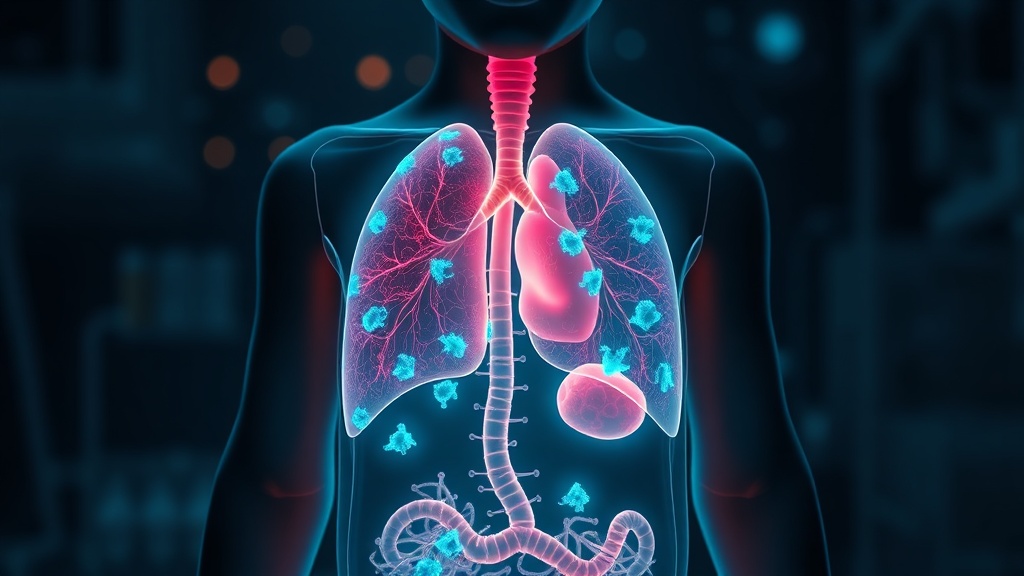
Probiotics for Pediatric Refractory Asthma: Gut-Lung Axis Trial

THE PROTOHUMAN PERSPECTIVE#
The thing about refractory asthma in children is that it represents a failure state — the standard playbook of bronchodilators and glucocorticoids simply isn't enough. Over 300 million people globally live with asthma, and a stubborn subset of pediatric patients keeps cycling through exacerbations despite "optimal" therapy. What Deng et al. are suggesting isn't that we replace the inhaler with a capsule of bacteria. It's that we've been ignoring an entire organ system — the gut ecosystem — while trying to fix the lungs.
The gut-lung axis is not a metaphor. It's a measurable, bidirectional immunological cascade where microbial metabolites in the intestine directly influence airway inflammation. If this data holds up in larger trials, it implies that asthma management in children may need to become a whole-body microbial strategy, not just a respiratory one. That's a genuine paradigm shift for pediatric pulmonology. But — and I need to be honest here — we're looking at 88 kids in a single trial. The signal is strong. The evidence base is thin.
THE SCIENCE#
The Gut-Lung Axis: An Ecosystem Under Pressure#
Refractory pediatric asthma is defined by persistent symptoms despite adherence to conventional bronchodilator and glucocorticoid therapy[1]. The emerging explanation for why some children don't respond centers on the gut-lung axis — a bidirectional communication network where intestinal microbiota modulate systemic and pulmonary immune responses through short-chain fatty acid production, regulatory T-cell induction, and cytokine signaling cascades.
Deng et al. (2026) enrolled 88 children aged 4–8 years with refractory asthma in a prospective randomized controlled trial at the Children's Hospital of Chongqing Medical University[1]. The conventional group (n=44) received standard bronchodilators and glucocorticoids. The combination group (n=44) received the same therapy plus a multi-strain probiotic containing Bifidobacterium, Lactobacillus acidophilus, and Streptococcus thermophilus for four months.
Clinical Outcomes: The Numbers That Matter#
Complete asthma control was achieved in 68.18% of the probiotic group versus 36.36% in the conventional group (Z = 2.415, p < 0.05)[1]. That's not a marginal improvement — it's nearly double the rate.
Post-treatment Asthma Control Test (ACT) scores were significantly higher in the combination group: 22.45 ± 1.20 versus 19.78 ± 1.45 (p < 0.05). For context, an ACT score above 20 generally indicates well-controlled asthma. The conventional group's mean didn't cross that threshold. The probiotic group's did.
Pulmonary function metrics told a consistent story. FEV₁ improved to 2.65 ± 0.10 L versus 2.30 ± 0.08 L (p < 0.001). FVC reached 3.10 ± 0.18 L versus 2.80 ± 0.15 L (p < 0.001). Peak expiratory flow hit 4.00 ± 0.25 L/s versus 3.50 ± 0.20 L/s (p < 0.001)[1].
Let me push back on that for a second. These p-values are impressive — all under 0.001 for the lung function metrics. But this is a single-center trial with 88 participants and no placebo arm described for the probiotic component. They didn't control for baseline microbial diversity, which makes certain mechanistic claims harder to interpret. The clinical signal is real. The causal chain still has gaps.
Microbiome Remodeling via 16S rRNA Sequencing#
The secondary outcome — gut microbiota changes assessed by 16S rRNA gene sequencing — showed distinct clustering between groups (PERMANOVA p < 0.05)[1]. This is where the ecosystem-level thinking becomes critical. We're not talking about a single bacterial species doing a single thing. The probiotic intervention appears to have shifted the entire microbial community structure toward a configuration associated with reduced systemic inflammation.

The Immunological Mechanism: IL-4 and IFN-γ#
A separate systematic review and meta-analysis by Liao et al. (2026) pooled six RCTs involving 731 pediatric asthma patients and found that probiotics significantly reduced interleukin-4 (IL-4) levels (SMD –0.66, 95% CI –1.24 to –0.08, p = 0.03) and increased interferon-γ (IFN-γ) levels (SMD 1.78, 95% CI 0.13–3.44, p = 0.03)[3]. IL-4 drives Th2-mediated allergic inflammation — it's the cytokine you don't want elevated in asthma. IFN-γ counterbalances it through Th1 activation.
But here's where it gets complicated. The trial sequential analysis in that same review did not confirm conclusiveness for either IL-4 or IFN-γ outcomes — meaning the cumulative sample sizes haven't yet crossed the statistical threshold to call these findings definitive[3]. The certainty of evidence was rated "very low." Their own conclusion states: the available evidence does not support routine use of probiotics as adjunctive therapy in pediatric asthma.
That's a direct contradiction with the Deng et al. clinical findings. I don't think either group is wrong — they're measuring different things at different scales. But anyone reading only the Deng trial would walk away more optimistic than the aggregate data currently supports.
Supporting Evidence: Beyond Asthma#
The broader probiotic-pediatric literature adds important context. A network meta-analysis by Yang et al. (2026) across 21 RCTs (n=1,807) found that probiotics significantly improved global outcomes in children with functional abdominal pain disorders (RR = 1.33, 95% CI 1.03–1.73), with Lactobacillus reuteri DSM 17938 and L. rhamnosus GG ranking highest[2]. The Mageswary et al. (2026) trial of Bifidobacterium infantis YLGB-1496 in 119 preschoolers showed reduced respiratory illness incidence and enhanced fecal IgA[4].
And then there's the Fragile X syndrome pilot — 15 children given L. casei, L. salivarius, and B. breve for 12 weeks showed improved irritability (–3.9, p = 0.027), communication (+1.7, p = 0.022), and socialization (+1.4, p = 0.033), with functional profiling revealing trends toward increased NAD salvage pathway activity[6]. That NAD connection is interesting because it hints at mitochondrial efficiency pathways being influenced by microbial metabolite production — something that deserves its own investigation.
Complete Asthma Control Rate: Probiotic vs. Conventional
COMPARISON TABLE#
| Method | Mechanism | Evidence Level | Cost | Accessibility |
|---|---|---|---|---|
| Multi-strain probiotic + standard therapy (Deng et al.) | Gut microbiome remodeling via gut-lung axis; Th1/Th2 rebalancing | Single RCT (n=88); preliminary | Low (~$15–30/month) | Widely available OTC |
| Standard bronchodilators + glucocorticoids | Direct bronchodilation + airway anti-inflammatory | Strong (decades of RCTs, guidelines-backed) | Moderate ($30–100/month) | Prescription required |
| Biologic therapies (omalizumab, mepolizumab) | Targeted IgE/IL-5 blockade | Strong (phase III trials) | Very high ($1,000–3,000/month) | Specialist prescription; limited pediatric approvals |
| L. reuteri DSM 17938 (for FAPD, not asthma) | Gut-brain axis modulation; anti-inflammatory metabolites | Moderate (NMA of 21 RCTs) | Low (~$10–25/month) | OTC |
| B. infantis YLGB-1496 | Immune modulation via fecal IgA enhancement, respiratory protection | Single RCT (n=119) | Low | Limited availability |
THE PROTOCOL#
Important caveat: This protocol is based on preliminary evidence from a single trial. It is intended for informational purposes and should not replace medical advice, particularly for children with refractory asthma. Always consult a pediatric pulmonologist before modifying any treatment plan.
Step 1. Maintain the existing prescribed asthma regimen — bronchodilators and inhaled corticosteroids — without modification. The probiotic intervention in the Deng et al. trial was adjunctive, not a replacement. Do not reduce controller medications.
Step 2. Select a multi-strain probiotic formulation containing Bifidobacterium species, Lactobacillus acidophilus, and Streptococcus thermophilus. Based on the trial protocol, look for products delivering at minimum 1×10⁹ CFU per dose of each strain. Your gut doesn't care about your supplement brand — it cares about strain identity and viability. Check for third-party testing (USP, NSF, or ConsumerLab verification).
Step 3. Administer the probiotic daily for a minimum of four months, consistent with the Deng et al. intervention duration[1]. Timing relative to meals was not specified in the trial, but general probiotic guidance suggests taking with food or 30 minutes before a meal to improve bacterial survival through gastric acid.
Step 4. Track symptoms using the Asthma Control Test (ACT) — a validated five-question assessment available freely online. Record scores at baseline, monthly, and at the four-month mark. An ACT score ≥20 indicates well-controlled asthma.

Step 5. Monitor pulmonary function through scheduled spirometry (FEV₁, FVC, PEF) with your child's pulmonologist at baseline and post-intervention. The Deng et al. trial showed statistically significant improvements across all three metrics, but individual responses will vary.
Step 6. If considering microbiome assessment, 16S rRNA stool testing services are commercially available. While not strictly necessary, a baseline and post-intervention sample could help identify whether microbial diversity shifts correlate with clinical improvement. Honestly, the clinical utility of consumer microbiome tests is still debatable — but for tracking purposes in the context of a deliberate intervention, I find them more useful than most clinicians admit.
Step 7. Reassess at four months. If no improvement in ACT scores or spirometry, discontinue the probiotic. The evidence does not support indefinite supplementation without measurable benefit.
Related Video
VERDICT#
Score: 6.5/10
The Deng et al. trial delivers a genuinely exciting signal — nearly doubling complete asthma control rates with a low-cost, well-tolerated adjunctive probiotic. The lung function data is statistically strong. The microbiome sequencing adds mechanistic plausibility through the gut-lung axis. But I can't ignore the limitations: 88 participants, single-center, no clear description of blinding for the probiotic arm, and no control for baseline microbial diversity. The broader meta-analytic evidence from Liao et al. actively cautions against routine use, rating overall certainty as "very low." The ecosystem-level thinking here is correct — gut dysbiosis likely contributes to refractory airway inflammation. But the specific protocol hasn't earned more than cautious optimism. We genuinely don't know enough to make strong recommendations here, and anyone who tells you otherwise is selling something. I'd want to see a multicenter, double-blind, placebo-controlled trial with 300+ participants before moving this into clinical practice. Until then: interesting, plausible, but unproven at scale.
Frequently Asked Questions5
References
- 1.Deng W, Xu W, Ye L, Rao Z, Liu Z. Probiotic supplementation modulates the gut microbiome and improves clinical outcomes in pediatric refractory asthma. Frontiers in Microbiology (2026). ↩
- 2.Yang Y, Yan X, Yan H, Leng L, Cao C, Huang W, Li Y. Comparative efficacy of probiotic, prebiotic, and synbiotic interventions in children with functional abdominal pain disorders: a systematic review and network meta-analysis. Frontiers in Nutrition (2026). ↩
- 3.Liao K, Li F, Wang M, Yang X, Yu Y, Hu G. Efficacy and safety of probiotics in the treatment of pediatric asthma: a systematic review and meta-analysis. Frontiers in Medicine (2026). ↩
- 4.Mageswary MU, Li P, Richmond RV, Azianey Y, Abd Hamid IJ, Taib F, Liong MT, Ali A, Tan JS, Zhang Y. Clinical benefits of Bifidobacterium infantis YLGB-1496 in modulating gut microbiota and immunity in young children. Frontiers in Nutrition (2026). ↩
- 5.Shi J, Liu Y, Chen X, Hou X, Chen H, Chen L, Li L. Effect of probiotic lozenges on improvement in tympanometric classification within 12 weeks in children aged 3–6 years with adenoid hypertrophy and otitis media with effusion undergoing non-surgical management: a randomized controlled trial. Frontiers in Cellular and Infection Microbiology (2026). ↩
- 6.Mageswary MU, Li P, Richmond RV, Azianey Y, Abd Hamid IJ, Taib F, Liong MT, Ali A, Tan JS, Zhang Y. Microbiome modulation and behavioural improvements in children with fragile X syndrome following probiotic intake: A pilot study. Scientific Reports (2025). ↩
Dax Miyori
Dax is comfortable with complexity and slightly impatient with people who want clean answers about the microbiome. He writes in systems terms and will point out when a study ignored confounding microbial variables: 'They didn't control for baseline diversity, which makes the result almost uninterpretable.' He uses 'ecosystem' and 'cascade' frequently — not as jargon, but because they're accurate.
View all articles →