Red Light Therapy Skin Science: JAAD Consensus Explained

SNIPPET: Red light therapy (photobiomodulation) at 620–660 nm stimulates mitochondrial cytochrome c oxidase, increasing cellular ATP production, fibroblast proliferation, and collagen synthesis. A 2025 JAAD consensus by 21 experts issued 38 evidence-based statements confirming its efficacy for skin rejuvenation. Randomized controlled trials show significant wrinkle reduction and up to 79.6% patient satisfaction after just 8–12 sessions.
Red Light Therapy Skin Science: What the 2025 JAAD Consensus Actually Proves
Photobiomodulation (PBM) is the application of specific wavelengths of red and near-infrared light — typically 620–850 nm — to modulate cellular function through direct interaction with mitochondrial chromophores. It matters because it represents one of the few non-pharmacological interventions with a plausible, well-characterized mechanism for enhancing dermal collagen synthesis and reducing inflammatory markers at the tissue level. A 2025 landmark consensus published in the Journal of the American Academy of Dermatology, authored by a 21-expert international panel, issued 38 consensus statements on PBM safety and efficacy — the most authoritative clinical guidance the field has ever received[1]. The global light therapy market hit $1.16 billion in 2025, and L'Oréal debuted its own LED mask at CES 2026, signaling that mainstream dermatology and consumer beauty have converged on this modality.
THE PROTOHUMAN PERSPECTIVE#
Here's what most coverage of red light therapy misses: this isn't about vanity. Skin is the body's largest organ and its first-line immune barrier. Collagen degradation isn't cosmetic — it's a biomarker of systemic aging that correlates with extracellular matrix integrity, wound healing capacity, and even metabolic function.
The 2025 JAAD consensus didn't just validate LED masks for wrinkle reduction. It formalized parameters — wavelength, irradiance, fluence — that allow us to treat PBM as a precision tool rather than a wellness gimmick. For anyone tracking biological age through skin elasticity, wound recovery time, or inflammatory load, this consensus is the inflection point.
What excites me is the specificity. We're no longer arguing about whether red light "does something." The question has shifted to dosimetry: how much, how often, at what wavelength. That's the conversation of a maturing field. The wellness market has done more damage to photobiomodulation's credibility than the skeptics ever could — and this consensus is the antidote.
THE SCIENCE#
Mechanism: Cytochrome c Oxidase and the Mitochondrial Energy Cascade#
The primary chromophore in PBM is cytochrome c oxidase (CCO), the terminal enzyme in the mitochondrial electron transport chain. Red light photons at 620–660 nm are absorbed by CCO, dissociating inhibitory nitric oxide (NO) from the enzyme's binuclear center. This releases the brake on electron flow, upregulating ATP synthesis through oxidative phosphorylation[6].
The downstream cascade is well-documented: increased ATP drives fibroblast proliferation, enhances NAD+ cycling through Complex I activity, and activates transcription factors including NF-κB and AP-1, which regulate genes involved in collagen production, anti-inflammatory cytokine release, and cellular survival pathways[6]. This isn't speculative biology. It's mitochondrial bioenergetics 101.
But here's where it gets complicated. The dose-response relationship in PBM follows a biphasic curve — the Arndt-Schulz principle. Too little energy, no effect. Too much, and you get inhibition or even cellular stress. This is why irradiance and fluence matter as much as wavelength. Most consumer devices get at least one of these wrong.
The JAAD Consensus: 38 Statements, One Clear Message#
The 2025 JAAD consensus represents the first time a multidisciplinary panel of 21 dermatologists, photobiologists, and laser specialists issued formal clinical guidance on PBM[1]. Thirty-eight consensus statements covered mechanism of action, device parameters, clinical indications, and safety profiles.
This wasn't a narrative review. It was a structured consensus process — the kind of evidence synthesis that changes clinical practice guidelines. The panel confirmed PBM's efficacy for skin rejuvenation, acne, and wound healing, while flagging the need for standardized dosimetry across studies.
I want to be precise about what this does and doesn't prove. It confirms that the mechanism is valid and that the clinical signal is real across multiple indications. It does not establish a single universal protocol. The heterogeneity in study parameters remains the field's biggest weakness.
Facial Rejuvenation RCT: Frequency Doesn't Matter as Much as You Think#
A 2025 randomized, sham-controlled, double-blind trial published in Lasers in Medical Science tested whether more frequent PBM sessions produce better outcomes[2]. Ninety-five women aged 45–60 used a red LED mask (660 ± 10 nm, 6.4 mW/cm², 8.05 J/cm², 21-minute sessions). Group 1 received three sessions per week; Group 2 received two sessions per week. Both ran for four weeks.
The results surprised me. No significant difference between three-times-weekly and twice-weekly protocols on the Wrinkle Assessment Scale or ImageJ measurements. Both active groups showed significant glabellar and periorbital wrinkle reduction compared to sham (p < 0.001). FACE-Q satisfaction scores hit 79.6% for three-times-weekly and 73.4% for twice-weekly — both significantly higher than control[2].
The implication is practical and important: two sessions per week appears sufficient. More isn't necessarily better.
Multi-Wavelength Combination: Yellow + Red + Infrared#
A single-center RCT published in Lasers in Medical Science (October 2025) explored combining yellow light (570 nm or 590 nm) with red (620 nm) and infrared (850 nm) LEDs for facial photoaging[4]. Thirty patients received three-times-weekly treatments for 8 weeks at 7.1 mW/cm² and 6.39 J/cm² total fluence.
Both groups showed significant reductions in GSP scores and wrinkle scores (P < 0.05). The 570 nm combination outperformed the 590 nm combination specifically for wrinkles and brown spots, with a statistically significant between-group difference (P < 0.05)[4].
This is early data — 30 subjects, single center. I'd want replication before changing any protocol. But the signal that multi-wavelength approaches may outperform monochromatic red alone is worth tracking.
The Broader Evidence Base: 59 Studies, 1,882 Patients#
A 2025 narrative review in Bratislava Medical Journal synthesized 59 studies covering 1,882 patients (mean age 43.5, 51.3% female)[3]. The strongest evidence was for acne vulgaris (23.7% of included studies), followed by cancerous and pre-cancerous lesions. Skin rejuvenation showed "variable success" — and I appreciate the honesty of that phrasing.
The review flagged a critical gap: most studies blend clinical and home-use settings, making it difficult to isolate the efficacy of consumer devices specifically[3]. The treatment was well-tolerated with minimal long-term side effects across the board.
Skin Phototype Warning#
One finding that deserves more attention: Curyło et al. (2025) noted that blue light PBM (400–495 nm) may worsen hyperpigmentation in darker skin phototypes (Fitzpatrick IV–VI) through Opsin-3–mediated melanogenesis[6]. This is not a theoretical concern. If you have darker skin, blue light protocols require caution. Red light does not carry this risk at established parameters.
Lipedema: A Surprising New Frontier#
A preliminary study (n=3) applied red and infrared PBM to lipedema patients 3–4 hours before dermolipectomy. Histopathological analysis showed reduced adipocyte size, enhanced apoptosis via caspase-3, increased macrophage activity (CD68), and upregulated CYP1A1 in irradiated tissue versus contralateral controls[5].
Three patients. No control group beyond contralateral comparison. This is hypothesis-generating at best. But the biological plausibility is there — PBM modulating adipose tissue inflammation and apoptosis pathways is consistent with established mitochondrial mechanisms. File this under "interesting, not actionable."
Patient Satisfaction (FACE-Q) by PBM Frequency
COMPARISON TABLE#
| Method | Mechanism | Evidence Level | Cost | Accessibility |
|---|---|---|---|---|
| Red LED PBM (660 nm) | Cytochrome c oxidase activation → ATP ↑, collagen synthesis | High — JAAD consensus + multiple RCTs | $50–$500 (home devices) | High — home-use masks widely available |
| Multi-wavelength LED (570/620/850 nm) | Additive chromophore targeting across tissue depths | Moderate — single RCT (n=30) | $200–$800 (specialized panels) | Moderate — fewer consumer devices |
| Low-level laser therapy (LLLT) | Coherent light, higher precision targeting | High — decades of clinical data | $2,000–$10,000+ (clinical only) | Low — requires clinical setting |
| Topical retinoids | Retinoid receptor activation → collagen gene expression | Very High — gold standard, decades of RCTs | $10–$150 | Very High — OTC and Rx |
| Microneedling | Controlled dermal injury → wound healing cascade | High — multiple RCTs | $100–$700 per session | Moderate — clinical or home devices |
THE PROTOCOL#
Based on the current evidence — particularly the 2025 RCT data and JAAD consensus parameters — here is an evidence-informed PBM protocol for facial skin rejuvenation.
1. Select the right wavelength and verify device specifications. Target 620–660 nm (red). The most-studied wavelength is 660 nm. Check the manufacturer's specifications for irradiance (target: 5–10 mW/cm²) and confirm the device delivers at the treatment surface, not just at the LED source. Wavelength matters. Irradiance matters. Time matters. Skin matters. Most consumer devices get at least one of these wrong.
2. Set your fluence (energy dose) correctly. Based on the RCT data, target 6–10 J/cm² per session[2]. With a 6.4 mW/cm² device, this translates to approximately 15–25 minutes of exposure. Do the math for your specific device: Fluence (J/cm²) = Irradiance (W/cm²) × Time (seconds).
3. Establish frequency: twice per week minimum. The 2025 double-blind RCT demonstrated that two sessions per week for four weeks produced statistically significant wrinkle reduction equivalent to three sessions per week[2]. Start with two. If your schedule allows three, the data suggests marginal additional benefit, primarily in subjective satisfaction.
4. Maintain consistent treatment distance. For LED masks worn directly on the face, this is controlled by design. For panel devices, maintain 6–12 inches from the treatment surface. Inverse square law applies — doubling the distance quarters the irradiance.
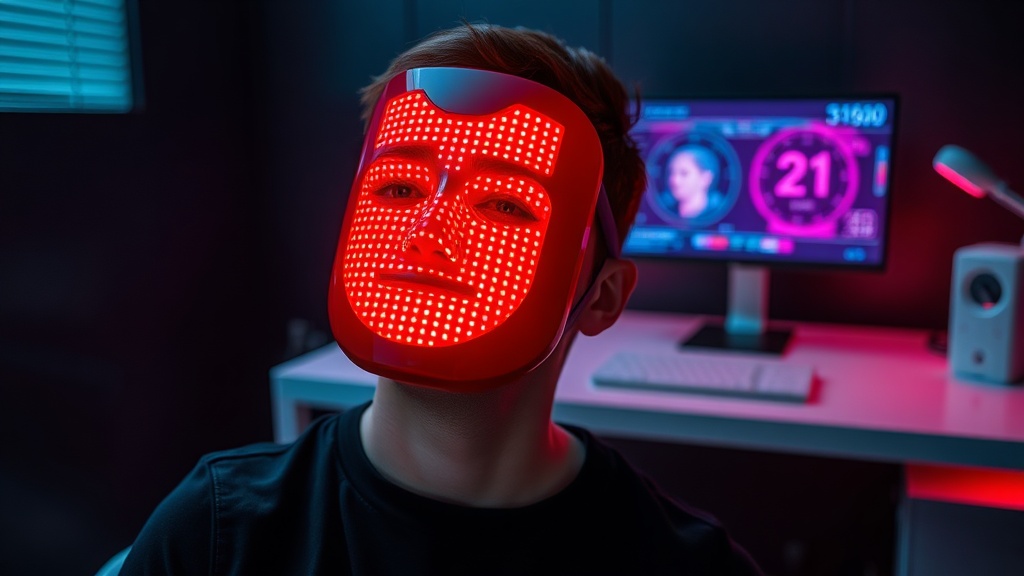
5. Run an initial 4-week block, then assess. The RCT showed measurable outcomes at 30 days post-treatment[2]. Take standardized photos (same lighting, same angle, same time of day) before starting and at 4 weeks. Without consistent documentation, you're just guessing.
6. Combine with established topicals for compounding effect. PBM upregulates collagen synthesis pathways. Retinoids do the same through a different mechanism (retinoid receptor activation). Using both isn't redundant — it's additive. Apply retinoids in the evening on non-PBM days to avoid potential photosensitivity interactions.
7. Fitzpatrick IV–VI: avoid blue light, stick with red. If you have darker skin, the data on Opsin-3–mediated melanogenesis from blue light exposure is concerning enough to warrant caution[6]. Red wavelengths (620–660 nm) do not carry this risk.
Related Video
What wavelength of red light is best for skin rejuvenation?#
The most-studied wavelength is 660 nm, which falls in the absorption peak of cytochrome c oxidase. The 2025 JAAD consensus and multiple RCTs use wavelengths in the 620–660 nm range[1][2]. Anything marketed as "red light" outside this range should be verified against the device's actual spectral output — marketing claims and emission spectra often disagree.
How often should I use a red light therapy mask?#
Based on the 2025 sham-controlled RCT by the research team in Lasers in Medical Science, twice-weekly sessions at 660 nm for 21 minutes produced results statistically equivalent to three-times-weekly sessions over four weeks[2]. Two sessions per week appears to be the efficiency sweet spot — more sessions didn't significantly improve outcomes.
Who should avoid certain types of light therapy?#
Individuals with Fitzpatrick skin phototypes IV–VI should exercise caution with blue light (400–495 nm) photobiomodulation, as Curyło et al. (2025) identified a risk of worsened hyperpigmentation through Opsin-3–mediated melanogenesis[6]. Red light at 620–660 nm does not carry this risk. Anyone on photosensitizing medications should consult a dermatologist before starting PBM.
Why is the 2025 JAAD consensus significant for red light therapy?#
It's the first structured, evidence-based clinical consensus on photobiomodulation from a panel of 21 international experts published in dermatology's leading journal. The 38 consensus statements move PBM from "promising but unvalidated" to "clinically recognized with defined parameters"[1]. This matters because it gives clinicians — and informed consumers — a benchmark for evaluating devices and protocols.
How does red light therapy compare to retinoids for anti-aging?#
Retinoids remain the gold standard with decades of large-scale RCT support. Red light PBM works through a different mechanism (mitochondrial, not receptor-mediated) and the evidence base is younger and smaller. The two are not competitors — they're complementary. Early data suggests combining both may produce additive benefits, though no head-to-head RCT has been published yet.
VERDICT#
7.5/10. The science is real. The mechanism is well-characterized. The 2025 JAAD consensus is a genuine milestone that separates PBM from the wellness noise. The RCT data on frequency is useful and practical — twice a week is enough, and that alone saves people time and money on protocols they don't need.
But I'm not going to oversell this. The rejuvenation RCTs are still relatively small. The multi-wavelength combination data is from a single 30-person trial. The lipedema work is n=3. And the narrative review's honest admission that skin rejuvenation shows "variable success" tells me we're still early in the optimization curve.
The parameters are there. The biology is sound. What's missing is the large-scale, long-term, standardized-dosimetry data that would push this above an 8. I'd use PBM — I do use PBM — but I wouldn't abandon retinoids for it, and I'd be skeptical of any device that doesn't publish its irradiance specs.
References
- 1.Hannah H.. Red Light Therapy Skin Health Science: What the 2025 JAAD Consensus Means for You. Top Doctor Magazine (2026). ↩
- 2.Role of photobiomodulation application frequency in facial rejuvenation: randomized, sham-controlled, double-blind, clinical trial. Lasers in Medical Science (2025). ↩
- 3.Photobiomodulation and Photodynamic Therapy Using Red LED Light in Dermatology: A Narrative Review. Bratislava Medical Journal (2025). ↩
- 4.Efficacy and safety of 570/590 Nm yellow light combined with red light and infrared LED in treating facial skin photoaging. Lasers in Medical Science (2025). ↩
- 5.Aquino AE Jr et al.. Photobiomodulation with IR and RED light acutely applied to lipedema patients: preliminary study with 3 cases. Lasers in Medical Science (2025). ↩
- 6.Curyło W, Chwaleba K, Kłak I, Szerocki J, Milewska-Plis K, Mazur K, Herian M, Bebko P, Nowakowska W. LED photobiomodulation: From dermatological care to neuroprotection and pain management – review. Our Dermatology Online (2025). ↩
Sova Reld
Sova writes with focused intensity and low tolerance for vague claims. She came to photobiomodulation through personal experimentation and is irritated by both true believers and reflexive skeptics. Her writing has edge: 'The wellness market has done more damage to this field than the skeptics ever could.' She's extremely precise about parameters — wavelength, irradiance, duration — and will tell you when a study used inadequate dosing without apology.
View all articles →