Binaural Beats for Sleep and Cognition: New PSG Evidence Reviewed

SNIPPET: Binaural beats may improve objective sleep efficiency and enhance error-aware response inhibition, according to a March 2026 polysomnography study in Sleep and Breathing. A two-week intervention showed more consolidated sleep and reduced unaware cognitive errors, though subjective sleep quality remained unchanged. Gamma-frequency (40 Hz) beats appear most effective for cognitive enhancement.
Binaural Beats for Sleep and Cognitive Performance: What the Latest Research Actually Shows
THE PROTOHUMAN PERSPECTIVE#
The ability to modulate brainwave states with nothing more than stereo headphones and a frequency differential sits at an interesting intersection of neuroscience and accessibility. If binaural beats genuinely improve sleep architecture and sharpen inhibitory control — two pillars of cognitive performance that degrade with age, stress, and modern screen exposure — we're looking at one of the cheapest interventions in the optimization toolkit. But "if" is doing heavy lifting in that sentence. The new data from Sleep and Breathing (March 2026) offers polysomnography-backed evidence, not just self-report questionnaires, which is a meaningful step forward. For anyone pursuing sustained cognitive output, the implications matter: better sleep consolidation feeds into prefrontal cortex function, which feeds into decision-making, impulse control, and error detection. The loop is tight. Whether binaural beats can reliably enter that loop — that's the question worth pressing on.
THE SCIENCE#
What Are Binaural Beats, Precisely?#
Binaural beats are an auditory illusion. When two tones of slightly different frequencies are delivered separately to each ear through headphones, the brain perceives a third tone — a "beat" — oscillating at the frequency equal to the difference between them[5]. Present a 400 Hz tone to the left ear and a 440 Hz tone to the right, and the brain registers a 40 Hz gamma-frequency beat. This phenomenon occurs in the auditory brainstem and cortex, and the working hypothesis is that it drives neural entrainment — essentially nudging brainwave oscillations toward the target frequency.
The entrainment hypothesis is central to every claim made about binaural beats. Without it, you're just listening to two slightly different tones.
The Sleep Study: Polysomnography, Not Questionnaires#
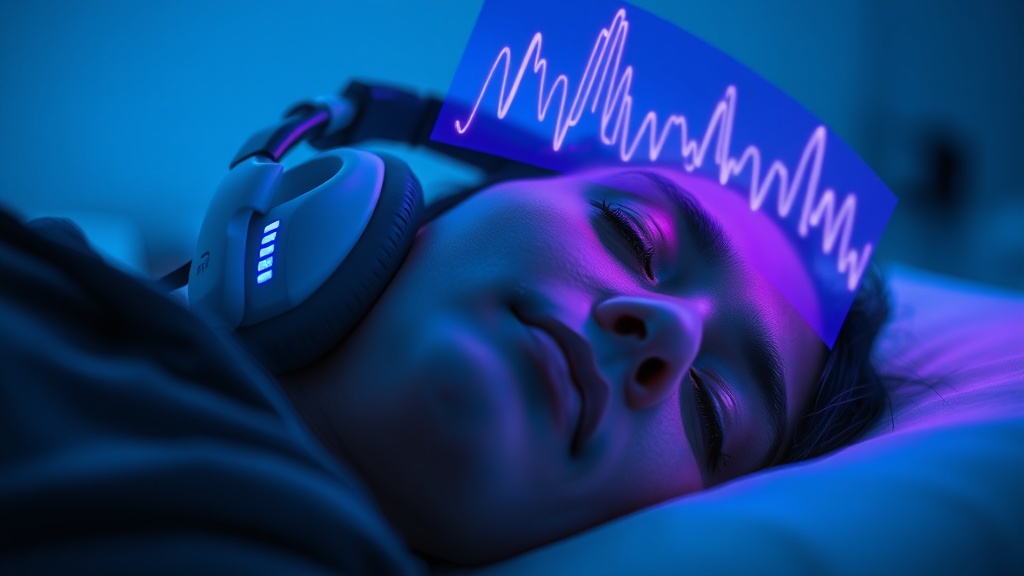
The March 2026 study published in Sleep and Breathing by researchers examining binaural beat effects on sleep used polysomnography (PSG) across multiple nights — adaptation, baseline, control, and post-intervention — in a within-subject design with 15 participants (mean age 28.37 ± 2.06 years)[1]. The intervention period was two weeks of binaural beat exposure.
Here's what they found: objective sleep efficiency increased significantly compared to both baseline and control conditions. Sleep latency showed marginal reductions. The sleep was more consolidated — meaning fewer awakenings, more time spent actually asleep relative to time in bed.
But — and I want to be clear about this — subjective sleep quality did not improve. Participants didn't feel like they slept better. This dissociation between objective and subjective measures is common in sleep research, and it's worth sitting with rather than dismissing. It could mean the improvements are real but subtle enough that conscious perception doesn't register them. Or it could mean the PSG changes, while statistically significant, aren't clinically meaningful enough to alter lived experience.
I'm not sure which interpretation I prefer. Fifteen participants is a small cohort. This is the part where, personally, I stopped trusting any sleep study that doesn't clear at least 30 subjects.
Error-Aware Response Inhibition: The Cognitive Angle#
The same study measured response inhibition using a modified Go/No-Go paradigm with mouse tracking — a clever methodological choice that allows researchers to differentiate between errors participants noticed (aware errors) and errors they didn't (unaware errors)[1].
After the binaural beat intervention, participants showed longer reaction times and a marginal decrease in unaware errors. The longer reaction times aren't a negative finding here — they suggest participants were being more deliberate, trading speed for accuracy. The reduction in unaware errors is the more interesting signal: it implies the prefrontal mechanisms responsible for error monitoring became slightly more active.
— Actually, I want to rephrase that. It doesn't prove prefrontal activation increased. It suggests behavioral output consistent with improved inhibitory control. The study didn't include EEG source localization, which the authors themselves acknowledge as a limitation.
Gamma-Frequency Beats and Attention: The 40 Hz Signal#
A separate line of evidence supports 40 Hz binaural beats specifically for cognitive performance. A 2026 study in Current Psychology with 72 participants found that 40 Hz binaural beats significantly enhanced reading comprehension accuracy and narrowed attentional scope on a global-local processing task[2]. The 7 Hz (theta-range) condition? No significant effects. Neither frequency altered mood.
This frequency-specific finding aligns with what we know about gamma oscillations: they're associated with binding sensory information, working memory maintenance, and attentional selection. The neural entrainment mechanism is plausible here — gamma-band frequencies have been consistently linked to these cognitive functions in the broader neuroscience literature.
A parametric investigation published in Scientific Reports (2025) with 80 participants adds nuance: gamma-frequency binaural beats with a low carrier tone (340 Hz) and white noise background improved general attention performance, and EEG confirmed brain entrainment[5]. But they did not reduce the vigilance decrement over time — meaning sustained attention didn't improve, only general attentional processing.
That distinction matters. "Binaural beats improve attention" is an oversimplification. The more accurate statement: 40 Hz binaural beats may improve certain components of attentional processing without enhancing the ability to sustain focus over prolonged periods.
The Inaudible Beats Question#
A team from Konkuk University (Kim et al., 2026) explored whether binaural beats still work when the baseline carrier frequency is set in the inaudible range — removing any confound from the sound itself[3]. Meanwhile, a 2025 study in Experimental Brain Research using inaudible 40 Hz beats found significantly lower reaction times during attention network testing, with the effect correlating with theta-band power in the left dorsolateral prefrontal cortex[4].
This is noteworthy. If beats work even when participants can't consciously hear the carrier tone, the mechanism is less likely to be a simple distraction or relaxation effect and more likely to involve genuine subcortical auditory processing.
Combining Binaural Beats with Suggestion#
A 2024 study in Neuroscience and Behavioral Physiology (n=63) tested binaural beats alone, suggestive relaxation instructions alone, and the combination[6]. Sleep latency was shortest with the combined approach (1149 ± 113 sec) versus beats alone (1469 ± 89 sec, p < 0.01). The researchers concluded that suggestion plays the decisive role, with binaural beats acting as an enhancer rather than a standalone intervention.
Sleep Latency by Intervention Type
The catch, though. That combined condition only shaved about 5 minutes off sleep latency compared to suggestion alone. I'd want to see whether that difference holds clinical significance or just statistical significance.
COMPARISON TABLE#
| Method | Mechanism | Evidence Level | Cost | Accessibility |
|---|---|---|---|---|
| Binaural Beats (delta/theta for sleep) | Neural entrainment via auditory frequency differential | Small human trials; PSG-confirmed in 1 study (n=15) | Free–$10/month (apps) | Very high — headphones only |
| Binaural Beats (40 Hz gamma for cognition) | Gamma-band entrainment modulating attention networks | Multiple small trials (n=72–80); EEG-confirmed entrainment | Free–$10/month (apps) | Very high |
| Melatonin supplementation | Exogenous hormone timing circadian rhythm | Meta-analyses support modest sleep latency reduction | $5–15/month | High (OTC in most countries) |
| CBT-I (Cognitive Behavioral Therapy for Insomnia) | Behavioral and cognitive restructuring of sleep patterns | Gold standard; multiple large RCTs and meta-analyses | $100–300/session | Moderate (requires therapist) |
| Prescription sleep aids (z-drugs) | GABAa receptor modulation | Strong acute evidence; dependency/tolerance concerns | $15–60/month | Requires prescription |
| White/pink noise | Auditory masking of environmental disruptions | Mixed evidence; some RCTs support | Free–$5/month | Very high |
THE PROTOCOL#
Based on the current evidence — and I want to stress this is preliminary — here is a structured approach for trialing binaural beats for sleep and cognitive performance.
1. Select your frequency based on your goal. For sleep improvement, use delta-range (1–4 Hz) or theta-range (4–7 Hz) binaural beats at bedtime. For cognitive performance and attentional sharpening, use 40 Hz gamma-frequency beats during work or study sessions.
2. Choose a carrier tone in the 340–400 Hz range. The parametric study by researchers published in Scientific Reports found that lower carrier tones (340 Hz) paired with gamma beats produced the strongest attentional effects[5]. For sleep protocols, carrier tone selection is less well-studied, but mid-range frequencies appear standard across the literature.
3. Use stereo headphones — this is non-negotiable. Binaural beats require dichotic presentation (different frequencies to each ear). Speakers won't work. Over-ear headphones or sleep-specific headband headphones are recommended for nighttime use.
4. Add white noise as a background layer for cognitive sessions. The parametric study confirmed that gamma-frequency beats with white noise background produced better attentional outcomes than those without masking noise[5]. For sleep sessions, consider whether background noise helps or hinders your personal sleep onset — individual variation is high here.
5. Duration: minimum 15 minutes for cognitive sessions, 20–30 minutes for sleep onset. The sleep study used a two-week nightly intervention period before measuring outcomes[1]. Don't expect single-session miracles.
6. Combine with relaxation techniques for sleep applications. The evidence from Dorokhov et al. suggests that binaural beats enhance the effect of suggestion-based relaxation rather than replacing it[6]. Progressive muscle relaxation or body scan meditation paired with beats is a reasonable protocol.
7. Track objectively if possible. Given the dissociation between objective and subjective sleep quality in the primary study, consider using a wearable (Oura, Whoop, Apple Watch) to monitor sleep efficiency and latency alongside your subjective ratings. Two weeks minimum before drawing conclusions.
Related Video
VERDICT#
Score: 5.5/10
The new polysomnography data from Sleep and Breathing is a genuine step forward — using PSG rather than questionnaires elevates this above the typical binaural beat study. The gamma-frequency attention data from multiple teams is building into something coherent. But I can't score this higher when the flagship sleep study has 15 participants, subjective measures don't align with objective ones, and the cognitive improvements are marginal. The field needs larger, pre-registered trials with standardized protocols before binaural beats can be recommended with any real confidence. Low risk, low cost, potentially useful — but don't restructure your sleep hygiene around this yet.
Frequently Asked Questions5
References
- 1.Sleep modulation by binaural beats and its relation to error-aware response inhibition. Sleep and Breathing (2026). ↩
- 2.The effects of binaural beats on attention, reading comprehension, and mood. Current Psychology (2026). ↩
- 3.Kim K, Lee M, Jeong Y, Kim J, Choi M, Kim H, Min B, Chung S. Effect of Inaudible Binaural Beats Stimulation Timing and Task Performance Level on Visuospatial Working Memory. Behavioral Sciences (2026). ↩
- 4.Effect of inaudible 40 Hz binaural beats on attention. Experimental Brain Research (2025). ↩
- 5.A parametric investigation of binaural beats for brain entrainment and enhancing sustained attention. Scientific Reports (2025). ↩
- 6.Dorokhov VB et al.. The Effectiveness of Suggestion-Based Methods to Improve Sleep Is Increased by Combining Them with Sound Stimuli Based on Binaural Beat. Neuroscience and Behavioral Physiology (2024). ↩
Yuki Shan
Yuki writes with measured precision but genuine intellectual frustration when the data is messy. She uses long, careful sentences for complex mechanisms, then cuts to very short ones for emphasis: 'That's the problem.' She's comfortable saying 'I'm not sure this matters clinically' even when the statistics look impressive. She'll sometimes restart a line of reasoning mid-paragraph: '— actually, I want to rephrase that.' She's suspicious of studies with small sleep cohorts and says so.
View all articles →