Biological Age Reversal Trials: MAC Supplements and Plasma Exchange

SNIPPET: Multiple approaches to reversing biological age are now entering human trials. A pilot study published in Scientific Reports showed a 60-day microbiota-accessible nutritional complex reduced biological age markers, cutting hs-CRP inflammation by 69%. Meanwhile, plasma-based rejuvenation and partial epigenetic reprogramming are advancing toward clinical translation, though rigorous validation remains essential.
THE PROTOHUMAN PERSPECTIVE#
We've spent most of our species' existence accepting that time moves in one direction. You age. You decline. You die. The idea that biological aging might be a modifiable condition — not a fixed trajectory — is arguably the most consequential shift in how we understand human performance since we started measuring VO₂ max.
What's happening now is different from the usual longevity hype cycle. We're seeing convergence: gut-targeted nutritional interventions, plasma dilution strategies, and epigenetic reprogramming are all being tested on real humans, not just mice. The data is early. Some of it is fragile. But the direction is unmistakable, and the implications for healthspan extension touch everything — from how we train to how we plan our lives. If even one of these approaches delivers consistent, replicable biological age reversal in humans, it rewrites the operating manual for the second half of life.
The question is no longer whether biological age can be influenced. It's which lever works best, how much it costs, and whether we're being honest about what the evidence actually shows so far.
THE SCIENCE#
Microbiota-Accessible Nutritional Complexes: The MAC Study#
Biological age refers to the functional state of your cells and systems relative to your chronological age — and it can be measured through serum biomarkers, epigenetic clocks, and machine-learning models trained on physiological data. A pilot study published in Scientific Reports in late 2025 tested whether a formulation called a microbiota-accessible nutritional complex (MAC) could shift these markers in the right direction [1].
The MAC formulation combined prebiotics, postbiotics, autophagy stimulators, senolytic activators, and natural probiotics — essentially a multi-pathway approach targeting the gut-systemic aging axis. Nine medically healthy adults (mean age 61) completed 60 days of daily supplementation.
Here's what the data told me.
The standout result was a 69% reduction in high-sensitivity C-reactive protein (hs-CRP) — from 2.66 mg/L to 0.84 mg/L (p = 0.009, Cohen's d ≈ 0.55). hs-CRP is a well-established marker of systemic inflammation, and chronic low-grade inflammation — sometimes called "inflammaging" — is one of the primary drivers of accelerated biological aging. A reduction of this magnitude, if it holds, is clinically meaningful.
Lactate dehydrogenase (LDH) also dropped by 6.8% (p = 0.038), suggesting reduced cellular damage or improved metabolic efficiency. Other markers — GGT, alkaline phosphatase, glucose — trended in the right direction without hitting statistical significance.
The biological age estimates were generated using three machine-learning regressors: Support Vector Regression, Random Forest, and XGBoost. The XGBoost model captured the most consistent improvements, with one participant showing a 3.3-year reduction in estimated BioAge. An independent empirical model confirmed a statistically significant BioAge reduction post-intervention (p < 0.0001) [1].
But here's where I push back. Nine participants. No control group. Single-arm design. Sixty days. The study authors acknowledge these limitations explicitly, and I respect that — but it means we're looking at signal detection, not proof. The hs-CRP result is encouraging, particularly because the effect size was moderate, but I'd want to see this in a randomized controlled trial with at least 50 participants before changing any protocol. The AI-modeled BioAge estimates are interesting as a framework but vary wildly depending on which algorithm you use — when SVR detects nothing and XGBoost detects 3.3 years, that's a methodological gap, not a consensus.
The feature importance analysis revealed that LDL cholesterol, glucose, and total cholesterol were the top predictors in Random Forest and SVR models, while ferritin and hs-CRP dominated the XGBoost model. This divergence matters. It suggests the biological age construct is still being defined, and different models are essentially measuring different things.
Plasma-Based Rejuvenation: The Parabiosis Legacy#
A separate line of research — reviewed in a 2026 open-access paper in GeroScience — examines plasma-based strategies for systemic rejuvenation [2]. The premise: circulating factors in blood can influence brain, vascular, and immune aging through cell non-autonomous mechanisms. Heterochronic parabiosis experiments (surgically joining old and young animals to share a circulatory system) have shown that pro-geronic and anti-geronic signals in blood can modulate neuroinflammation, neurovascular health, and cognitive resilience.
Therapeutic plasma exchange (TPE) has emerged as a less invasive approach — essentially diluting the aged plasma environment to reduce pro-aging circulating factors. Preclinical studies report rejuvenative effects on multiple organ systems.
The catch, though. The GeroScience review is deliberately cautious. The authors argue that clinical translation "remains fraught with uncertainty" and that "future progress in systemic rejuvenation will depend on precise, mechanistically informed interventions — rather than broad, premature applications of plasma therapies" [2]. The ethical dimension is real: the review explicitly addresses the "Vampires 2.0" framing of young blood infusions. This is science trying to stay ahead of its own hype, and I appreciate the restraint.
Life Biosciences and Epigenetic Reprogramming#
Meanwhile, Life Biosciences has announced plans to begin human trials of partial epigenetic reprogramming — an approach that aims to reset cellular age markers without losing cell identity. This builds on the Yamanaka factor research that's been advancing through preclinical models for years. The concept targets the epigenetic clock directly: if methylation patterns accumulate damage over time, partial reprogramming could theoretically reverse that drift while keeping cells functional.
I'm less convinced by the social media announcements than by the underlying biology. Partial reprogramming has shown promise in mouse models, but the gap between rejuvenating mouse liver cells and safely reprogramming human tissues in vivo is enormous. The risk of teratoma formation — cells reverting too far and becoming cancerous — hasn't been fully resolved. Still, the fact that human trials are being planned signals that the preclinical safety data has reached a threshold someone is willing to bet on.
MAC Supplementation: Key Biomarker Changes (60 Days)
COMPARISON TABLE#
| Method | Mechanism | Evidence Level | Cost | Accessibility |
|---|---|---|---|---|
| MAC Supplementation | Gut microbiota modulation, autophagy activation, senolytic signaling | Pilot study (n=9), single-arm | Low (~$30–80/month estimated) | High — oral supplement |
| Therapeutic Plasma Exchange (TPE) | Dilution of pro-geronic circulating factors | Preclinical + early human case studies | High ($2,000–5,000/session) | Low — clinical setting required |
| Partial Epigenetic Reprogramming | Yamanaka factor-mediated methylation reset | Preclinical (entering human trials) | Unknown (experimental) | Very low — trial access only |
| Caloric Restriction / Fasting | mTOR inhibition, autophagy upregulation, NAD+ conservation | Multiple human RCTs | Free | High |
| Rapamycin (off-label) | mTOR inhibition, autophagy pathway activation | Multiple human trials, ongoing | Moderate (~$50–200/month) | Moderate — requires prescription |
THE PROTOCOL#
Based on current evidence — particularly the MAC pilot study — here is a cautious protocol for those interested in targeting biological age through gut-accessible interventions. This is not medical advice; it's a framework informed by early data.
Step 1. Establish your baseline. Get a comprehensive blood panel including hs-CRP, LDH, fasting glucose, LDL-C, total cholesterol, ferritin, GGT, and alkaline phosphatase. Consider an epigenetic age test (TruAge, GrimAge, or equivalent) for a biological age estimate. Without a baseline, you have no way to measure whether anything moved.
Step 2. Begin a microbiota-accessible nutritional complex. Look for formulations that combine prebiotics (e.g., inulin, FOS), postbiotics (e.g., short-chain fatty acids or their precursors), natural probiotics (multi-strain, including Lactobacillus and Bifidobacterium species), autophagy-stimulating compounds (e.g., spermidine, fisetin), and senolytic activators (e.g., quercetin). The MAC study used a 60-day protocol with daily dosing.
Step 3. Support autophagy pathways independently. Time-restricted eating (a 16:8 feeding window) may amplify the autophagy-stimulating effects of supplementation. This is well-supported by separate literature on mTOR inhibition and NAD+ conservation during fasting states.
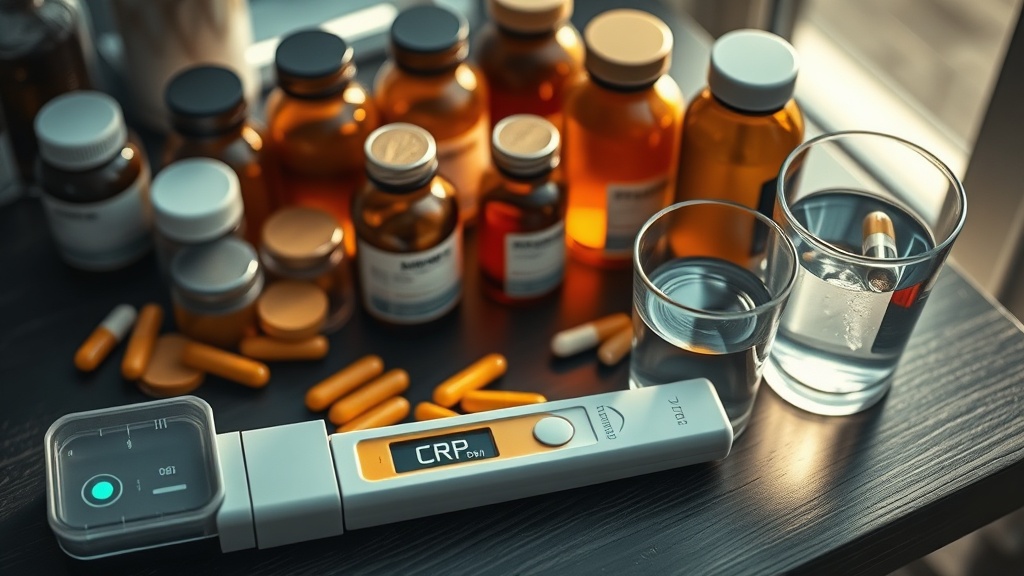
Step 4. Track inflammation weekly if possible, or at minimum at 30 and 60 days. hs-CRP is affordable to test and provides the most direct signal based on the MAC study's strongest finding. If hs-CRP drops meaningfully (>30% from baseline), the intervention may be working through the inflammation-aging axis.
Step 5. Retest your full panel at 60 days. Compare against baseline. If you ran an epigenetic clock at the start, repeat it. Document everything — the value here is in your personal longitudinal data, not in any single snapshot.
Step 6. Evaluate whether to continue, modify, or stop. If inflammatory markers improved and no adverse effects occurred, a continued protocol seems reasonable based on the safety profile reported. If no change was detected, the intervention may not be the right lever for your biology.
Related Video
What is biological age and how is it different from chronological age?#
Biological age reflects the functional state of your cells, tissues, and organ systems — measured through biomarkers, epigenetic clocks, or AI models — rather than simply how many years you've been alive. Two people born the same year can have biological ages that differ by a decade or more, depending on lifestyle, genetics, and accumulated cellular damage.
How reliable are AI-based biological age estimates?#
Honestly, it depends heavily on which model you use. The MAC study showed that XGBoost, Random Forest, and SVR produced meaningfully different estimates from the same data. AI-based BioAge tools are useful for detecting trends within an individual over time, but the absolute numbers should be taken as directional signals, not precise measurements. The field hasn't converged on a single standard yet.
Who should consider trying a microbiota-accessible nutritional complex?#
Based on the pilot data, medically healthy adults over 50 with elevated inflammatory markers (particularly hs-CRP > 1.0 mg/L) may see the most benefit. However, the evidence base is a single pilot study with nine participants. If you have existing health conditions or take medications, consult a physician before starting any new supplementation protocol.
Why is plasma exchange being studied for anti-aging?#
Preclinical parabiosis experiments showed that old animals exposed to young blood experienced rejuvenation of brain, immune, and vascular tissues. Therapeutic plasma exchange attempts to achieve a similar effect by diluting pro-aging factors in the blood. The 2026 GeroScience review emphasizes that this approach is still experimental and that mechanisms, efficacy, and long-term safety remain incompletely understood [2].
When will epigenetic reprogramming trials produce results?#
Life Biosciences has announced plans to begin human trials of partial epigenetic reprogramming, but timelines for results are uncertain. Even optimistic projections suggest initial safety and efficacy data won't be available for at least 18–24 months after enrollment begins. The preclinical-to-clinical gap for reprogramming therapies is substantial, and I'd expect a cautious, phased approach.
VERDICT#
Score: 6/10
The direction is right. The convergence of gut-targeted nutritional interventions, plasma-based strategies, and epigenetic reprogramming represents a genuine paradigm shift in how we approach aging — from inevitable decline to potentially modifiable biology. But the data supporting actionable human protocols today is thin. The MAC study is a well-designed pilot that produced a genuinely impressive hs-CRP result, but nine participants and no control group means we're still in hypothesis-generating territory. Plasma exchange and epigenetic reprogramming are further from validated human application than the headlines suggest.
I take the long view on these things. On a decade-level timescale, one of these approaches — probably some combination — will likely deliver meaningful, measurable biological age reversal. But right now, the honest assessment is that we're watching the foundation being laid, not the building going up. The inflammation data from MAC supplementation is the most actionable signal in this collection of research. Everything else requires patience.
That patience matters.
References
- 1.Author(s) not listed. Targeting biological age with bioactive, microbiota-accessible nutritional complexes: a pilot study on healthspan extension in medically healthy adults. Scientific Reports (2025). ↩
- 2.Author(s) not listed. Plasma-based strategies for systemic rejuvenation: critical perspectives on clinical translation. GeroScience (2026). ↩
Orren Falk
Orren writes with the seriousness of someone who thinks about their own mortality every day and has made peace with it. He takes the long view, which means he's less excited than others about marginal gains and more focused on whether something moves the needle on a decade-level timescale. He'll admit when a study impresses him: 'This one actually moved me.' He uses 'the data' as a character in his writing — it speaks, it tells him things, it sometimes disappoints him.
View all articles →