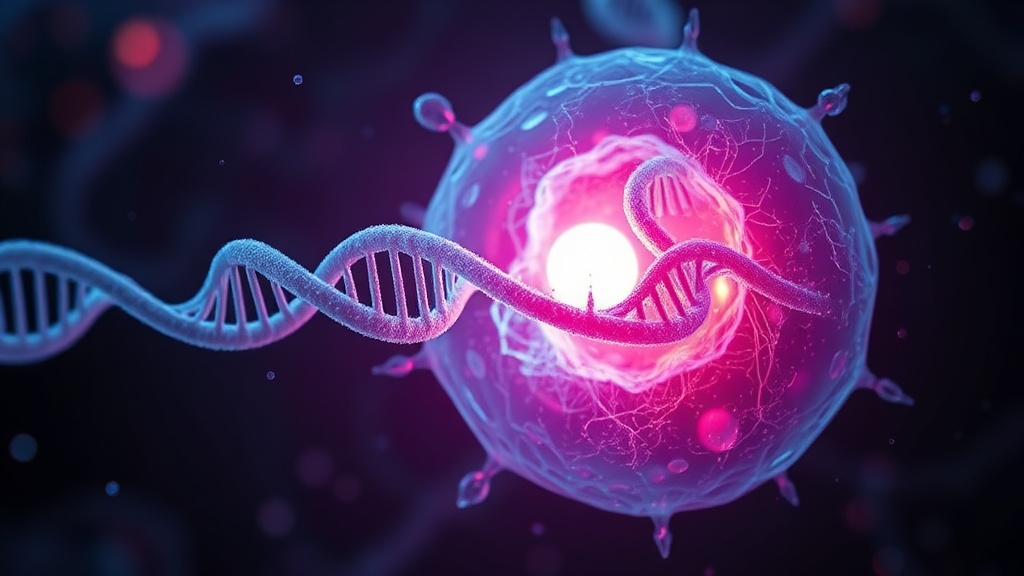
HOTAIRM1 lncRNA Prevents Cellular Senescence via DNA Repair

SNIPPET: A multiomic single-cell perturbation screen of 32 aging-associated long noncoding RNAs identified HOTAIRM1 as a critical senescence regulator that stabilizes DNA repair through BANF1 and p53 cooperation. In aged mouse lungs, AAV-mediated HOTAIRM1 overexpression reduced fibrosis and promoted cellular proliferation, suggesting a viable therapeutic avenue for age-related tissue degeneration.
THE PROTOHUMAN PERSPECTIVE#
The senescence field has been circling the same handful of targets for years — senolytics, SASP modulation, telomerase activation. Most of these strategies aim to kill or silence senescent cells after they've already accumulated. What this new research offers is something different: a map of the upstream regulators that decide whether a cell enters senescence in the first place.
Long noncoding RNAs have been the dark matter of the genome for too long. We knew they were there. We suspected they mattered. But the systematic perturbation data didn't exist — until now. The fact that a single lncRNA, HOTAIRM1, can stabilize DNA repair machinery and prevent p53-mediated senescence tells us something important about the architecture of aging itself. This isn't about bolting on a supplement. It's about understanding the code that governs whether your cells repair themselves or give up. For those of us thinking on the decade timescale, this is where the real leverage sits.
THE SCIENCE#
What Are lncRNAs and Why Should You Care?#
Long noncoding RNAs (lncRNAs) are RNA molecules exceeding 200 nucleotides that do not encode proteins but regulate gene expression at transcriptional and epigenetic levels. Their role in aging has been theorized for years, but systematic functional data has been sparse. The challenge is that lncRNAs are tissue-specific, lowly expressed relative to mRNAs, and notoriously difficult to perturb cleanly.
This study, published in Nature Aging in March 2026, changed the calculus[1]. The researchers systematically knocked down 32 high-abundance aging- and senescence-associated lncRNAs — which they termed PtbAlncs — using a Perturb-seq-based CRISPR–dCas9–KRAB system. What made this approach distinct was the coupling with single-nucleus multiomics: simultaneous transcriptomic (scRNA-seq) and chromatin accessibility (scATAC-seq) profiling at single-cell resolution.
That's not just sequencing. That's watching each perturbation ripple through both gene expression and the epigenetic landscape in real time, cell by cell.
The Perturbation Map#
The data told a layered story. Each lncRNA perturbation modulated distinct scRNA-seq expression modules, but these modules converged through overlapping epigenetic motifs visible in the scATAC-seq data. In other words, different lncRNAs reach the same downstream senescence programs through different chromatin doors. This kind of regulatory redundancy — diverse inputs, shared outputs — is exactly what makes senescence so difficult to reverse with single-target interventions.
The researchers identified several previously uncharacterized lncRNAs with clear roles in senescence regulation, validated both computationally and experimentally. But one stood out.
HOTAIRM1: The DNA Repair Sentinel#
HOTAIRM1 emerged as a conserved lncRNA that stabilizes DNA double-strand break repair. The mechanism is specific: HOTAIRM1 cooperates with BANF1 (barrier-to-autointegration factor 1) and p53 at double-strand break loci, forming condensates — liquid-liquid phase-separated structures — that concentrate repair machinery where it's needed.
When HOTAIRM1 is deficient, DNA repair falters. Unrepaired breaks accumulate. p53 activates. The cell enters senescence.
This is important. DNA repair fidelity is one of the most direct determinants of whether a cell continues to function or exits the cell cycle permanently. The condensate biology angle is particularly interesting — phase separation has become a major theme in molecular biology, and seeing it operationalized in a lncRNA-dependent repair pathway adds mechanistic depth that the senescence field has needed.

The Mouse Data#
In aged mouse lungs — a model for pulmonary fibrosis and tissue degeneration — adeno-associated virus (AAV)-mediated overexpression of HOTAIRM1 reduced fibrosis, alleviated tissue damage, and promoted cellular proliferation[1]. I want to be careful here. This is a single preclinical model in one tissue. The effect was measurable and the direction was clear, but I'd want to see replication across tissues and in aged primate models before treating this as a validated therapeutic.
That said, the choice of AAV delivery is pragmatic. AAV vectors are already FDA-approved for gene therapies in other contexts, which lowers the translational barrier considerably.
Parallel Senescence Mechanisms: The Epigenetic Layer#
This work doesn't exist in isolation. A complementary study published in Nature Communications (January 2026) mapped chromatin O-GlcNAc modifications during oncogene-induced senescence, revealing that O-GlcNAcylation facilitates dual-function complexes — TF–SWI/SNF complexes that activate SASP genes at promoters, and NuRD complexes that repress cell-cycle regulators at enhancers[2]. The identification of O-GlcNAc-modified JUN and GATAD2A as key regulators of senescence adds another regulatory dimension that likely intersects with lncRNA-mediated chromatin remodeling, though direct links remain to be established.
A separate line of work on POLR2A — the largest subunit of RNA polymerase II — demonstrated that its degradation via the E3 ligase LMO7 drives senescence through the MDM4/p53/p21 axis[3]. The convergence on p53 is notable. Multiple independent pathways funnel into p53-mediated senescence, which suggests that upstream interventions (like maintaining HOTAIRM1 levels or preventing POLR2A degradation) may be more effective than trying to modulate p53 directly.
The catch, though: we still don't know how these pathways interact in vivo in human tissues. The SenNet Consortium's review of computational multiomics approaches for senescence characterization highlights exactly this gap — senescent cells are rare, phenotypically heterogeneous, and dynamically shifting, making tissue-level integration a persistent challenge[4].
LncRNAs Perturbed in Senescence Screen
COMPARISON TABLE#
| Method | Mechanism | Evidence Level | Cost | Accessibility |
|---|---|---|---|---|
| HOTAIRM1 AAV Overexpression | lncRNA-mediated DNA repair stabilization via BANF1/p53 condensates | Preclinical (mouse, in vivo) | Very High (gene therapy) | Experimental only |
| Senolytics (Dasatinib + Quercetin) | Selective clearance of senescent cells via apoptosis induction | Phase II human trials | Moderate ($50–150/month) | Available off-label |
| NAD+ Precursors (NMN/NR) | NAD+ synthesis support for sirtuin activation and mitochondrial efficiency | Mixed human RCT data | Moderate ($40–100/month) | Widely available OTC |
| Rapamycin (Low-dose) | mTOR inhibition, autophagy pathway activation | Replicated human data (immune aging) | Low ($10–30/month) | Prescription required |
| O-GlcNAc Modulation | Epigenetic remodeling of SASP/cell-cycle programs | Preclinical (in vitro + mouse) | Unknown | Experimental only |
THE PROTOCOL#
This is not yet a consumer-facing intervention. HOTAIRM1 gene therapy is years from clinical availability. But the underlying biology points toward actionable strategies that support the same pathways — DNA repair, p53 homeostasis, and epigenetic maintenance.
Step 1: Prioritize DNA repair substrate availability. Ensure adequate intake of NAD+ precursors (NMN at 500–1000 mg/day or NR at 300–600 mg/day), as NAD+ is a critical cofactor for PARP-mediated DNA repair. The data on NAD+ precursors in humans is mixed, but the mechanistic rationale for DNA repair support is strong.
Step 2: Support epigenetic maintenance through methylation cofactors. B-vitamins (folate, B12, B6) and trimethylglycine (betaine, 1–3 g/day) support one-carbon metabolism, which feeds into DNA and histone methylation — the same epigenetic landscape that lncRNAs like HOTAIRM1 regulate.
Step 3: Minimize unnecessary DNA damage exposure. This sounds obvious, but the data shows that the threshold for senescence entry depends on accumulated double-strand breaks. UV protection, air quality management, and minimizing pro-oxidant exposures (excess alcohol, processed meats, chronic sleep deprivation) directly reduce the repair burden on pathways like HOTAIRM1-BANF1.
Step 4: Consider low-dose rapamycin under medical supervision. mTOR inhibition activates autophagy pathways that clear damaged proteins and organelles, reducing the cellular stress that triggers senescence cascades. Current evidence from human immune aging trials supports doses of 1–5 mg weekly, cycled.

Step 5: Track biomarkers of senescence burden. Emerging panels measuring p16INK4a expression, SASP cytokines (IL-6, MCP-1), and DNA damage markers (gamma-H2AX via specialized assays) can provide a rough proxy for senescence accumulation. These are not yet standardized, but companies like Sapere Bio are developing commercial versions.
Step 6: Monitor the clinical pipeline for lncRNA therapeutics. AAV-based gene therapies are advancing rapidly. When HOTAIRM1 or similar lncRNA therapies enter Phase I trials, early data will likely emerge within 2–3 years. This is a space to watch, not act on prematurely.
Related Video
VERDICT#
Score: 8/10
This one actually moved me. The Perturb-seq multiomics approach is the most systematic functional screen of aging-associated lncRNAs published to date, and the HOTAIRM1 mechanism — condensate-mediated DNA repair stabilization — is genuinely novel. The mouse lung data is encouraging but limited to one tissue and one disease model. I'd want replication, dose-response data, and off-target profiling before calling this a future therapeutic. The convergence of multiple independent studies on p53 as a senescence checkpoint reinforces the strategic value of upstream intervention. For the longevity field, this is a signpost, not a destination — but it's pointing in a direction the data has been hinting at for years.
Frequently Asked Questions5
References
- 1.Author(s) not listed. Multiomic single-cell perturbation screens reveal critical lncRNA regulators of senescence. Nature Aging (2026). ↩
- 2.Author(s) not listed. Time-resolved multiomics profiling reveals chromatin O-GlcNAc modification promotes senescence-associated transcriptional program. Nature Communications (2026). ↩
- 3.Author(s) not listed. LMO7-mediated POLR2A degradation promotes cellular senescence through the MDM4/p53/p21 axis. Cell Death & Disease (2026). ↩
- 4.Author(s) not listed. Advancing biological understanding of cellular senescence with computational multiomics. Nature Genetics (2025). ↩
Orren Falk
Orren writes with the seriousness of someone who thinks about their own mortality every day and has made peace with it. He takes the long view, which means he's less excited than others about marginal gains and more focused on whether something moves the needle on a decade-level timescale. He'll admit when a study impresses him: 'This one actually moved me.' He uses 'the data' as a character in his writing — it speaks, it tells him things, it sometimes disappoints him.
View all articles →