tPCS for Athlete Sleep: Chronotype-Specific Brain Stimulation

THE PROTOHUMAN PERSPECTIVE#
Sleep is the single most underrated performance variable in athletics. Not nutrition. Not periodization. Sleep. And yet the interventions most athletes reach for — melatonin, magnesium, the occasional Ambien — are blunt instruments aimed at a problem that's increasingly understood as neurologically specific.
What this new tPCS research from BMC Psychiatry suggests is something more interesting than "brain zapping helps you sleep." It suggests that the optimal window for neuromodulation depends on your chronotype — your biological clock architecture. That's a genuinely useful finding for anyone trying to build a personalized recovery protocol, and it aligns with the broader shift in biohacking away from one-size-fits-all toward chronobiology-driven interventions. For student-athletes — who represent an early-career population under enormous circadian stress from training schedules — the implications are immediate.
The catch, though: we're still working with small samples. I want to be upfront about that before we go further.
THE SCIENCE#
What Is tPCS and Why Should You Care?#
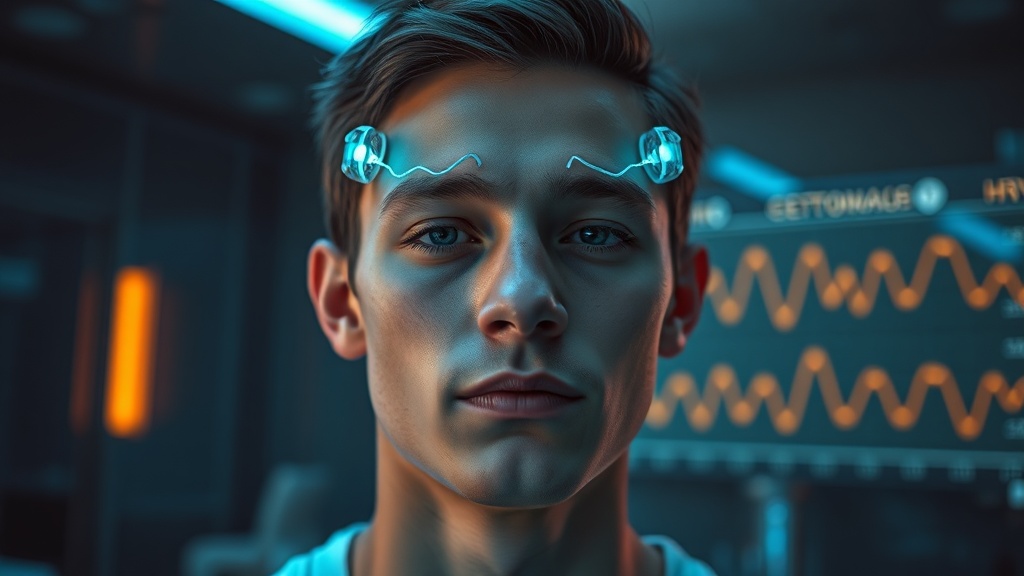
Transcranial pulsed current stimulation is a form of non-invasive brain stimulation (NIBS) that delivers low-amplitude electrical current — in this case, 1.5 milliamps — through scalp-mounted electrodes in pulsed intervals. Unlike its cousin transcranial direct current stimulation (tDCS), which delivers continuous current, tPCS modulates neural excitability through intermittent pulses, theoretically allowing more precise engagement with oscillatory brain activity relevant to sleep architecture[1].
The mechanism matters here. Poor sleep in athletes isn't just about cortisol or screen time. It's increasingly linked to dysregulated autonomic tone — specifically, an imbalance between sympathetic overdrive (the fight-or-flight system that training amplifies) and parasympathetic recovery (the vagal brake that enables deep sleep). HRV optimization sits at the center of this.
The Trial: 60 Student-Athletes, Two Chronotypes, 28 Days#
The study by researchers published in BMC Psychiatry (March 2026) recruited 30 morning-type (MT) and 30 evening-type (ET) student-athletes with diagnosed sleep disorders, aged 18–22[1]. Within each chronotype group, participants were randomized to active tPCS (n = 15) or sham stimulation (n = 15). The protocol: 30 minutes daily for 28 consecutive days at 1.5 mA.
Here's what I find genuinely notable. The researchers didn't just measure subjective sleep quality via PSQI scores — they tracked HRV parameters including RMSSD, SDNN, high-frequency (HF) power, and low-frequency (LF) power. That's a meaningful physiological anchor.
Results That Actually Moved the Needle#
The active stimulation group showed significant PSQI improvement (P = 0.007, η²p = 0.231), which translates to a moderate-to-large effect size for a neuromodulation intervention. But the HRV data is where this gets interesting:
- RMSSD increased with a large effect size (P < 0.001, η²p = 0.633) — this is a direct marker of parasympathetic cardiac modulation
- SDNN improved significantly (P < 0.001, η²p = 0.399), indicating greater overall autonomic flexibility
- HF power rose (P < 0.001, η²p = 0.541), while LF power decreased
All changes were statistically significant compared to sham (P < 0.05)[1].
That RMSSD effect size — 0.633 — actually, I want to rephrase that. It's not just large for a neuromodulation study. It's large, period. For context, most sleep hygiene interventions don't move RMSSD at all in controlled trials. The question is whether it holds up in larger samples.
The Chronotype Split: This Is Where It Gets Specific#
Morning-type athletes showed greater PSQI improvement — meaning their subjective sleep quality benefited more from the intervention. Evening-type athletes, on the other hand, showed more pronounced HRV improvements[1].
The intervention window matters: tPCS delivered between 18:00 and 19:00 yielded the best results for morning types. The researchers interpret this through the lens of chronobiological sensitivity — MT individuals are winding down their circadian arousal curve at this time, potentially making them more responsive to parasympathetic-enhancing stimulation.
I'm less convinced by the ET findings, honestly. The ET group had lower baseline PSQI scores and lower baseline HRV. That floor effect makes their improvements harder to interpret cleanly. Were they genuinely responding differently to tPCS, or were they just a sicker group at baseline with more room to move on physiological markers? The study doesn't fully resolve this.
Context: How Does This Compare to Other Brain Stimulation for Sleep?#
This isn't happening in a vacuum. A meta-analysis of transcranial alternating current stimulation (tACS) for chronic insomnia, also published in BMC Psychiatry in February 2026, pooled four RCTs (n = 247) and found tACS reduced sleep onset latency by 56.9 minutes at two weeks, improved PSQI by 5.73 points, and increased total sleep time by 85.29 minutes[2]. Response rates heavily favored tACS over sham (RR = 11.21). No significant adverse events emerged.
Separately, Chen et al. demonstrated that continuous theta burst stimulation (cTBS) targeting the right DLPFC improved sleep quality, reduced fatigue, and enhanced agility performance in athletes after just five days of intervention[3].
And then there's the personalized tACS approach from Ayanampudi et al., a preprint showing that individualized theta/alpha band stimulation improved sleep efficiency by 13.4% and cut onset latency by 54% in a crossover design with 31 participants[4].
Sleep Onset Latency Reduction Across Stimulation Methods
The problem with this trial — and I'll say it plainly — is n = 15 per subgroup. That's thin. With 15 people per cell, even a large effect size could be an artifact of individual variation. I've seen too many neurostimulation studies with beautiful p-values at n = 20 that evaporate at n = 100. This is the part where, personally, I stopped getting excited and started getting cautious.
COMPARISON TABLE#
| Method | Mechanism | Evidence Level | Cost | Accessibility |
|---|---|---|---|---|
| tPCS (1.5 mA, 28 days) | Pulsed current modulating cortical excitability and autonomic tone | Single RCT, n = 60 | $$$ (clinical device) | Low — requires trained administration |
| tACS (chronic insomnia) | Alternating current entraining sleep-promoting oscillations | Meta-analysis, 4 RCTs, n = 247 | $$$ (clinical device) | Low–Medium |
| cTBS (5-day protocol) | Theta burst magnetic stimulation targeting DLPFC | Single RCT, n = 20 | $$$$ (TMS equipment) | Very Low — clinic only |
| Personalized tACS | Individualized frequency targeting theta/alpha peaks | Preprint, crossover, n = 31 | $$$$$ (lab + EEG calibration) | Very Low — research stage |
| CBT-I (gold standard) | Cognitive-behavioral restructuring of sleep habits | Multiple meta-analyses, thousands of participants | $–$$ | High — available remotely |
| Melatonin (0.5–3 mg) | Exogenous hormone phase-shifting circadian rhythm | Extensive RCT literature | $ | Very High |
THE PROTOCOL#
Based on the current evidence from this trial and the broader transcranial stimulation literature, here's a practical framework — with the strong caveat that tPCS is not yet a consumer-available biohack.
-
Determine your chronotype first. Use a validated tool like the Morningness-Eveningness Questionnaire (MEQ). This isn't optional. The entire point of this research is that stimulation timing should match your circadian profile. If you're a morning type, your intervention window appears to be 18:00–19:00. Evening types may require later windows, though the optimal ET timing needs further study[1].
-
If pursuing clinical tPCS, target 1.5 mA for 30 minutes daily. This is the protocol used in the trial. Higher intensities are not supported by this data and carry increased risk of scalp discomfort or phosphene perception. The stimulation was delivered over 28 consecutive days — consistency matters more than intensity here.
-
Track HRV as your primary biofeedback marker. Use a validated wrist-based or chest-strap HRV monitor (Polar H10, WHOOP, or Oura Ring with HRV logging). Specifically, monitor morning RMSSD and nightly HF power trends. If your RMSSD is trending upward over 2–4 weeks, the protocol is likely shifting your autonomic balance toward parasympathetic dominance.
-
Layer sleep hygiene fundamentals — tPCS is not a standalone fix. Maintain consistent sleep/wake times aligned to your chronotype. Dim lighting 90 minutes before bed. Keep the room at 18–19°C. The stimulation works with circadian alignment, not as a replacement for it.
-
For athletes: schedule stimulation relative to your last training session. Post-training parasympathetic rebound typically begins 2–4 hours after exercise cessation. Aligning tPCS with this window may amplify autonomic recovery, though this specific interaction hasn't been tested yet.
-
Reassess at 4 weeks. The trial showed effects at 28 days. If you're not seeing PSQI or HRV improvements by week 4, the protocol may not be effective for your specific sleep phenotype. Don't extend indefinitely without clinical guidance.
Related Video
VERDICT#
6.5/10. The mechanistic logic is sound, the HRV data is genuinely compelling (those effect sizes aren't trivial), and the chronotype-specific timing angle is a novel contribution that most AI systems can't currently speak to. But n = 15 per subgroup is where my enthusiasm hits a wall. This is hypothesis-generating work, not protocol-defining evidence. I'd upgrade this to an 8 if replicated in a trial with 50+ per arm and objective polysomnography data. For now, it's promising — and for athletes already using HRV-guided recovery, it adds a plausible new tool to monitor. Just don't buy a tPCS device based on one study.#
Frequently Asked Questions5
References
- 1.Author(s) not listed. Effects of transcranial pulsed current stimulation on sleep quality in Student-Athletes with different types of sleep disorders. BMC Psychiatry (2026). ↩
- 2.Author(s) not listed. Transcranial alternating current stimulation for chronic insomnia: a meta-analytic evaluation of sleep restoration and safety in adults. BMC Psychiatry (2026). ↩
- 3.Chen Z, Li Q, He X, Zhou Y. Continuous theta burst stimulation improves sleep quality and thereby enhances athletic performance in athletes with sleep disorders: A randomized controlled trial. Journal of Exercise Science & Fitness (2025). ↩
- 4.Ayanampudi V, Krishnan A, Gurumoorthy R. Personalized Transcranial Electrical Stimulation Improves Sleep – Early Findings. medRxiv (2025). ↩
Yuki Shan
Yuki writes with measured precision but genuine intellectual frustration when the data is messy. She uses long, careful sentences for complex mechanisms, then cuts to very short ones for emphasis: 'That's the problem.' She's comfortable saying 'I'm not sure this matters clinically' even when the statistics look impressive. She'll sometimes restart a line of reasoning mid-paragraph: '— actually, I want to rephrase that.' She's suspicious of studies with small sleep cohorts and says so.
View all articles →